
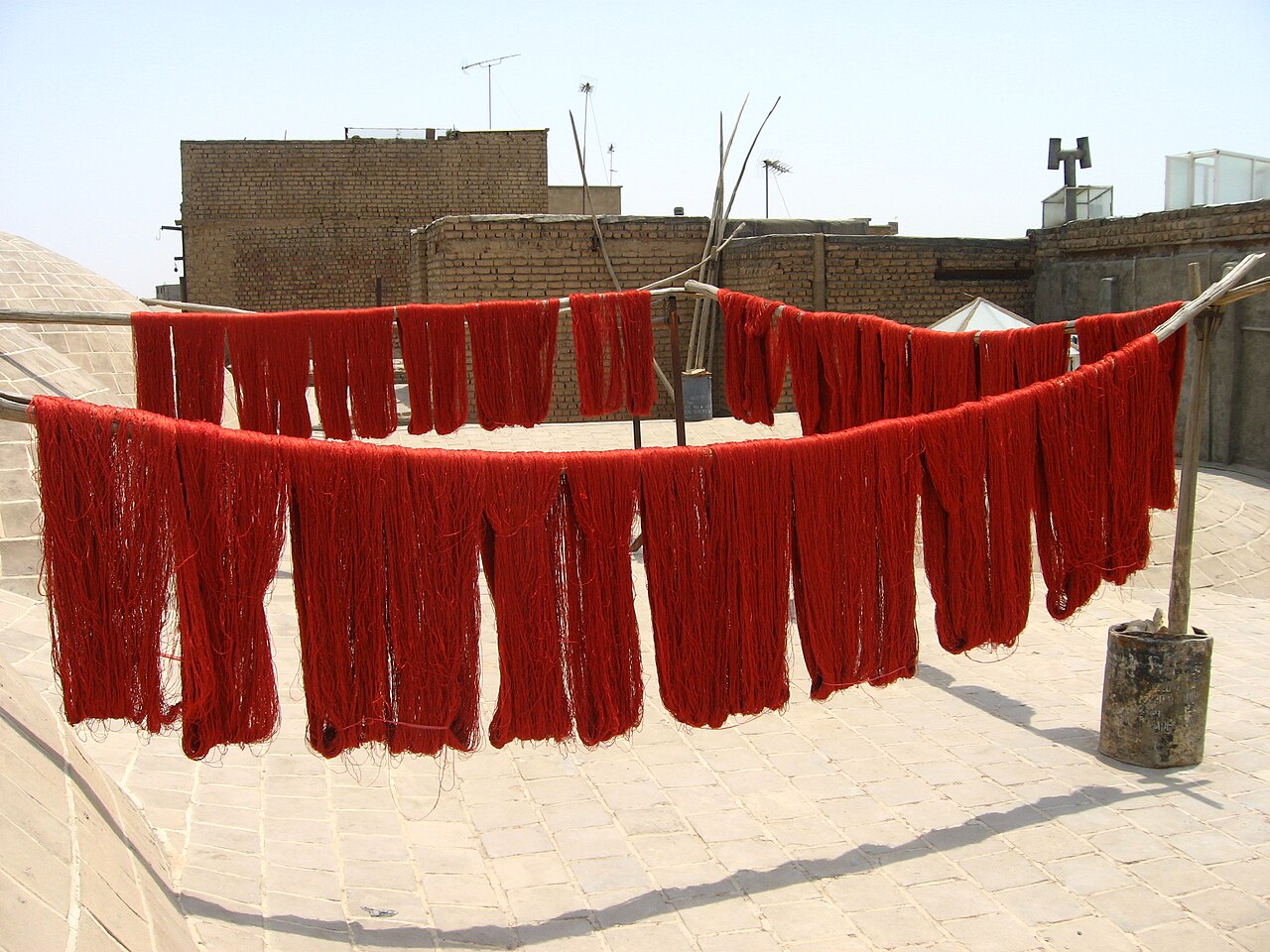
Dyed yarn drying on the roof of the surviving traditional dyers' row of a bazaar · Photographed 2016 · Hanks of dyed yarn on drying poles · Iran (registered national monument)
Seyyedeh Zeynab Safavi · CC BY-SA 4.0 · Wikimedia Commons record
Shows the dyers' working setting; the record does not say whether these hanks were coloured with natural or synthetic dyes. One example, not a defining specimen.
Process, step by step
- Prepare the fibre
- Prepare the appropriate vat or mordant system
- Dye, fix and rinse for that recipe
Variations
Abrash describes colour variation, not proof of natural dyeing, age or Iranian origin.
Conservation
Do not experiment with wet cleaning on unstable or historical textiles; seek object-specific conservation advice.
Different colour systems require different processes
Indigo is a vat dye; many plant-derived reds and yellows use mordant systems. Not every dye requires the same preparation, temperature or auxiliary material. “Natural” describes a source category, not a promise of non-toxicity, durability or age. Modern and traditional dye systems can coexist in the same workshop.
Abrash does not prove a botanical source
Colour variation can result from dye lots, fibre differences, fading, washing or later intervention. Synthetic dyeing can also create variation. A smooth colour field can be naturally dyed, and an uneven one can be synthetic. Keep visual observations separate from chemical identification.
Evidence for a dye claim
For a new commission, request the dyer’s recipe or documented account, with fibre and colour named. For a historical textile, specific dye identification generally depends on specialist analysis and may require authorised sampling. Do not perform bleach, burn or solvent tests at home; they damage objects without establishing the claimed history.
Handling and cleaning decisions
Dye origin alone does not predict whether a textile can be washed. Fibre, mordant, finish, damage and previous treatments all matter. Seek object-specific instructions from the maker for new work; unstable or valuable older pieces should be assessed by a textile conservator. Preventive care is safer than experimental cleaning.
References and further reading
- [1] H. E. Wulff, The Traditional Crafts of Persia, MIT Press, 1966.Historical process reference; not authentication of an individual object.
- [2] Canadian Conservation Institute, preventive conservation and CCI Notes. ↗Consult material-specific guidance; treatment requires assessment.
These sources provide context, not authentication or provenance for an individual object. Editorial interpretations remain under review.
Used in these crafts
A hand-knotted pile textile woven across Iran in city workshops, village looms and pastoral camps, distinguished by regional structure, palette and design vocabulary.
A thick, coarsely knotted pile rug woven mainly by pastoral and village weavers of the Zagros, with open fields, few motifs and a directly personal design language.
A flat, pileless woven textile made across Iran by interlocking or slit-weaving coloured weft threads over a warp, used as floor covering, storage bag, saddle cover and tent divider depending on region.