
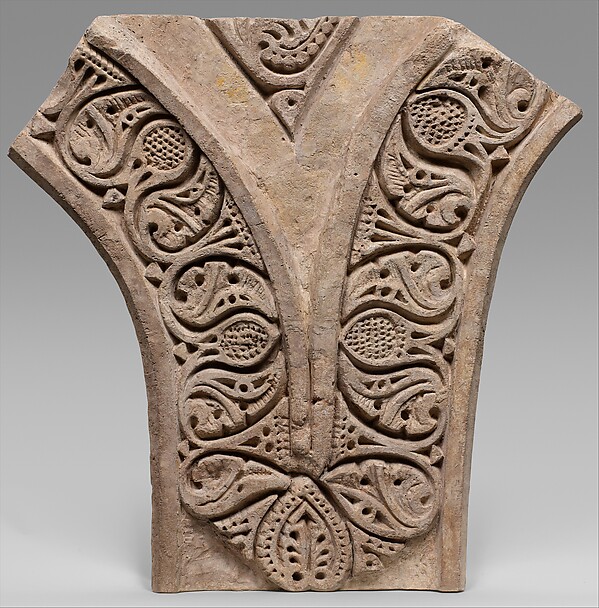
Carved Stucco Panel from Between Two Arches · 10th century · Stucco; carved · Iran
The Metropolitan Museum of Art, 40.170.440 · CC0 · Museum record
One catalogued Iranian example whose museum title or technique line names this process; not a defining specimen.
Process, step by step
- Apply plaster
- Transfer design
- Carve before full set
Variations
Mirror work and paint are sometimes added.
Conservation
Keep dry; repairs need matching plaster.
Gach-bori
Plaster carving shapes fresh or set gypsum into relief ornament, muqarnas and inscriptions. Notable examples include the Ilkhanid mihrab of Oljeitu at Isfahan's Friday Mosque.
Layers and moulds
Deep work is built in layers; repeated elements may be cast. Mixed methods are normal.
Care
Keep dry; salts and damp powder the surface.
Regional Traditions and Stylistic Evolution
Plaster carving, or gach-bori, holds a venerable lineage across the Iranian plateau, evolving through Sasanian palaces into monumental Islamic architectural settings. While early medieval stucco often featured deeply undercut floral vines and geometric bands, the Ilkhanid and Timurid periods witnessed an extraordinary elaboration of multi-layered relief, notably seen in regional centres such as Isfahan, Saveh, and Yazd. In later centuries, particularly under Safavid patronage, stucco work integrated intricate openwork known as tong-bori or chinikhaneh motifs, designed to receive porcelain vessels. The Qajar era further adapted plasterwork in residential mansions throughout Kashan, Shiraz, and Tehran, absorbing European stylistic elements such as acanthus sprays and figurative cherubs alongside traditional arabesques. Distinct provincial preferences emerged; central desert oases frequently privileged crisp calligraphic borders and delicate palmettes, whereas northern workshops adjusted recipes to withstand higher atmospheric humidity. These shifts demonstrate how local geology, workshop lineages, and shifting dynastic tastes shaped plaster decoration across centuries without adhering to a single monolithic technique.
Evaluating Integrity and Preventative Conservation
When examining architectural plasterwork or detached fragments, scholars and conservators evaluate depth of carving, tool marks, and substrate preparation. Authentic hand-carved relief generally exhibits subtle irregularities, slight undercut chisel facets, and varying angles where the craftsman worked the drying gypsum, unlike modern machine-moulded casts that often display uniform cross-sections and air-bubble voids. Surface patination, however, is not a definitive proof of age, as intentional distressing and tinted washes can imitate centuries of grime. Conservation mandates rigorous environmental control. Gypsum is exceptionally susceptible to moisture migration, which causes efflorescence as subterranean salts crystallise beneath the surface, eventually spalling the plaster face. Detached panels should be housed in climate-controlled spaces maintaining relative humidity between forty and fifty percent. Cleaning must never involve liquid solvents or abrasive scrubbing; rather, loose surface particulate should be lifted delicately using soft natural-bristle brushes alongside specialised conservation vacuums to protect fragile painted surfaces or friable edges.
Practical questions
- Is moulding cheating? No; it is traditional for repeats.
- Why does it crumble? Moisture.
| Observation | Useful description | Not established |
|---|---|---|
| Layered relief | Carved stucco | Ilkhanid |
| Identical units | Moulded parts | Modern |
| Powdery loss | Damp | Age |
References and further reading
- [1] H. E. Wulff, The Traditional Crafts of Persia, MIT Press, 1966; A. U. Pope & P. Ackerman, A Survey of Persian Art, 1938–39.Historical context; not evidence for an individual object.
- [2] Encyclopaedia Iranica ↗Peer-reviewed entries on crafts, motifs and terms.
These sources provide context, not authentication or provenance for an individual object. Editorial interpretations remain under review.
Used in these crafts
The carving and moulding of gypsum plaster into architectural ornament, including mihrabs, inscriptions, muqarnas and wall panels.