
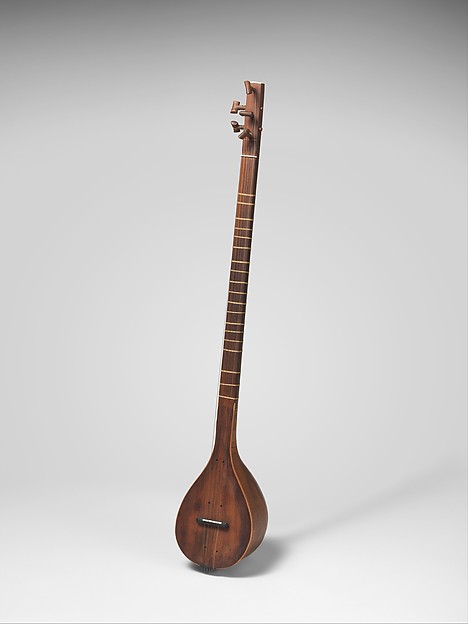
Setar · 19th century · Wood, bone, wire · Iran (Persia)
The Metropolitan Museum of Art, 89.4.327 · CC0 · Museum record
The setar's pear-shaped bowl is hollowed from wood; the museum record lists materials, not the carving method. One example, not a defining specimen.
Process, step by step
- Select and rough out suitable wood
- Hollow a carved bowl or prepare ribs for an assembled one
- Adjust wall thickness and assemble with other instrument parts
Variations
Carved and rib-built bodies are different construction methods; sound depends on the whole instrument, not thickness alone.
Conservation
Keep in a supported case away from heat and sudden humidity changes.
Instrument bowls
Luthiers carve instrument bowls, such as the double-bowled tar or the setar's pear shape, from a single block of mulberry, hollowing the inside to a precise thickness.
Stave vs solid
Some setars use joined staves (tarkeh) instead of a solid carved bowl; both are traditional.
Care
Keep humidity stable to avoid cracks.
Acoustic Anatomy and Luthier Lineages
The carving of instrument resonators occupies a delicate intersection between sculpture and acoustic science in Persian musical heritage. Luthiers historically favoured aged Persian mulberry wood (toot) for classical instruments such as the tar, setar, and kamancheh, valuing its specific resonant elasticity, ring density, and gradual drying stability. While regional workshops in Isfahan, Shiraz, Tabriz, and Tehran established distinct aesthetic silhouettes, the overall geometry was continuously refined through oral master-apprentice lineages. For the tar, the hollowed double-chambered body, consisting of the larger kaseh and smaller naqareh, is traditionally hewn from a single split trunk, requiring exceptional spatial intuition to achieve balanced wall thickness. In contrast, setar soundboxes developed two parallel branches: the solid carved bowl and the assembled multi-stave shell (tarkeh-i), the latter often associated with resourceful adaptations to timber availability. These woodworking lineages preserved subtle regional voicings, where slight variations in internal curvature altered tone colour, projection, and sustained resonance across generations of performers.
Evaluating Soundboxes and Preventative Storage
Assessing a carved instrument soundbox involves testing both construction integrity and material condition. An experienced observer examines the symmetry of the bowl, checking internal carving with light probes to detect thin spots, hidden wood-knot faults, or uneven scraping that could compromise resonance. When inspecting stave-built bowls, seams must be examined for minute separations or deteriorating animal glues. Distinctive maker stamps and wood-grain orientation provide contextual clues, though signatures can be posthumously added or forged and must not be taken as solitary proof of provenance. Preservation requires constant environmental vigilance, as thin resonant timber expands and contracts rapidly with atmospheric changes. Relative humidity should ideally remain between forty-five and fifty-five percent; sudden dryness risks catastrophic longitudinal cracking along the grain lines, whereas high moisture warps thin wooden soundboards and softens hide-glue joints. Instruments should always be stored untensioned during extended storage and kept inside lined hardshell cases away from direct sunlight or exterior walls.
Practical questions
- Stave or solid better? Both traditional.
- Wood? Usually mulberry.
| Observation | Useful description | Not established |
|---|---|---|
| Single-block bowl | Carved body | Maker |
| Visible staves | Stave construction | Quality |
| Crack | Humidity stress | Poor work |
References and further reading
- [1] H. E. Wulff, The Traditional Crafts of Persia, MIT Press, 1966; A. U. Pope & P. Ackerman, A Survey of Persian Art, 1938–39.Historical context; not evidence for an individual object.
- [2] Encyclopaedia Iranica ↗Peer-reviewed entries on crafts, motifs and terms.
These sources provide context, not authentication or provenance for an individual object. Editorial interpretations remain under review.
Used in these crafts
The workshop making of Iranian instruments such as the tar, setar, kamancheh, santur and oud, combining woodwork, skin membranes and inlaid decoration.