
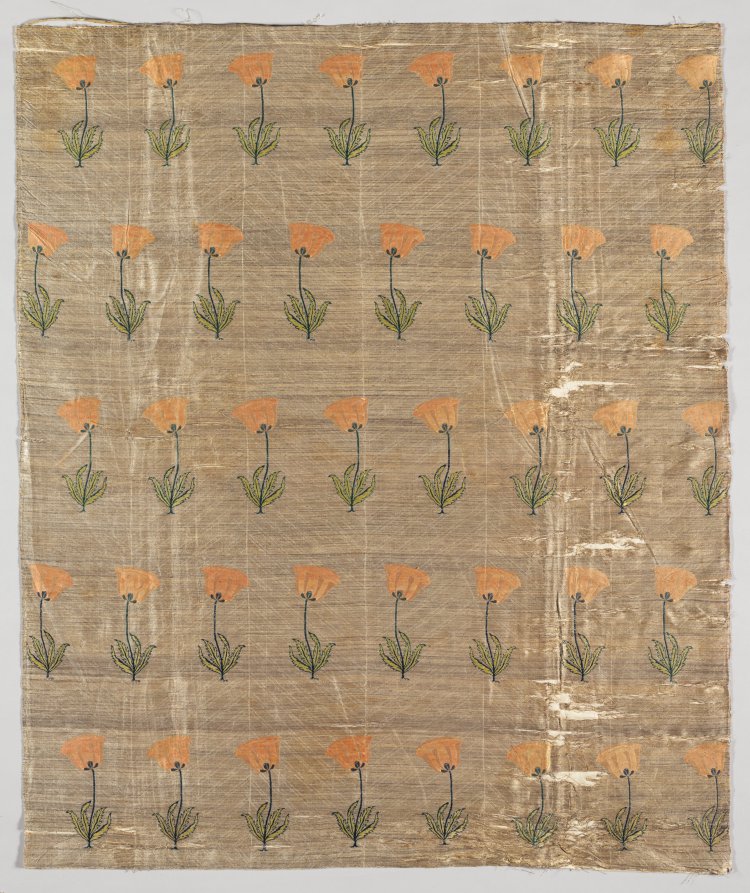
Textile with field of poppies on a golden ground · 1600–1750 · Silk and gilt-metal thread: twill weave with supplementary weft, stamped · Iran, Safavid period (1501–1722)
Cleveland Museum of Art, 1926.22 · CC0 · Museum record
One catalogued Iranian example whose museum title or technique line names this process; not a defining specimen.
Process, step by step
- Dress the loom with a fine warp.
- Weave the ground cloth.
- Introduce supplementary wefts on the patterned picks.
- Finish the cloth without cutting structural or pattern threads indiscriminately.
Variations
Drawloom and jacquard systems organise pattern selection differently; colour count alone does not identify historical hand production.
Conservation
Store rolled rather than folded; floats abrade quickly along a fold.
Ground weave and added pattern threads
Supplementary wefts create pattern in addition to a ground weave. These threads may float on the face or reverse depending on the structure. Brocading is not synonymous with embroidery: in embroidery stitches are added to an already formed support. Metallic or silk pattern threads describe material, while supplementary weft describes construction.
Termeh is not a universal structural label
Termeh is a textile tradition and commercial category, not proof of one weave. Historical shawls and modern decorative cloth can differ in fibre, patterning system and production equipment. Some patterned textiles use compound weaves rather than a simple supplementary-weft structure. Record a weave analysis when available rather than assigning every termeh to the same loom technique.
Handloom, drawloom and jacquard evidence
A drawloom and a jacquard system organise pattern selection differently. Either system can be used in a workshop, and “jacquard” does not by itself describe whether power drives the loom. The number of colours or density of pattern is not a safe test of historical hand production. Seek actual-object reverse views and documented workshop process.
Floats, metallic threads and supports
Long floats can snag and abrade, while metal-wrapped threads may have a fragile organic core. Avoid cutting loose ends or polishing metal threads on the cloth. Fold lines, weak areas and old repairs determine whether flat or rolled storage is appropriate. Support the textile during display so its own weight does not concentrate on a few stitches or a damaged edge.
Practical questions
- Is every termeh supplementary-weft brocade? No; the actual weave must be identified.
- Does jacquard mean machine-made? The pattern-selection system alone does not identify the power source.
| Feature | What it can tell you | What it cannot establish |
|---|---|---|
| Added weft floats | Patterning construction | Termeh classification alone |
| Metal-wrapped thread | Composite thread material | Pure gold or silver |
| Complex repeat | Pattern organisation | Hand-powered manufacture |
References and further reading
- [1] H. E. Wulff, The Traditional Crafts of Persia, MIT Press, 1966.Historical craft-process context, not authentication of a specific object.
- [2] Canadian Conservation Institute — Caring for cultural objects ↗Preventive care; treatment must be assessed for the actual materials.
These sources provide context, not authentication or provenance for an individual object. Editorial interpretations remain under review.
Used in these crafts
A patterned Iranian brocade woven with supplementary wefts, historically in silk and wool, associated above all with Yazd and Kerman.
A narrow-strip flatwoven textile, usually made in warp-faced bands on a portable loom and then sewn together into a wider cloth, traditionally used as bedding cover, floor spread or door hanging by village and pastoral households.
A figured silk weaving technique in which supplementary wefts, often including gold- or silver-wrapped thread, create pictorial or floral designs on a silk ground.