
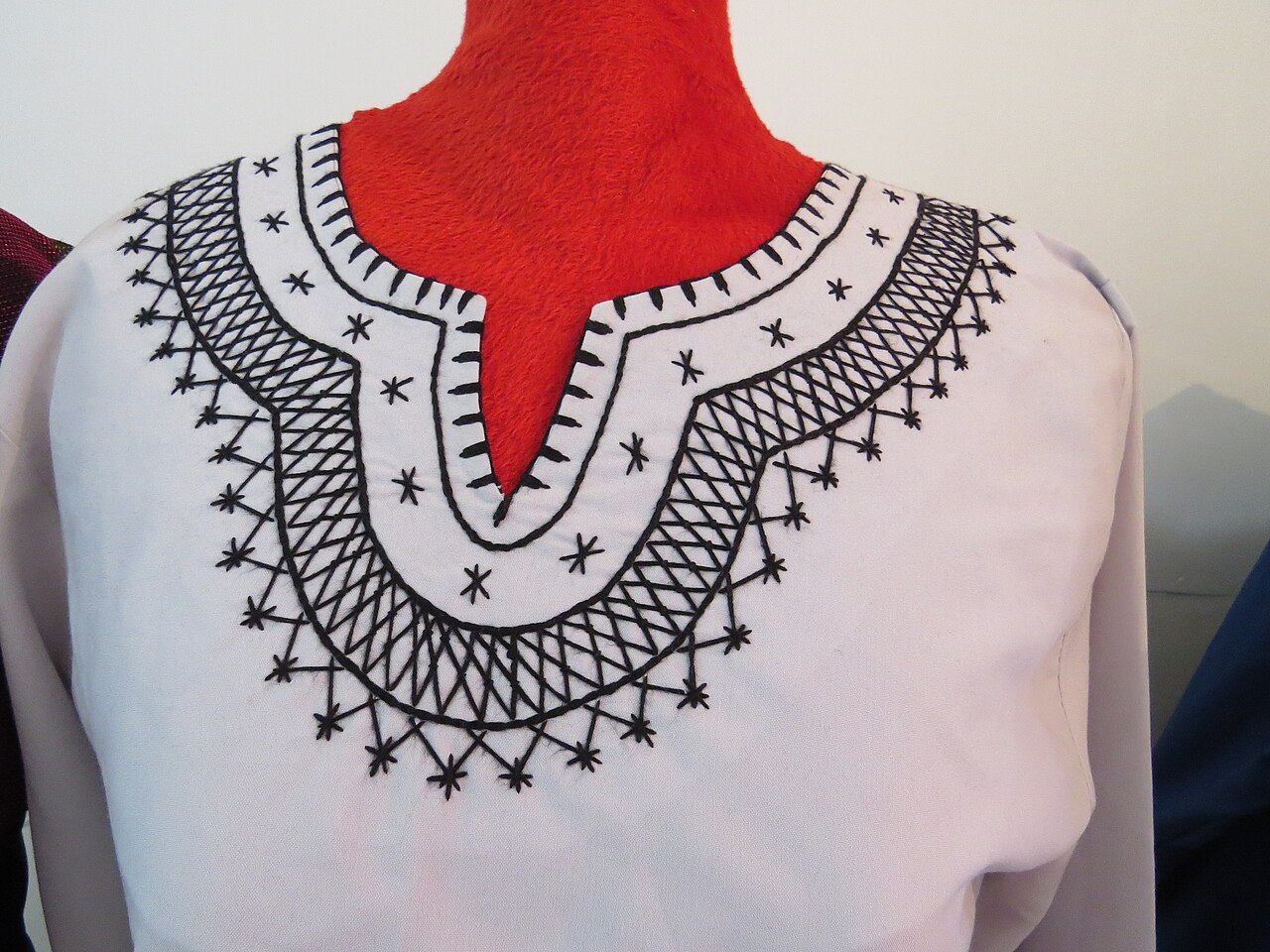
Siyah-doozi (blackwork) embroidery from Sistan · date not stated · Surface embroidery on cloth · Iran
Rahmat Golestani · CC BY-SA 4.0 · Wikimedia Commons record
One catalogued Iranian example whose museum title or technique line names this process; not a defining specimen.
Process, step by step
- Mark the cloth
- Build dense stitched outlines and fills
- Finish the reverse
Variations
Stitch vocabulary and colour schemes vary by community.
Conservation
Do not stretch or brush embroidered surfaces.
Needle on cloth
Surface embroidery adds decoration with a needle to a finished ground fabric. Iranian traditions include pateh of Kerman (wool on wool twill), Baluchi needlework, suzan-duzi and silk embroidery of Isfahan and Yazd.
Stitches
Pateh relies on dense darning-type stitches that cover the ground; Baluchi work uses tiny counted stitches and mirrors. Stitch type and ground cloth, not motif, distinguish traditions.
Machine embroidery
Machine embroidery shows identical stitch lengths and continuous thread on the back. Hand work shows knots, changes and slight irregularities.
Domestic Needlework and Regional Identifiers
Surface embroidery in Iran evolved primarily within domestic and rural spaces, serving as an emblem of dowry preparation, local identity, and familial prestige. In Kerman, the pateh tradition flourished as women applied plant-dyed wool threads to a handwoven twill ground (ariz), densely filling tear-drop boteh designs and floral roundels with couching and stem stitches. In Sistan and Baluchestan, needlework developed into an intricate mathematical art, where fine geometric motifs and tiny embedded mirrors reflect cultural links to adjacent South Asian communities. Historic centres like Isfahan, Rasht, and Yazd produced their own distinctive surface stitching, from delicate silk chain-stitch to woollen patchwork inlay. While historical documents generally attribute commercial embroidery workshops to late Qajar urban centres, domestic makers sustained these traditions across generations through oral instruction. The choice of ground fabric, whether hand-spun local wool or imported trade cotton, serves as a vital historical indicator of regional trade networks and household economics.
Technical Scrutiny and Textile Preservation
When evaluating historic surface embroidery, begin by examining the relationship between the ground cloth and the decorative needlework. Genuine hand-stitched pieces, such as antique Kerman pateh or Baluch panels, exhibit slight variations in stitch tension, thread twist, and reverse finishing. On modern mechanical reproductions, stitches appear rigidly identical on the surface, while the reverse reveals a uniform bobbin thread lacking the knots and thread shifts typical of artisan work. Inspect dyed fibres under magnification: natural dyes often present subtle tonal modulation (abrash), whereas synthetic dyes may exhibit stark uniformity or bleeding onto the ground cloth. Embroideries must never be washed in domestic water baths, as unfixed dyes can bleed and wool grounds risk irreversible felting. To preserve fragile surface stitches, store pieces completely flat between sheets of acid-free, unbuffered tissue paper, away from insect activity, direct ultraviolet exposure, and humid basements where mould can rot wool grounds.
Practical questions
- How to spot machine work? Uniform stitches and back.
- Is pateh woven? No; embroidered.
| Observation | Useful description | Not established |
|---|---|---|
| Dense wool stitching | Pateh-type work | Kerman maker |
| Uniform stitches | Possible machine | — |
| Tiny mirrors | Mirror work | Baluchi origin |
References and further reading
- [1] H. E. Wulff, The Traditional Crafts of Persia, MIT Press, 1966; A. U. Pope & P. Ackerman, A Survey of Persian Art, 1938–39.Historical context; not evidence for an individual object.
- [2] Encyclopaedia Iranica ↗Peer-reviewed entries on crafts, motifs and terms.
These sources provide context, not authentication or provenance for an individual object. Editorial interpretations remain under review.
Documented material and craft examples
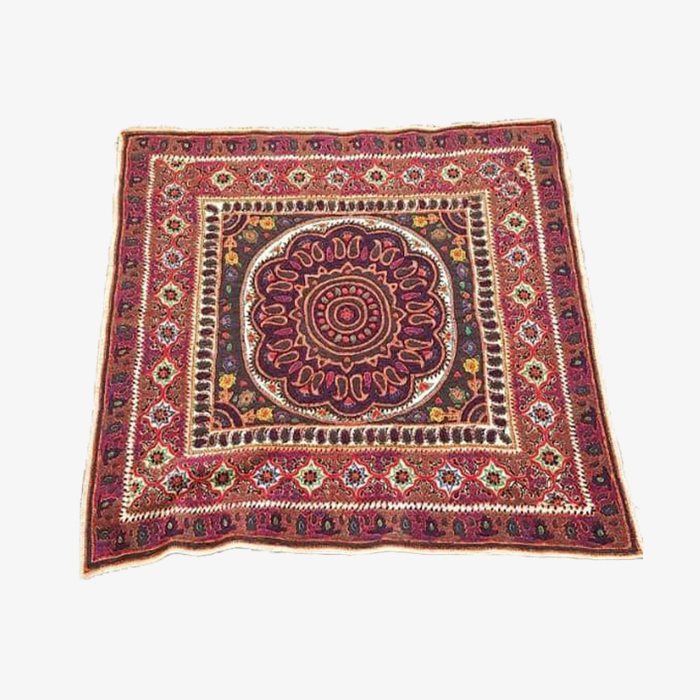
Representative photographs only. Marketplace examples rely on seller descriptions; CraftPersia has not independently authenticated their maker, origin, or rights status. Follow each source link for the listing context.
Used in these crafts
A hand-embroidered wool textile from Kerman in which coloured silk or wool threads are worked in dense chain and satin stitching over a woollen ground, typically in a limited palette against a natural or dyed field.
A broad term for Iranian needle embroidery on cotton, silk or wool grounds, including counted, darned and satin-stitch work used on covers, garments and prayer cloths.