
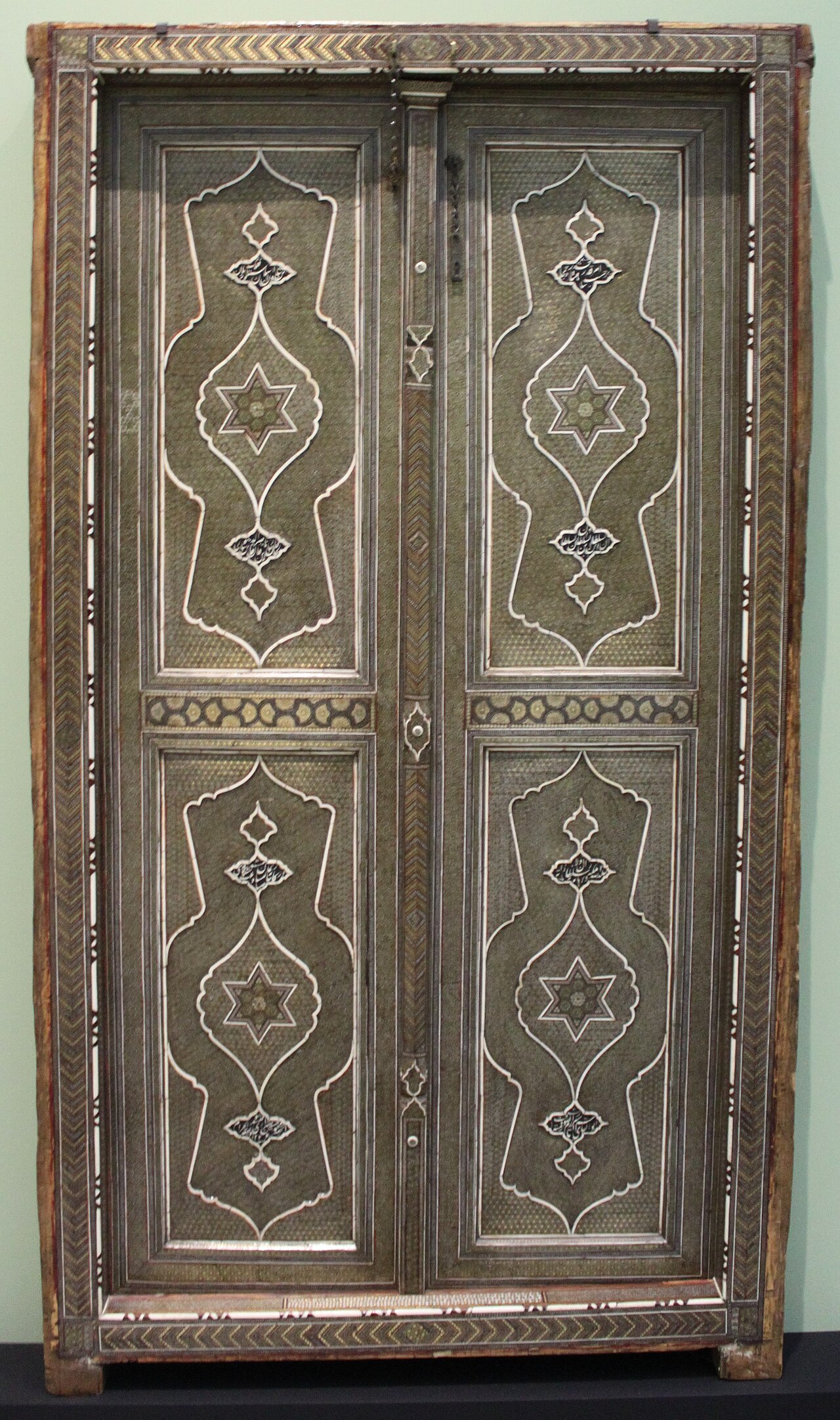
Inlaid wooden door made for Nasir al-Din Shah · 1859-1860 · Wood with inlay; National Museum of Iran · Iran
Faqscl · CC BY-SA 4.0 · Wikimedia Commons record
One catalogued Iranian example whose museum title or technique line names this process; not a defining specimen.
Process, step by step
- Cut and file rods to a precise triangular section.
- Bundle rods into a six-pointed star unit and bind tightly.
- Glue bundles into larger blocks and cure under pressure.
- Slice the block into sheets under one millimetre thick.
- Lay sheets onto the prepared carcase and press until dry.
- Scrape level, then polish and finish.
Variations
Unit density varies by workshop; finer work packs visibly more elements into the same area.
Conservation
Keep humidity steady. Lifted sheets should be re-adhered by a conservator, not re-glued in place.
Bundle geometry and sliced veneers
Khatam assembles small rods of contrasting materials into patterned bundles, then slices those bundles into decorative veneers. The resulting surface is different from marquetry cut from individual shapes and from a printed star design. Follow the boundaries of rods and slices rather than counting stars alone. The veneer and its supporting box or frame are separate constructions.
Quality is more than miniature scale
Look at alignment at corners, continuity across panels, gaps, adhesion and the finish over the inlay. Dense units can require skilled preparation, but fine scale alone cannot establish a workshop, age or handmade origin. A modern box can use handmade khatam panels on a machine-cut support. Request a production description for both decoration and carcase.
Material and repair disclosure
Pale rods may be bone or another material; appearance alone cannot distinguish ivory, bone and substitutes. Ask for documented material identification and legal checks where restricted materials are possible. Dark seams, replacement patches and refinished areas should be recorded. New varnish does not imply that all construction beneath it is new.
Humidity and lifted veneer
Wood, bone, metal and adhesive respond differently to environmental changes. Keep conditions stable and support panels during handling. Do not press down loose veneer, inject household glue or oil the surface: an intervention may stain materials or obscure future repair. Detached fragments should be retained with the object for a specialist assessment.
Practical questions
- Is khatam the same as wood marquetry? No; the patterned-bundle method is distinctive.
- Can I oil an antique khatam box? Avoid adding oils without conservation advice.
| Feature | What it can tell you | What it cannot establish |
|---|---|---|
| Sliced rod pattern | Khatam construction evidence | Maker or date |
| Dense star units | Pattern scale | Independent authenticity |
| Lifted panel | Adhesion problem | Safe DIY repair |
References and further reading
- [1] H. E. Wulff, The Traditional Crafts of Persia, MIT Press, 1966.Historical craft-process context, not authentication of a specific object.
- [2] Canadian Conservation Institute — Caring for cultural objects ↗Preventive care; treatment must be assessed for the actual materials.
These sources provide context, not authentication or provenance for an individual object. Editorial interpretations remain under review.
Documented material and craft examples
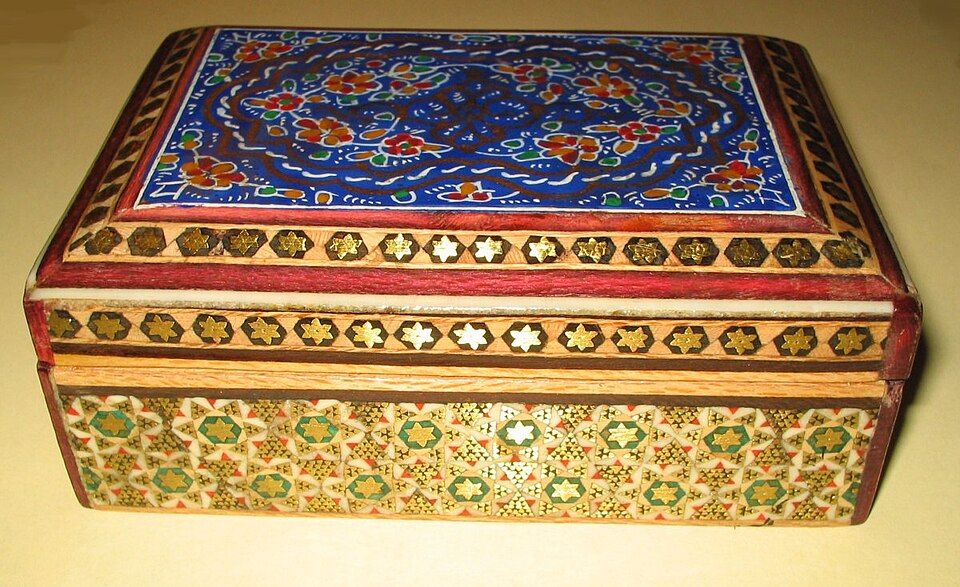
Representative photographs only. Marketplace examples rely on seller descriptions; CraftPersia has not independently authenticated their maker, origin, or rights status. Follow each source link for the listing context.
Used in these crafts
A Persian inlay art in which fine rods of wood, bone and metal are bundled into star units, sliced into thin sheets and applied to a wooden surface to form dense geometric tessellation.