
Process, step by step
- Set coloured warp bands
- Weave narrow strips
- Join strips along the long edges
Variations
Supplementary wefts may create small accent figures.
Conservation
Support joining seams and avoid tension.
Warps carry the pattern
In warp-faced weaving the warps are packed so densely that they hide the weft, and colour stripes run lengthwise. Jajim is the best-known Iranian example, woven in narrow strips on ground looms and sewn together.
Pattern methods
Small motifs come from warp substitution or complementary warps lifted by hand. Strip width and seams are clues to loom type.
Use and care
Jajim served as bedding wraps and covers. Seams are weak points; support the whole textile when hanging.
Nomadic Foundations and Strip Looms
Warp-faced weaving represents one of the oldest structural textile traditions on the Iranian plateau, inextricably bound to the pastoralist economy. Practised widely by Shahsavan, Qashqai, Bakhtiari, Kurdish, and Baluch weavers, it relies on horizontal ground looms that could be dismantled quickly during migration. Because ground looms naturally impose narrow working widths, weavers produced long, narrow bands of fabric, termed jajim, which were subsequently severed and hand-sewn selvedge to selvedge to create broader domestic textiles. Historically, these textiles served essential practical roles as horse covers, luggage wraps, wall hangings, and floor bedding inside nomadic tents. Patterns were traditionally governed by the structural mechanics of the loom, generating vertical bands, checks, and supplementary-warp motifs. While nineteenth-century observers often viewed warp-faced textiles as simple utilitarian articles, modern scholarship recognises them as sophisticated expressions of nomadic engineering, in which high warp tension and dense wool spinning guaranteed durability against harsh weather and migratory wear.
Condition Assessment and Structural Care
When inspecting a warp-faced textile such as an antique jajim, focus first on the joining seams and selvedges. Because individual strips were stitched together manually with wool or cotton yarn, these joins frequently stretch, tear, or pull apart under tension. Gently examine the reverse to verify warp substitution or floating pattern threads; synthetic repair yarns or machine stitching along seams are critical indicators of later intervention. Uneven fading across alternating strips often reveals that strips came from different loom runs or experienced differing light exposure before assembly. Avoid hanging a multi-panel jajim by its top edge alone, as the structural weight will place immense shear stress on the lengthwise seams, causing irreversible distortion. Instead, stitch the entire upper reverse to a wide, unbleached cotton Velcro strip for uniform support. Store rolled along the direction of the warps in breathable, unbleached muslin, away from moths and fluctuations in humidity.
Practical questions
- Is jajim a kilim? No; it is warp-faced.
- Why sewn strips? Narrow looms.
| Observation | Useful description | Not established |
|---|---|---|
| Lengthwise stripes | Warp-faced weave | Tribe |
| Sewn strips | Narrow loom | Date |
| Small warp motifs | Warp substitution | Village |
References and further reading
- [1] H. E. Wulff, The Traditional Crafts of Persia, MIT Press, 1966; A. U. Pope & P. Ackerman, A Survey of Persian Art, 1938–39.Historical context; not evidence for an individual object.
- [2] Encyclopaedia Iranica ↗Peer-reviewed entries on crafts, motifs and terms.
These sources provide context, not authentication or provenance for an individual object. Editorial interpretations remain under review.
Documented material and craft examples
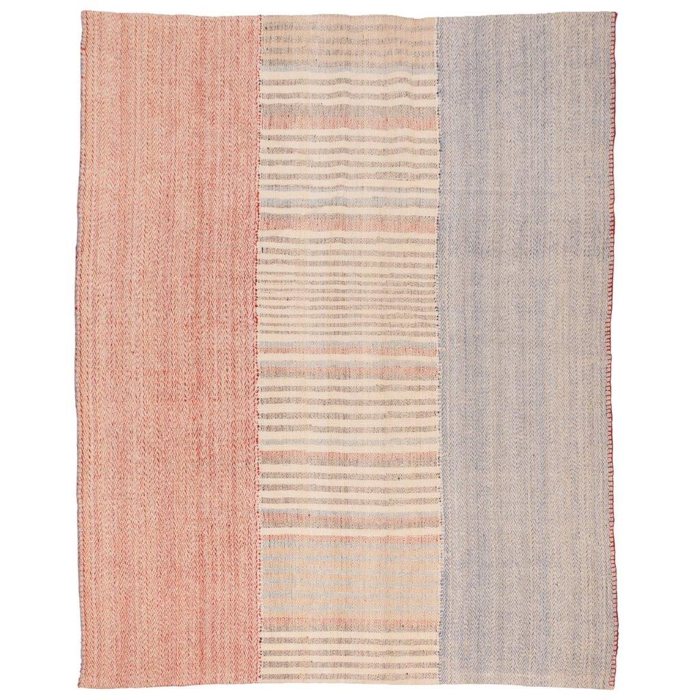
Representative photographs only. Marketplace examples rely on seller descriptions; CraftPersia has not independently authenticated their maker, origin, or rights status. Follow each source link for the listing context.
Used in these crafts
A narrow-strip flatwoven textile, usually made in warp-faced bands on a portable loom and then sewn together into a wider cloth, traditionally used as bedding cover, floor spread or door hanging by village and pastoral households.