
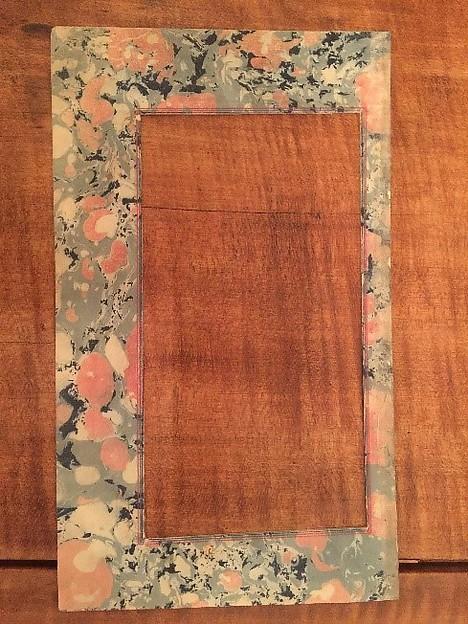
Folio with Marbled Decoration · 19th century · Ink and pigments on marbled paper · Iran
The Metropolitan Museum of Art, 2019.297.9 · CC0 · Museum record
One catalogued Iranian example whose museum title or technique line names this process; not a defining specimen.
Process, step by step
- Prepare colour bath
- Float and move colours
- Lift pattern onto a sheet
Variations
Bath chemistry and tools vary by workshop.
Conservation
Keep sheets flat, dark and dry.
Abri: floating colour on size
In abri (ebru) marbling, colours prepared with ox-gall or similar dispersants are sprinkled onto a thickened size bath, traditionally made with plant gums such as gum tragacanth (katira). The marbler draws combs and styluses through the floating colour, then lays a sheet of paper on the surface to lift the pattern. Each sheet is unique; repeat patterns are similar but never identical.
Uses in book arts
Marbled paper was used for margins, endpapers, album borders and calligraphy panels, sometimes with text written in reserved areas. Its history spans the Persian, Ottoman and Indian worlds, and attribution of an individual sheet to Iran requires more than style. Contemporary Iranian marblers continue the practice, often combining abri with calligraphy and illumination.
Printed imitations
Printed 'marble' papers repeat exactly across a sheet or between sheets and show halftone dots under magnification. Genuine marbling shows colour sitting on the paper surface with soft, fluid boundaries and slight variations in density. Buying from an identified Iranian maker is more reliable than judging from a photograph.
Care
Marbled sheets are sensitive to light and to acidic mounts. Frame with acid-free mat board and UV-filtering glazing, avoid damp, and handle by the edges.
Practical questions
- Are two marbled sheets ever identical? No; each pull is unique.
- Is marbling uniquely Iranian? No; it has Persian, Ottoman and Indian histories.
| Observation | Useful description | Not established |
|---|---|---|
| Fluid soft boundaries | Hand marbling | Iranian maker |
| Exact repeats, dots | Printed paper | — |
| Text in reserved area | Calligraphy panel use | Period or scribe |
References and further reading
- [1] H. E. Wulff, The Traditional Crafts of Persia, MIT Press, 1966.Historical process context; not evidence for an individual object.
- [2] Canadian Conservation Institute — Caring for cultural objects ↗General preventive care; treatment requires assessment of the actual object.
These sources provide context, not authentication or provenance for an individual object. Editorial interpretations remain under review.
Documented material and craft examples
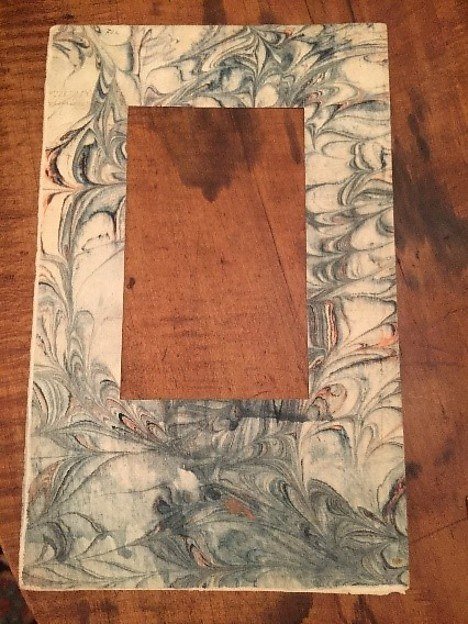
Representative photographs only. Marketplace examples rely on seller descriptions; CraftPersia has not independently authenticated their maker, origin, or rights status. Follow each source link for the listing context.
Used in these crafts
A decorative paper technique in which pigments are floated and manipulated on a thickened liquid bath and then transferred to a sheet of paper by careful contact, producing swirling, veined patterns historically used for manuscript covers, borders and endpapers.