
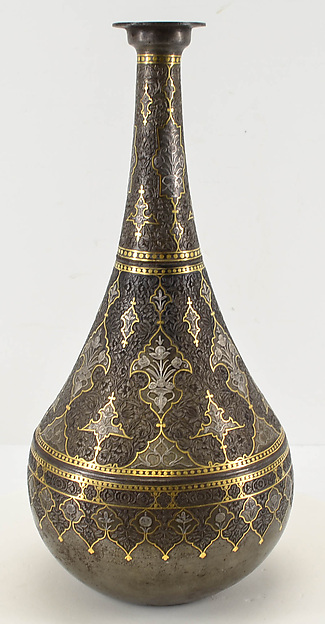
Vase · 19th century · Steel; chased and damascened in gold and silver · Iran
The Metropolitan Museum of Art, 2018.377 · CC0 · Museum record
One catalogued Iranian example whose museum title or technique line names this process; not a defining specimen.
Process, step by step
- Cross-hatch the ground
- Lay precious wire
- Hammer and burnish
Variations
True inlay sits in cut channels; overlay sits on a hatched surface.
Conservation
Keep dry to prevent rust on steel grounds.
Gold on steel
Damascening (zar-neshani, koftgari) hammers gold or silver wire into hatched or grooved steel or iron. It decorated Safavid and Qajar arms, armour and steel objects.
True inlay vs overlay
Deep inlay sets wire into channels; overlay (koftgari) hammers it onto a crosshatched surface and can wear off.
Care
Keep steel dry; abrasives remove gold.
Armory patronage and technical lineages
Steel damascening flourished under imperial Safavid and Qajar patronage, where ceremonial arms, helmets, shields, and diplomatic accoutrements functioned as masterworks of both metallurgy and political display. Royal arsenals in Isfahan, Shiraz, and Khorasan patronized specialized craftsmen known as 'zarneshan-saz', who mastered the complex behavior of crucible steel ('pulad-e johardar'). Craftsmen distinguished between true channeled inlay ('tah-neshan'), wherein precious wire was hammered into undercut grooves carved directly into the hardened steel, and surface hatching ('koftgari'), where crosshatched file marks caught and secured thin gold or silver foil. In addition to defensive arms, this decorative technique came to embellish ceremonial peacocks, begging bowls ('kashkul'), mirrors, and calligraphic plaques inscribed with Quranic verses or Persian poetic hemistichs. The contrast between dark, watered steel grounds and shimmering gold wire embodied a visual aesthetic celebrating strength masked in courtly elegance.
Evaluating wire adhesion and corrosion management
When assessing damascened steel, examine wire junctions under oblique lighting to determine whether the technique relies on true undercut channeling or superficial hatch-hammering. On worn pieces, surface hatch-lines often show losses where gold foil has flaked away from the ground, leaving naked crosshatching exposed. Beware of modern replicas that utilize acid-etched designs filled with gold leaf paint or electroplated gilding, which lack the crisp mechanical bite and physical depth of hammered metal wire. Steel with precious metal inlays presents complex conservation challenges due to galvanic corrosion: contact with moisture triggers chemical reactions between the iron base and noble gold wire, accelerating rust along the inlay boundaries. Never use water, liquid detergents, or rust-dissolving acids, as they weaken wire anchoring and strip watered steel patinas. Maintain objects in desiccated, climate-controlled environments and wipe lightly with mineral spirits or high-grade microcrystalline wax applied with a lint-free swab.
Practical questions
- Is the gold solid? Usually thin wire.
- Polish rust? Not over gold.
| Observation | Useful description | Not established |
|---|---|---|
| Gold lines on steel | Damascening | Safavid |
| Crosshatched ground | Overlay method | Date |
| Lost gold | Wear | Restoration |
References and further reading
- [1] H. E. Wulff, The Traditional Crafts of Persia, MIT Press, 1966; A. U. Pope & P. Ackerman, A Survey of Persian Art, 1938–39.Historical context; not evidence for an individual object.
- [2] Encyclopaedia Iranica ↗Peer-reviewed entries on crafts, motifs and terms.
These sources provide context, not authentication or provenance for an individual object. Editorial interpretations remain under review.
Used in these crafts
Decoration of brass, bronze or steel vessels by setting silver, copper or gold into cut recesses, producing figurative scenes, inscriptions and ornament in contrasting colour.
The chiselling and piercing of steel into plaques, standards (alam), locks and fittings, often with inscriptions or arabesque openwork.