
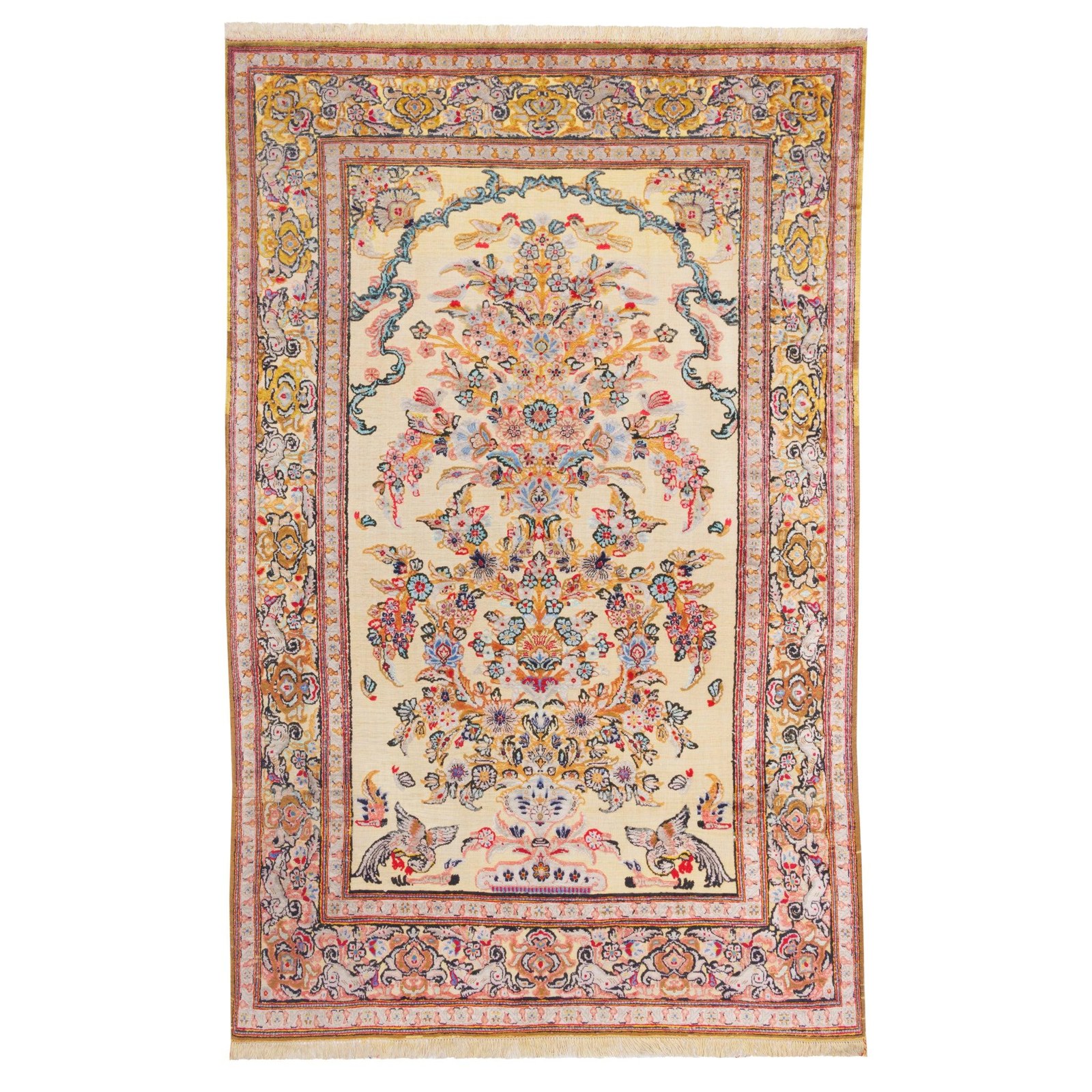
Representative image from an independent shop or archive, not a photograph of the listed object. The seller, price, date, materials, provenance and documentation described on this page have not been verified against the pictured item. Colour varies between screens.
Kashan Silk Carpet
A finely knotted silk carpet with a dense medallion field. The dating rests on structure and palette rather than documentation, and is presented here as an estimate.
- Craft
- Persian carpet
- Region
- Kashan
- Technique
- Knotted pile weaving
- Materials
- Silk pile, cotton foundation
- Dimensions
- 130 × 200 cm
- Weight
- 6 kg
- Date
- Early 20th century, attribution uncertain
Condition
Good; restored selvedge on one long side, minor reweave in a corner
Provenance
Private European collection since the 1970s; earlier history unknown.
Documentation
Condition report by an independent textile conservator. Date given as an estimate; no dye analysis has been carried out.
This is illustrative sample documentation, not evidence for the pictured object. No seller or object claim has been independently verified. The archive does not certify authenticity.
Care
Follow the preservation guidance in the Persian carpet entry: light, humidity and physical support matter more than cleaning.
About Persian carpet
Definition
A Persian carpet is built by tying pile yarn around warp threads on a loom, row by row, with wefts inserted between rows to lock the structure. What varies — and what defines the regional traditions — is knot type, density, foundation material, palette and how the design was arrived at.
Three production contexts are usually distinguished: city workshops weaving from a drawn cartoon, village looms working from memory and local convention, and pastoral weaving where the design is held entirely by the weaver.
History
Pile weaving in the region is very old; the Pazyryk carpet, preserved in permanent ice and dated to roughly the fifth to fourth century BCE, shows that the technique was already highly developed, though its place of manufacture is debated.
Organised workshop production is best documented from the Safavid period, when royal ateliers in Isfahan, Kashan and Tabriz produced large designed carpets on commission. Nineteenth-century export demand reshaped the industry again, introducing commercial workshops, standard sizes and, in some places, synthetic dyes.
Structure and quality
Knot density, usually given in knots per square decimetre, records fineness but not quality on its own. Wool character, dye preparation, evenness of weave and the coherence of the drawing matter as much.
- Asymmetric knot: allows fine curvilinear drawing; usual in city work
- Symmetric knot: robust, usual in village and pastoral weaving
- Cotton foundation: dimensionally stable, usual in workshop carpets
- Wool foundation: more flexible, usual in tribal weaving
- Abrash: visible dye-lot variation, expected in hand-dyed wool
General background on the craft, not a statement about any individual object; dates and attributions summarise common positions in the literature and remain under review. Read the full Persian carpet entry.
Checklist before buying Persian carpet
Inspect
- Turn the piece over: hand-knotted or hand-stitched work shows slight irregularities on the back.
- Look at fringes and edges — on knotted carpets the fringe is usually the warp itself, not a sewn-on strip.
- Check colour consistency; natural dyes often show gentle banding (abrash), which is not a defect.
- Ask whether the colours have been tested for bleeding; never wet-test an old or valuable piece yourself.
Red flags
- Perfectly uniform backs, glued backing cloth or a latex layer (typical of machine or tufted rugs).
- Listings that say 'Persian style', 'Persian design' or 'inspired by' without naming a place of making.
- Printed patterns sold as hand-embroidered or hand-block-printed.
Ask the seller
- Where and by whom was this made, and roughly when?
- What are the fibre and dye (wool, silk, cotton; natural or synthetic)?
- Can you show a close-up photo of the back and the edges?