
Process, step by step
- Sew the text block
- Cover the boards
- Tool and gild
Variations
Stamped, cut-work and lacquer bindings are other options.
Conservation
Store upright but supported; keep leather dry.
Islamic bookbinding
Persian bindings typically have a flap (lisān) that wraps the fore-edge, and covers of tooled, stamped or lacquered leather. Text blocks are sewn and the cover attached.
Re-bindings
Manuscripts were often rebound; a cover may be later than the text. Describe text and binding separately.
Care
Support open books on cradles; never force the spine flat.
Scribal Workshops and Binding Typologies
The Islamic bookbinding tradition in Iran represents a sophisticated synthesis of structural engineering and decorative arts, intimately bound to royal scriptoria from Herat and Tabriz to Isfahan and Qazvin. Classical Persian bindings distinctively featured an integrated envelope flap (lisān) attached to the lower board, folded over the text block edge to protect leaves from dust and handling wear. During the Timurid and early Safavid eras, leather bindings attained unparalleled refinement through blind tooling, gold stamping with metal matrices, and exquisite paper filigree (monabbat-kari) applied to interior doublures. By the seventeenth and eighteenth centuries, polychrome lacquer bindings (jeld-e lakhi) gained immense popularity, showcasing intricate floral motifs, hunt scenes, or courtly tableaux painted on papier-mâché substrates beneath protective coats of sandarac or linseed varnish. These stylistic shifts reflected broader artistic movements in illumination and miniature painting, linking binder workshops directly to court patronage and commercial book bazaars throughout the Islamic world.
Codicological Analysis and Conservative Handling
Examining an antique binding requires distinguishing original assembly from later restorations or marriages of disparate manuscripts. Assessors should scrutinise the inner joints, headbands (shirazeh), and paste-downs: sewing thread inconsistencies, trimmed marginal annotations, or modern paper endleaves often suggest rebinding. Gold tooling and blind stamps should be inspected for crispness and matrix wear, yet fine craftsmanship alone cannot confirm a specific workshop without supportive codicological evidence. Lacquer bindings must be checked under raking light for surface crazing, lifting varnish layers, or insect losses within the papier-mâché core. Regarding handling, historical bindings should never be forced open past a comfortable angle; cradles lined with book-foam must be used during study to support fragile spine structures without strain. Environmental management is paramount: bindings require stable temperatures around eighteen to twenty degrees Celsius and relative humidity between forty-five and fifty percent. Direct handling requires clean, dry hands without lotion to prevent grease transference onto delicate leather or painted surfaces.
Practical questions
- Is the cover original? Not necessarily.
- What is the flap? The lisan protecting the fore-edge.
| Observation | Useful description | Not established |
|---|---|---|
| Fore-edge flap | Islamic binding | Date |
| Stamped medallion | Tooled leather | Original cover |
| Mismatched sizes | Possible rebinding | — |
References and further reading
- [1] H. E. Wulff, The Traditional Crafts of Persia, MIT Press, 1966; A. U. Pope & P. Ackerman, A Survey of Persian Art, 1938–39.Historical context; not evidence for an individual object.
- [2] Encyclopaedia Iranica ↗Peer-reviewed entries on crafts, motifs and terms.
These sources provide context, not authentication or provenance for an individual object. Editorial interpretations remain under review.
Documented material and craft examples
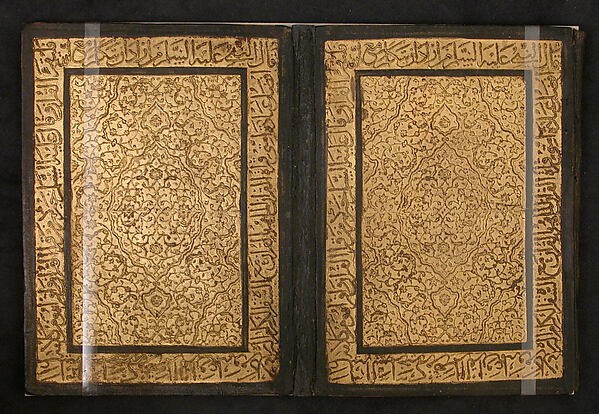
Representative photographs only. Marketplace examples rely on seller descriptions; CraftPersia has not independently authenticated their maker, origin, or rights status. Follow each source link for the listing context.
Used in these crafts
The hand binding of manuscripts and books with leather or lacquer covers, often with a flap (lisan) and stamped, cut or gilded decoration.
The cutting, stitching, tooling and painting of leather for bags, belts, bookcovers, saddlery and small goods.