
Process, step by step
- Lay out a geometric grid
- Cut matching wooden pieces
- Fit into a stable frame
Variations
Some window screens incorporate coloured glass.
Conservation
Avoid pressure on joints and glazing.
Gereh-chini
Gereh-chini assembles small wooden pieces without glue or nails into geometric lattices for doors, windows and orosi sashes, often with coloured glass.
Geometry
Patterns derive from girih star-and-polygon systems shared with tile and stucco; masters work from compass-drawn layouts.
Care
Joints loosen with humidity changes; avoid forcing sashes and keep wood dry.
Regional Lineages and Climate Function
Lattice-joinery in the Iranian architectural sphere is widely considered an outgrowth of earlier Islamic architectural timber framing, reaching sophisticated expression from the Timurid into the Safavid and Qajar eras. While surviving early structural woodwork is scarce due to fire and climate, historical accounts suggest that intricately pieced screens developed as practical climate modifiers across the Iranian plateau. In sun-drenched central oasis cities such as Isfahan, Kashan, and Yazd, as well as western centers like Sanandaj and Tabriz, wooden lattice screens served to diffuse harsh desert sunlight, reduce solar heat gain, and maintain privacy without obstructing ventilation. The integration of mouth-blown tinted glass into vertical sash windows, known as orosi, is often associated with the late eighteenth and nineteenth centuries, reflecting changing domestic aesthetics. Regional variations emerged primarily through available timber species, ranging from plane and walnut in mountain zones to cypress or poplar elsewhere, reflecting local builders' responses to thermal expansion, seasonal humidity, and interior lighting needs.
Evaluating Joinery and Conservation
When examining historic or traditional lattice-joinery, observers should first inspect the joinery methodology at intersections. True traditional gereh-chini relies entirely on friction-fitted tongue-and-groove or notched wooden members without modern metal staples, synthetic glues, or concealed pins. Connoisseurs examine whether individual wooden struts display slight structural irregularities, gentle plane marks, and soft edges typical of hand-chiseled craft, contrasting with the strictly uniform, burnt, or perfectly perpendicular cuts of laser or automated saws. In glazed sashes, inspecting the glass pane edges where they meet wooden grooves helps determine age; early mouth-blown cylinder glass reveals thickness variations, wavy undulations, and trapped seed bubbles, whereas modern float glass is completely flat. Structural conservation requires careful humidity regulation, as abrupt desiccation causes shrinkage and joint separation, while excess dampness prompts swelling and buckling. Rather than applying surface varnishes that seal the wood pores, custodians traditionally rely on minimal dry brush cleaning and passive climate stabilization to preserve structural flexibility.
Practical questions
- Is glue used? Traditionally no.
- Laser-cut lattice? Not joinery.
| Observation | Useful description | Not established |
|---|---|---|
| Interlocking pieces | Joinery | Age |
| One-piece cut panel | Fretwork or laser | Joinery |
| Coloured glass | Orosi type | Region |
References and further reading
- [1] H. E. Wulff, The Traditional Crafts of Persia, MIT Press, 1966; A. U. Pope & P. Ackerman, A Survey of Persian Art, 1938–39.Historical context; not evidence for an individual object.
- [2] Encyclopaedia Iranica ↗Peer-reviewed entries on crafts, motifs and terms.
These sources provide context, not authentication or provenance for an individual object. Editorial interpretations remain under review.
Documented material and craft examples
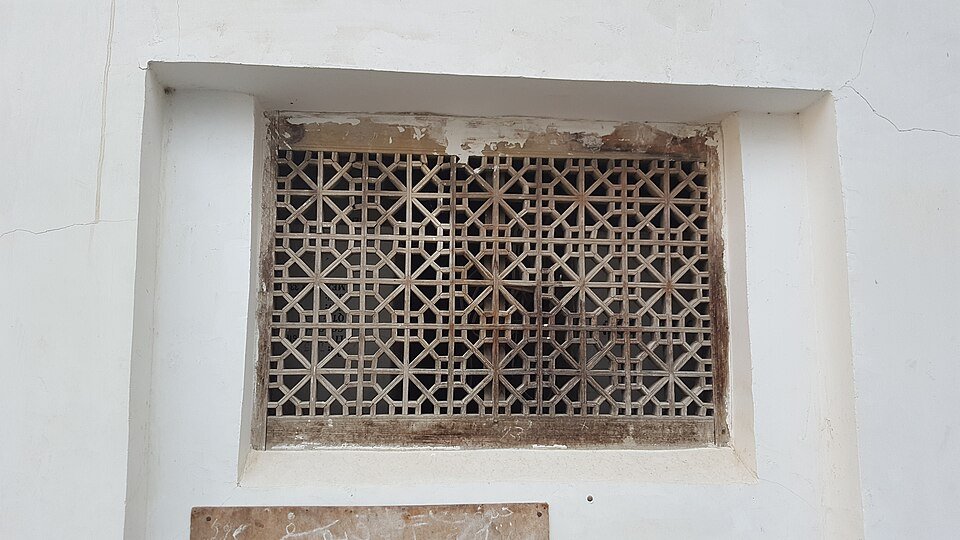
Representative photographs only. Marketplace examples rely on seller descriptions; CraftPersia has not independently authenticated their maker, origin, or rights status. Follow each source link for the listing context.
Used in these crafts
A joinery technique for building geometric lattice screens and panels from small, precisely cut wooden pieces assembled without glue or nails, using interlocking notched joints to form windows, doors and room dividers with openwork star and polygon patterns.