
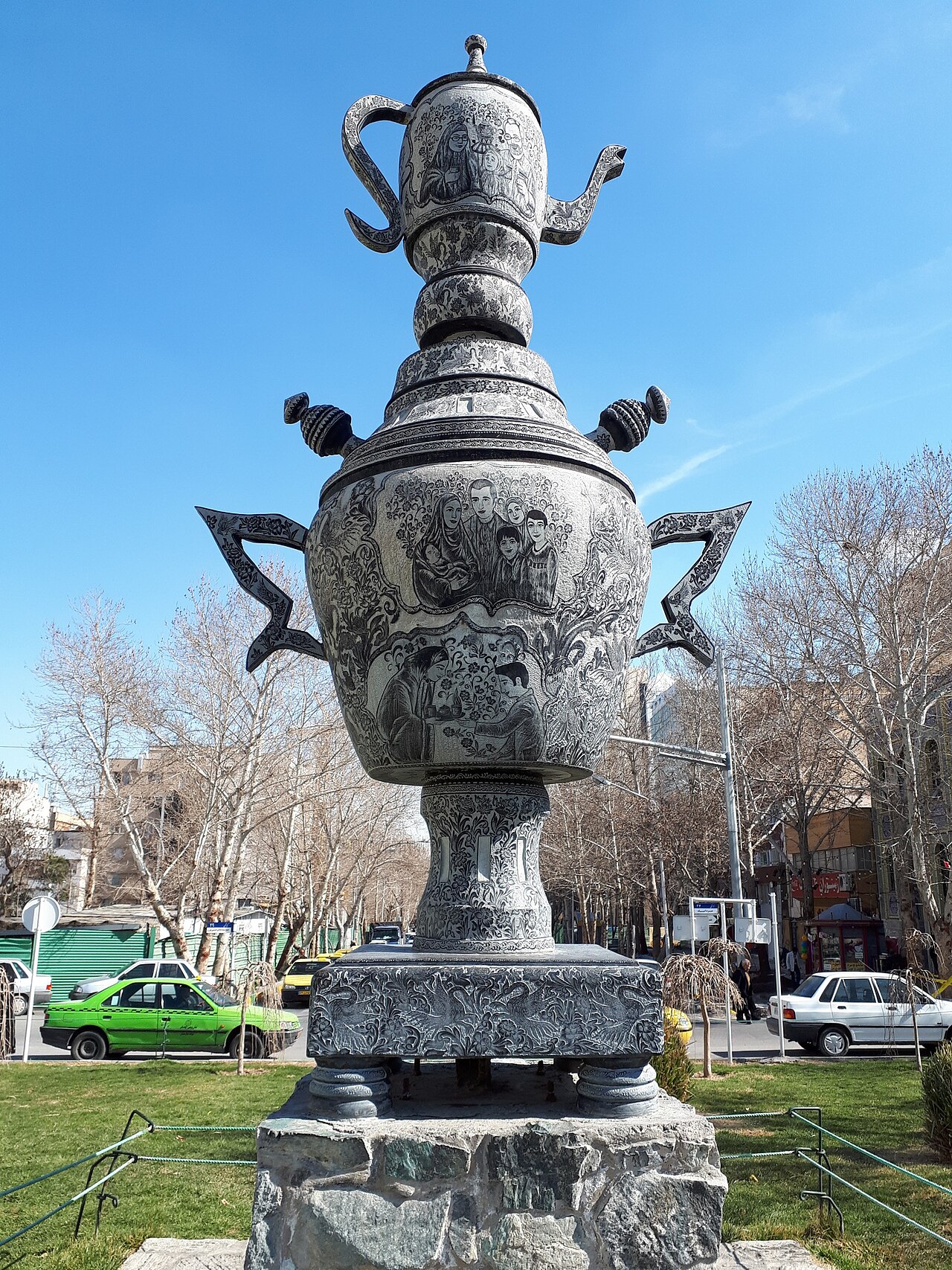
Carved soft-stone samovar and teapot at Kuh-e Sangi park, Mashhad · Photographed 10 January 2018 · Carved soft stone from the Mashhad quarries · Iran (Mashhad)
Kohdarmiansali · CC BY-SA 4.0 · Wikimedia Commons record
A monumental showpiece of the Mashhad soft-stone tradition; the record describes carving, not whether a lathe was used. One example, not a defining specimen.
Process, step by step
- Cut a block
- Turn or carve the form
- Smooth and polish
Variations
Mashhad soapstone cookware is season-treated before first use.
Conservation
Avoid thermal shock and acid.
Turned stone
Soft stone is turned on lathes to make bowls, mortars and pots. Mashhad's Khorasan stone vessels (sang-e siah, steatite-like) are carved and turned for cooking pots.
Hand or machine
Most production now uses powered lathes with hand finishing; this still counts as craft work when made by artisans.
Care
Season stone pots with oil before cooking and avoid sudden temperature change.
Quarries, Trade, and Turning Traditions
Lathe-turned stonework in Iran is intimately tied to specific geological outcrops, most famously the chlorite and talc-schist deposits around Mashhad and south-eastern regions such as Kerman. Soft, workable stone vessels boast an ancient heritage dating back millennia in the Near East, but the continuous craft tradition of turning cookware, mortars, and cosmetic containers flourished markedly in northeastern Iran. Mashhad emerged as the primary pilgrimage and trade hub for this industry, where artisans harnessed the heat-resistant qualities of local dark grey stone, colloquially termed sang-e siah or har-kareh. These vessels were historically transported along caravan routes across the Iranian plateau and Central Asia, prized for slow-cooking stews such as abgoosht due to their even thermal conductivity. Over successive eras, guild practices governed the extraction from open-cast quarries and the division of labour between rough-hewing miners and urban workshop turners, forging a resilient domestic craft that survived industrialization by adapting simple mechanical assistance while preserving traditional vessel morphology.
Assessment, Seasoning, and Structural Maintenance
When evaluating turned stone vessels, one should closely inspect surface tooling and structural soundness. Traditional pieces generally show concentric turning grooves along the walls alongside faint manual chisel facets near the base or handles, reflecting hand-held tool guidance on the rotating block. Modern fully automated counterparts often present unnaturally smooth surfaces devoid of minor human calibration, though mechanical assistance alone does not invalidate artisanal origin. Structural inspection requires running a fingertip along rims and bases to detect hairline fissures, which can propagate disastrously under heat. Prospective collectors and users should never expose an unseasoned vessel to direct flame. Proper seasoning traditionally involves rubbing all surfaces thoroughly with vegetable or animal fat and allowing the stone to absorb moisture gently, often through low, indirect heating over several hours. To preserve historical or utilitarian pieces, avoid thermal shock by never submerging hot stone into cold water, and clean solely with warm water and soft cloths, eschewing harsh chemical detergents.
Practical questions
- Is it marble? Usually soft steatite-like stone.
- Safe for cooking? Traditionally yes, if seasoned.
| Observation | Useful description | Not established |
|---|---|---|
| Concentric rings | Lathe turning | Mashhad |
| Hand-cut facets | Hand finishing | Age |
| Hairline crack | Thermal stress | Defect |
References and further reading
- [1] H. E. Wulff, The Traditional Crafts of Persia, MIT Press, 1966; A. U. Pope & P. Ackerman, A Survey of Persian Art, 1938–39.Historical context; not evidence for an individual object.
- [2] Encyclopaedia Iranica ↗Peer-reviewed entries on crafts, motifs and terms.
These sources provide context, not authentication or provenance for an individual object. Editorial interpretations remain under review.
Used in these crafts
The carving of marble, limestone, alabaster and softer stones for architectural elements, gravestones, inscriptions and vessels.