
Process, step by step
- Prepare the metal surface
- Set closely fitted fragments in mastic
- Grind the set surface level and polish it
Variations
Stone and setting materials vary; colour does not establish origin.
Conservation
Avoid detergent and impact.
Firuzeh-kubi
Firuzeh-kubi sets small turquoise pieces close together on copper or brass vessels with an adhesive mastic, then grinds and polishes the surface. Isfahan and Mashhad are centres; Neyshabur is the historic turquoise source.
Stone quality
Natural, stabilised, dyed and reconstituted turquoise and resins are all used. Ask for the material; colour alone cannot tell.
Care
Turquoise is porous and changes with oils and detergents; wipe dry only.
Historical Roots and Regional Emergence
Unlike ancient Iranian metalsmithing arts, turquoise-inlay (firuzeh-kubi) is widely documented as a twentieth-century innovation, generally said to have originated in Mashhad before taking deep root in the master workshops of Isfahan. The craft evolved as an ingenious synthesis: it utilized the small, irregular chips of raw turquoise left behind during the lapidary cutting of gemstone cabochons, marrying them to Iranian decorative copper and brass vessels. Neyshabur's historic mines in Khorasan provided the primary mineral source, prized for intense hues ranging from sky-blue to greenish-blue with characteristic dark matrix veining. In Isfahan, craftsmen systematized the application of bituminous black mastic, developing standardized tableware, vases, and ceremonial containers. By elevating discarded gemstone shards into prestigious decorative surfaces, firuzeh-kubi established a distinct modern identity within Iranian applied arts, reflecting both the mineral wealth of northeastern Iran and the meticulous metal-spinning and finishing traditions of central Iranian craft guilds.
Quality Assessment and Material Care
Assessing firuzeh-kubi requires evaluating the density of stone placement, the regularity of the ground, and the authenticity of the mineral material. In superior masterworks, turquoise chips are set with exceptional proximity, leaving minimal visible black mastic lines between individual fragments. A high proportion of resin or noticeable voids indicates hurried workmanship. Prospective collectors must differentiate between untreated natural turquoise, stabilized stone impregnated with polymers, and artificial or reconstituted aggregates consisting of dyed chalk powders. Natural stones reveal subtle tonal shifts and organic, irregular mineral matrix, whereas artificial stones often display unvarying monochromatic blues or unnatural matrix veining. Objects typically receive a clear topcoat to protect the metal and polish the mosaic. Caring for firuzeh-kubi demands protecting the porous gemstone from chemical alteration: moisture, household detergents, perfumes, cooking grease, and cosmetic oils can penetrate stone pores and permanently shift brilliant blue hues to dull green. Objects should be wiped only with dry, soft microfiber.
Practical questions
- Is all the stone Neyshabur? Not necessarily.
- Can I wash it? Avoid detergents.
| Observation | Useful description | Not established |
|---|---|---|
| Mosaic of blue chips | Firuzeh-kubi | Natural stone |
| Even bright blue | Possible treatment | Grade |
| Greenish shift | Absorption | Age |
References and further reading
- [1] H. E. Wulff, The Traditional Crafts of Persia, MIT Press, 1966; A. U. Pope & P. Ackerman, A Survey of Persian Art, 1938–39.Historical context; not evidence for an individual object.
- [2] Encyclopaedia Iranica ↗Peer-reviewed entries on crafts, motifs and terms.
These sources provide context, not authentication or provenance for an individual object. Editorial interpretations remain under review.
Documented material and craft examples
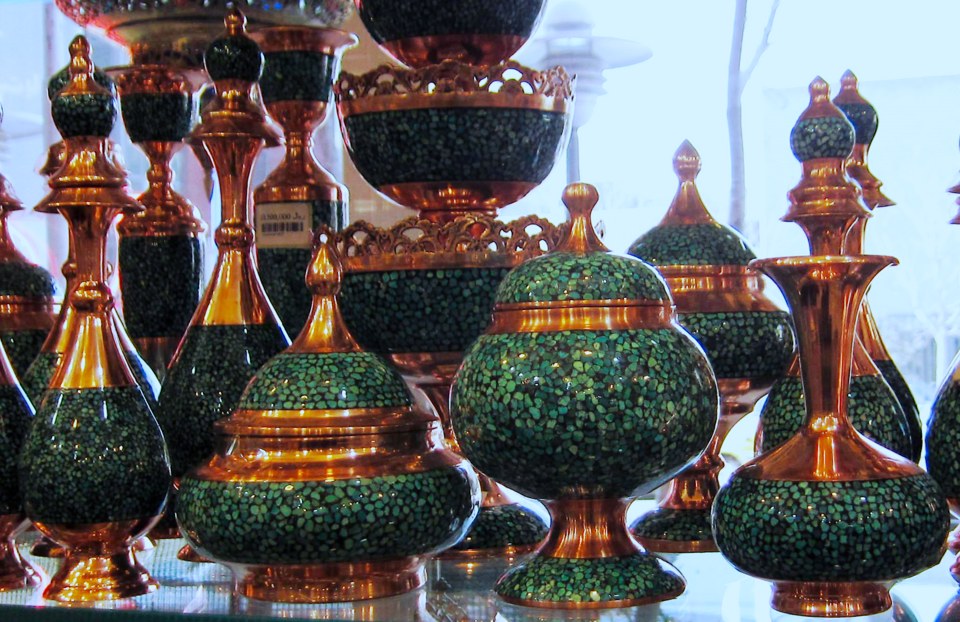
Representative photographs only. Marketplace examples rely on seller descriptions; CraftPersia has not independently authenticated their maker, origin, or rights status. Follow each source link for the listing context.
Used in these crafts
A decorative technique, associated particularly with Mashhad, in which small chips of turquoise are set edge to edge with adhesive onto a metal object's surface to create a dense mosaic-like covering, most often seen on vessels, jewellery and decorative plates.