
Process, step by step
- Dress the loom
- Pass coloured wefts over and under the warp
- Beat wefts close and finish the edges
Variations
Slit, interlocked and dovetailed wefts create different boundaries.
Conservation
Avoid uneven stretching and hard creases.
Weaving without pile
Flatweaves have no knotted pile: the pattern is formed by the wefts or by added yarns. In Iran the main families include kilim (slit or dovetailed tapestry weave), jajim (warp-faced striped weave), soumak/sumak (weft-wrapping) and various brocaded techniques. Names in the trade are used loosely, so structure should be described alongside the local term.
Slit tapestry and its geometry
In slit-tapestry kilims, coloured wefts turn back at colour boundaries, leaving small vertical slits. Weavers favour diagonal and stepped outlines to keep slits short, which partly explains the geometric vocabulary of kilims. Dovetailing or interlocking avoids slits by sharing warps or linking wefts. These choices relate to structure and regional habit, not to one tribe.
Soumak and weft wrapping
Soumak wraps coloured wefts around groups of warps, creating a dense, slightly raised surface and loose yarn ends on the back. It is associated with the Caucasus as well as north-western Iran, so attribution needs evidence beyond technique. Weft-wrapping is also used in bags and animal trappings made by Shahsavan and other groups.
Use and care
Flatweaves are lighter than pile rugs and were used as floor covers, bedding wraps, bags and partitions. Slits are weak points; avoid hanging a kilim by its edge without a support sleeve, and use a non-slip underlay on floors. Do not machine-wash; dyes and structure need specialist cleaning.
Practical questions
- Are all flatweaves kilims? No; jajim, soumak and brocaded weaves differ.
- Do slits mean poor quality? No; they are part of slit-tapestry structure.
| Observation | Useful description | Not established |
|---|---|---|
| Small vertical slits | Slit tapestry | Tribal attribution |
| Raised wrapped surface | Weft-wrapping | Iran vs Caucasus |
| Warp-faced stripes | Jajim-type weave | A specific village |
References and further reading
- [1] H. E. Wulff, The Traditional Crafts of Persia, MIT Press, 1966.Historical process context; not evidence for an individual object.
- [2] Canadian Conservation Institute — Caring for cultural objects ↗General preventive care; treatment requires assessment of the actual object.
These sources provide context, not authentication or provenance for an individual object. Editorial interpretations remain under review.
Documented material and craft examples
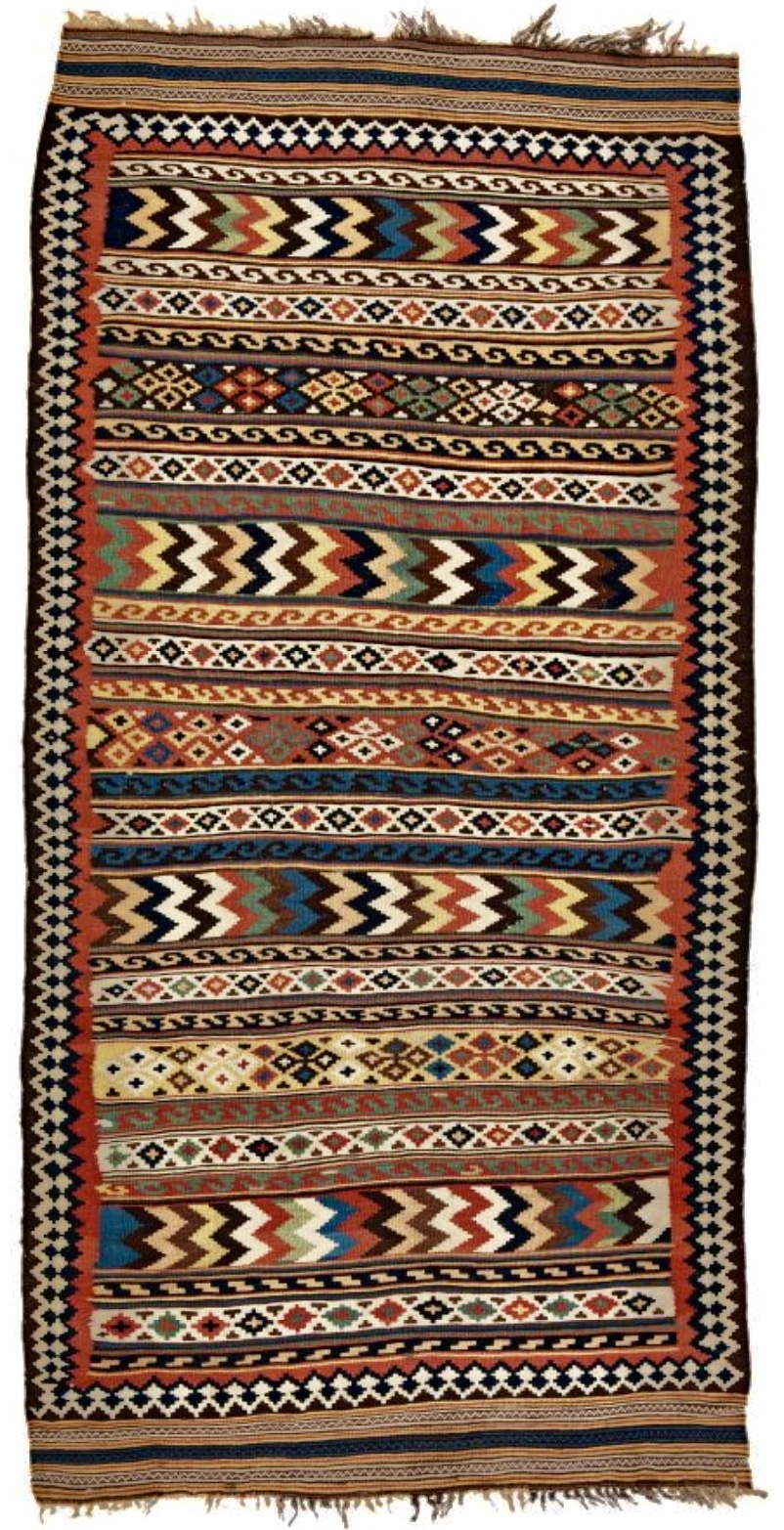
Representative photographs only. Marketplace examples rely on seller descriptions; CraftPersia has not independently authenticated their maker, origin, or rights status. Follow each source link for the listing context.
Used in these crafts
A flat, pileless woven textile made across Iran by interlocking or slit-weaving coloured weft threads over a warp, used as floor covering, storage bag, saddle cover and tent divider depending on region.
A pileless, reversible cotton floor covering associated especially with Meybod near Yazd, woven on a vertical loom with ground heddles and pattern harnesses that control its geometric, often two-colour design.