
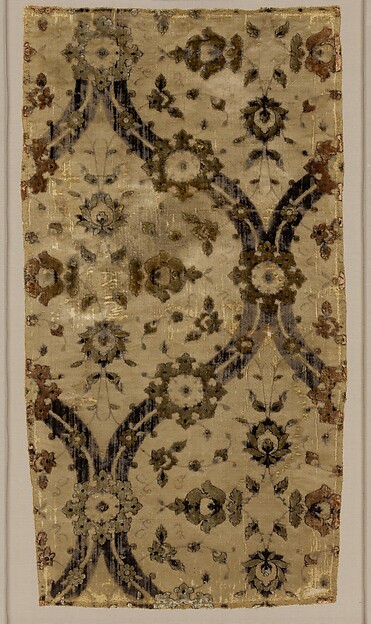
Silk Velvet Designed by 'Ghiyath' · second half 16th century · Silk, cut and voided velvet with continuous floats of flat metal thread · Iran
The Metropolitan Museum of Art, 52.20.13 · CC0 · Museum record
One catalogued Iranian example whose museum title or technique line names this process; not a defining specimen.
Process, step by step
- Weave the pile warp over rods
- Cut the loops
- Brush the pile
Variations
Voided and cut-and-uncut velvets create patterns.
Conservation
Never press pile flat; store rolled.
Velvet structure
Velvet has an extra warp raised over rods during weaving; cutting the loops creates pile. Safavid voided and brocaded velvets with figures are among the finest Iranian textiles.
Survival
Handwoven velvet in Kashan has nearly disappeared; modern velvet is machine-made.
Care
Pile crushes under pressure; store flat or rolled pile-out.
The Golden Age of Velvet Workshops
Velvet weaving (makhmal-bafi) holds a revered status in Iranian textile history, flourishing particularly in urban guild workshops from the sixteenth through nineteenth centuries. Kashan emerged as the undisputed historic center of luxury cut-pile velvet production, followed by specialized workshops in Isfahan, Tabriz, and Yazd. During the Safavid reign of Shah Abbas I and his successors, master designers—most famously Ghiyath al-Din Ali Naqshband of Yazd—elevated figured cut-pile velvet into an internationally prized art form. Elite workshops perfected voided velvets (makhmal-e barjasteh), where dense, supple silk pile was raised exclusively within patterned motifs, leaving recessed backgrounds shimmering with supplementary metallic warps and brocaded wefts. These costly textiles were fashioned into royal caftans, ceremonial tent hangings, and diplomatic gifts across Eurasia. During the nineteenth century, changing court fashions and the flood of mass-produced European industrial imports led to a gradual contraction of Iranian handloom velvet production, rendering historical surviving fragments extraordinary testaments to pre-industrial craftsmanship.
Structural Analysis and Velvet Conservation
Examining antique cut-pile velvet involves checking pile integration, structural foundation, and loop termination. In historic Iranian velvets, the silk pile was created by lifting pile warps over fine grooved brass rods (mil) and manually slicing the loops with a specialized knife (tegh-e makhmal). Close magnification reveals subtle variations in pile height and the presence of occasionally uncut loops, distinguishing historic hand craftsmanship from modern industrial velvets woven on double-cloth looms where two layers are machine-slit apart. In voided varieties, examine the gold or silver ground; real metallic strips will show delicate mechanical wear and oxidation rather than synthetic uniformity. Velvet conservation requires extreme care, as compressed silk pile rarely recovers its loft. Objects should never be folded, stacked under weight, or subjected to adhesive mounts. Historical fragments should be supported flat on sloped padded boards or rolled around wide-diameter cylinders with the pile facing outwards, interleaved with acid-free tissue to prevent friction and crushing.
Practical questions
- Is new velvet handwoven? Rarely.
- What is voided velvet? Pile only in parts.
| Observation | Useful description | Not established |
|---|---|---|
| Pile in motifs only | Voided velvet | Safavid |
| Uniform pile | Plain velvet | Handwoven |
| Crushed areas | Pressure damage | Age |
References and further reading
- [1] H. E. Wulff, The Traditional Crafts of Persia, MIT Press, 1966; A. U. Pope & P. Ackerman, A Survey of Persian Art, 1938–39.Historical context; not evidence for an individual object.
- [2] Encyclopaedia Iranica ↗Peer-reviewed entries on crafts, motifs and terms.
These sources provide context, not authentication or provenance for an individual object. Editorial interpretations remain under review.
Used in these crafts
A silk weaving technique producing a cut or voided pile on a foundation weave, used in Iran for garments, cushion covers and furnishing panels, with figured Safavid velvets among the most studied survivals.