
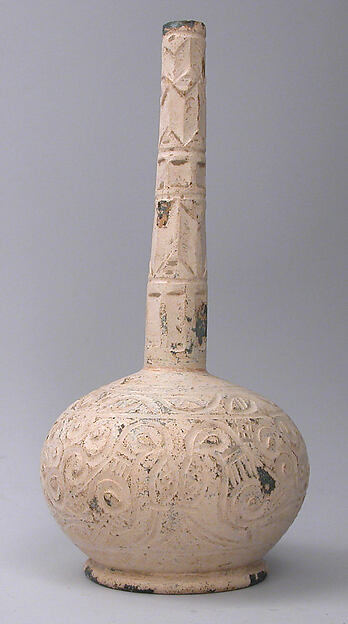
Glass Bottle · 10th–11th century · Glass; free blown, tooled and cut · Iran
The Metropolitan Museum of Art, 63.157.2 · CC0 · Museum record
One catalogued Iranian example whose museum title or technique line names this process; not a defining specimen.
Process, step by step
- Gather glass
- Blow and shape
- Anneal slowly
Variations
Hand-blown Iranian glass often has bubbles and a greenish or blue tint.
Conservation
Avoid sudden temperature changes.
Shisheh-gari
Glassblowers gather molten glass on a blowpipe and inflate and shape it. Iran has a long glass history, and Qajar-era blue and amethyst rosewater sprinklers are well known; Tehran and Shiraz have small studios today.
Signs of blowing
A pontil scar under the base, slight asymmetry and bubbles indicate hand work; moulded glass has seams.
Care
Avoid thermal shock; old glass can 'weep' in humidity.
Evolution of Persian workshops and forms
The tradition of free-blown glass in Iran demonstrates enduring technical mastery from early Islamic periods through the decorative renaissance of the eighteenth and nineteenth centuries. Major urban centers including Shiraz, Isfahan, and Tehran sustained lively quarters of glassblowers ('shisheh-garan') who produced distinctive vessels tailored to Persian domestic rituals and aristocratic banquets. The late Safavid and Qajar periods are especially celebrated for long-necked rosewater sprinklers ('golab-pash'), spiraling decanters with swan-like spouts, and tinted bowls crafted in deep cobalt blue, emerald green, and rich manganese violet. Glassblowers relied on simple furnace structures, iron blowpipes, and pearwood shaping blocks, drawing hot viscous gathers directly from the crucible. These vessels, while occasionally exhibiting technical imperfections such as slight asymmetry and organic air bubbles, possess an expressive fluidity that deliberately rejected the cold precision of industrial European crystal imports, maintaining a distinct visual identity rooted in regional glasshouse practices.
Distinguishing blow methods and glass disease mitigation
When inspecting historic Iranian glass, check the base for an authentic pontil scar, where the temporary iron rod was sheared away after final manipulation. Free-blown and mold-blown artisanal pieces display organic variations in wall thickness, subtle spiral tool marks along the neck, and internal bubbles elongated by the physical act of blowing. Conversely, modern machine-molded glass exhibits crisp, raised mold seams running continuously along opposing sides and a sterile, uniform weight distribution. A critical preservation concern for historical glass is 'crizzling' or glass disease, caused by chemically unstable flux formulas deficient in lime. Under high relative humidity, unstable glass leaches alkaline ions, developing a hazy, weeping surface that eventually fissures into microscopic networks of micro-cracks. Store antique glass in tightly controlled, stable environments with moderate humidity (around forty to forty-five percent). Never wash fragile historical glass in hot water or harsh detergents, which instantly accelerate internal chemical leaching.
Practical questions
- What is a pontil mark? The scar where a rod was attached.
- Is moulded glass handmade? Mould-blown can be.
| Observation | Useful description | Not established |
|---|---|---|
| Pontil scar | Hand blowing | Qajar |
| Mould seam | Moulding | Factory |
| Bubbles | Hand glass | Age |
References and further reading
- [1] H. E. Wulff, The Traditional Crafts of Persia, MIT Press, 1966; A. U. Pope & P. Ackerman, A Survey of Persian Art, 1938–39.Historical context; not evidence for an individual object.
- [2] Encyclopaedia Iranica ↗Peer-reviewed entries on crafts, motifs and terms.
These sources provide context, not authentication or provenance for an individual object. Editorial interpretations remain under review.
Used in these crafts
Iranian glass includes Sasanian cut glass, early Islamic mould-blown and cut vessels, and later blown bottles and rosewater sprinklers, with a small studio glassblowing tradition today.