
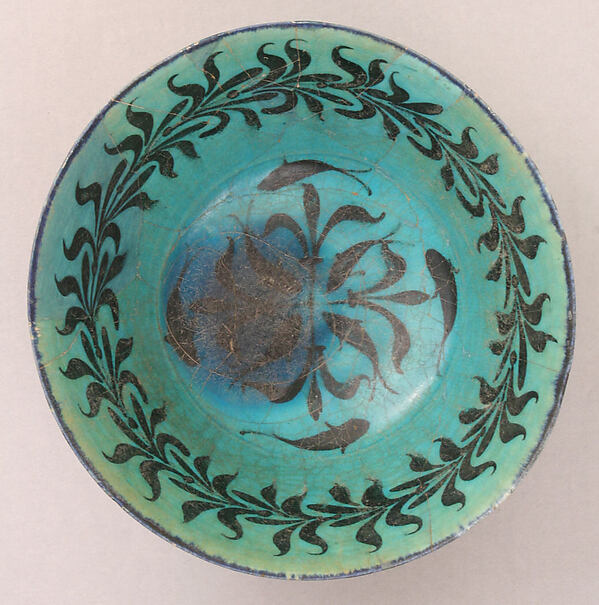
Bowl with Scrolls and Fishes · 13th century · Stonepaste; underglaze painted · Iran
The Metropolitan Museum of Art, 20.120.32 · CC0 · Museum record
One catalogued Iranian example whose museum title or technique line names this process; not a defining specimen.
Process, step by step
- Biscuit-fire the formed body.
- Paint the design in metal-oxide pigments.
- Dip or pour the transparent glaze.
- Glost-fire to maturity.
Variations
Haft-rang overglaze work fires a broader palette at lower temperature; cuerda seca separates colours with a greasy resist line.
Conservation
Crazed glazes admit salts; wash only under specialist advice.
Decoration beneath the glaze
Underglaze painting places colour under a glaze layer; overglaze decoration sits above an already glazed surface and is often fired separately. Cuerda seca separates glaze areas using resist lines and is another system. The terms describe the relationship of decoration to glaze, not a guaranteed city or period. Multiple systems can occur on one object.
Bodies and workshop sequences
Some workshops paint a biscuit-fired body; others use different preparation and firing sequences. Clay-rich bodies and stonepaste require distinct recipes and behaviour in the kiln. Colours depend on pigment, glaze chemistry and firing conditions, so blue alone cannot identify a cobalt mine, kiln temperature or Kashan workshop.
Inspection, wear and restoration
Inspect decorated edges, exposed breaks and recorded museum comparisons. Flaking, overpaint or restoration can conceal how layers relate. Do not scrape through a glaze to determine the technique. Catalogue descriptions may identify the decoration more accurately than a photograph, especially when a repaired surface changes the visible gloss.
Care and collection records
Keep accession or seller records with photographs of face, reverse, base and condition. Protect chipped edges and support heavy tiles rather than holding them by old hanging fittings. Washing may be unsafe for porous, salt-bearing or restored objects. Use the decoration term as part of a material description, not as a shortcut to dating.
Practical questions
- Are mina’i and underglaze painting interchangeable? No; mina’i commonly includes overglaze decoration.
- Can I scratch the glaze to check? No; rely on documentation and specialist examination.
| Feature | What it can tell you | What it cannot establish |
|---|---|---|
| Blue below glaze | Possible layer relationship | Exact pigment source |
| Paint above glaze | Possible overglaze decoration | One fixed firing temperature |
| Resist boundary | Separated glaze areas | Underglaze brushwork |
References and further reading
- [1] H. E. Wulff, The Traditional Crafts of Persia, MIT Press, 1966.Historical craft-process context, not authentication of a specific object.
- [2] Canadian Conservation Institute — Caring for cultural objects ↗Preventive care; treatment must be assessed for the actual materials.
These sources provide context, not authentication or provenance for an individual object. Editorial interpretations remain under review.
Used in these crafts
A regional pottery tradition centred on the town of Lalejin near Hamadan, producing thrown and press-moulded glazed and unglazed earthenware, from utilitarian storage vessels to decorative tableware, in a large number of household workshops.
Stonepaste wares painted in cobalt blue under a clear glaze, produced in Iran with strong dialogue with Chinese porcelain, especially in the Timurid and Safavid periods.