
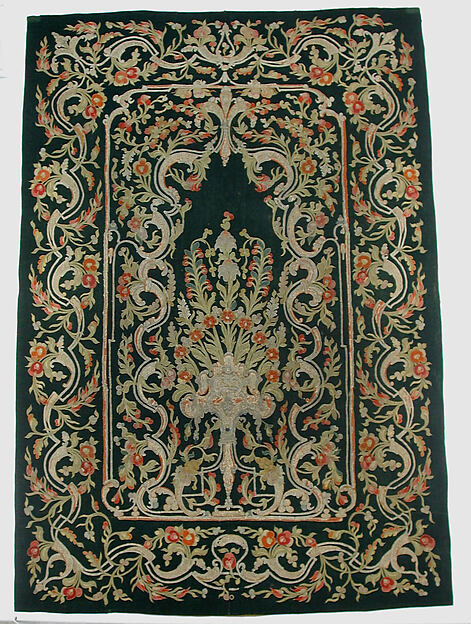
Hanging · 18th century · Wool; design in wool applique outlined in silk, broken scrolls in silver thread couched in brickwork pattern; lining of brown satin. · Iran
The Metropolitan Museum of Art, 43.136 · CC0 · Museum record
One catalogued Iranian example whose museum title or technique line names this process; not a defining specimen.
Process, step by step
- Cut coloured pieces
- Inlay or sew them to the ground
- Outline with chain stitch
Variations
Rasht work combines inlay with embroidery.
Conservation
Protect from moths and folding.
Cut-cloth decoration
Appliqué and inlay (tekeh-duzi) cut shapes from coloured cloth or felt and stitch them onto or into a ground, as in Rasht work and some Baluchi and Turkmen textiles.
Inlay vs overlay
In inlay the ground is cut away and the new piece fills the gap; in overlay it sits on top. The back reveals which.
Care
Edges fray where stitching loosens; support during display.
Structural origins and regional traditions
Textile inlay and overlay represent distinct regional approaches to cut-cloth embellishment throughout Iran. In the Caspian littoral, Rasht's specialized artisans refined true mosaic inlay, carefully cutting motifs from dyed fulled wool and inserting them into perfectly voided apertures within the ground cloth. This technique required immense precision to avoid structural bulk, creating smooth surfaces reminiscent of glazed architectural tiles. Parallel traditions evolved among nomadic Baluch and Turkmen pastoralists, who utilized layered overlay appliqué on woven wool, felt covers, and camel trappings. Nomadic work favored bold geometric borders, protective amulets, and stylized horned emblems, utilizing dense running stitches or couched cords to anchor layered felt pieces. These varied practices reflect distinct socioeconomic contexts: urban guild workshops in Gilan catered to prosperous merchant houses and courtly interiors, whereas pastoral appliqué reinforced heavy load-bearing animal trappings and insulated domestic tents, demonstrating how functional cut-cloth joining transformed into refined cultural ornamentation across diverse climates.
Structural verification and physical conservation
To distinguish true cut-cloth inlay from surface overlay appliqué, inspect the reverse under focused magnification. In genuine inlay, the main foundation cloth is meticulously excised to match the motif, showing identical flush contours on both faces secured by diagonal binding stitches along the seamline. Overlay appliqué, conversely, retains an intact foundation layer beneath the applied cloth segments. Beware of modern reproductions that utilize chemical adhesives or fusible bonding webs along pattern margins; traditional masterworks depend entirely on tailored thread tension. When examining older examples, assess joint integrity, as differential shrinkage between the foundation wool and decorative patches frequently generates puckering or broken edge stitches. Objects should be conserved away from direct sunlight, which degrades wool proteins and organic dyes. Support fragile composite hangings across their entire reverse using washed linen or cotton webbing rather than hanging them from isolated points, preventing gravitational strain from tearing delicate inlay joins.
Practical questions
- How tell inlay from overlay? Check the back.
- Is glued appliqué traditional? No.
| Observation | Useful description | Not established |
|---|---|---|
| Cut shapes stitched | Appliqué | Region |
| Ground cut away | Inlay | Rasht |
| Glued pieces | Shortcut method | Handmade |
References and further reading
- [1] H. E. Wulff, The Traditional Crafts of Persia, MIT Press, 1966; A. U. Pope & P. Ackerman, A Survey of Persian Art, 1938–39.Historical context; not evidence for an individual object.
- [2] Encyclopaedia Iranica ↗Peer-reviewed entries on crafts, motifs and terms.
These sources provide context, not authentication or provenance for an individual object. Editorial interpretations remain under review.
Used in these crafts
A northern Iranian needlework tradition associated with Rasht in Gilan, combining wool felt or broadcloth appliqué with chain-stitch embroidery for covers, hangings and saddle cloths.
A non-woven wool textile made by matting and pressing raw wool fibres with moisture, heat and friction rather than by weaving, traditionally produced across Iran for floor coverings, cloaks and protective mats.