
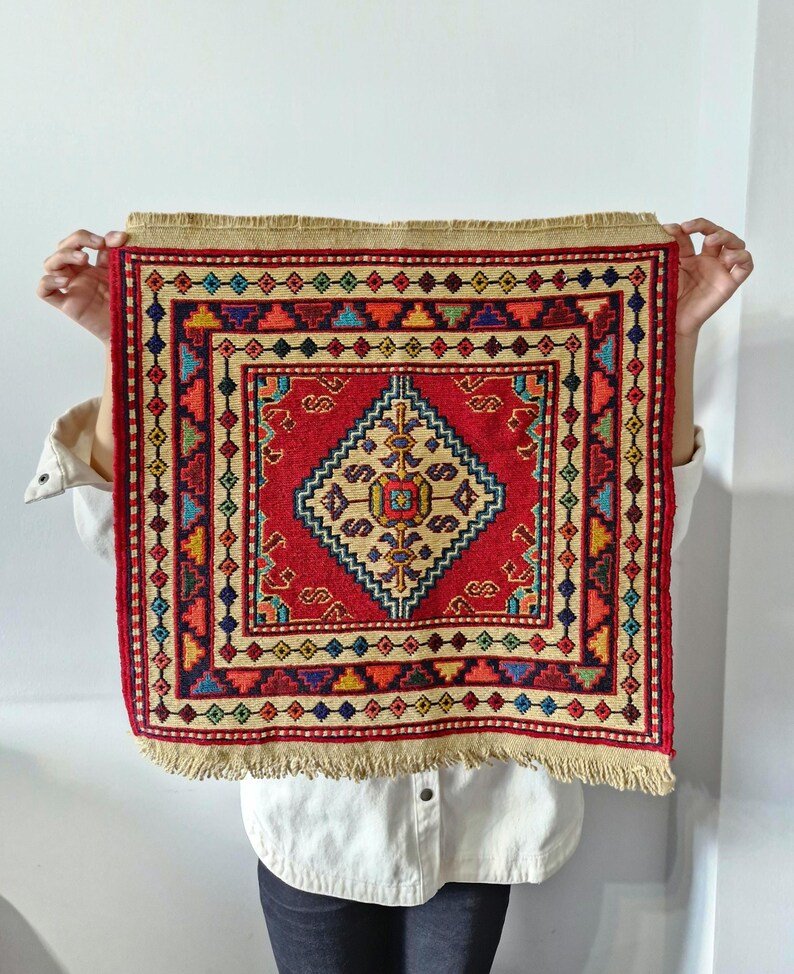
Photos and details come from a third-party Etsy listing, shown here as an illustrative example. CraftPersia has not inspected the object or verified the seller's claims, and the listing may have changed or ended since it was viewed.
Handwoven Wool Kilim Rug: Vintage Persian Varni, Geometric Wall Art
This vintage Persian kilim rug features a geometric pattern, making it an elegant addition to your home decor. Handwoven with care, this piece showcases traditional craftsmanship.
- Craft
- Kilim (Gelim)
- Region
- Shiraz
- Technique
- —
- Materials
- Wool
- Dimensions
- Not specified
- Weight
- Not stated
- Date
- Listing viewed 29 Sep 2026; listing unavailable when rechecked 28 Oct 2026
Condition
As described by the seller; not inspected by CraftPersia.
Provenance
Seller states: “Made in Iran”. Origin and maker not verified by CraftPersia.
Documentation
None reviewed.
This is illustrative sample documentation, not evidence for the pictured object. No seller or object claim has been independently verified. The archive does not certify authenticity.
Care
Follow the preservation guidance in the Kilim (Gelim) entry: light, humidity and physical support matter more than cleaning.
About Kilim (Gelim)
Definition
Gelim, commonly known in English as kilim, describes a family of flat-woven textiles produced without knotted pile. The design is created by interlocking coloured wefts directly against each other, or by slit-weaving where blocks of colour meet, leaving small vertical gaps at the colour boundaries that are a structural signature of the technique rather than a flaw.
Because the surface carries no pile, kilims are lighter, more flexible and typically reversible compared to knotted-pile carpets, and the same interlocking-weft logic underlies related utilitarian forms such as saddlebags, grain sacks and tent bands woven by pastoral and village weavers.
History
Flatweaving is among the oldest textile technologies practised in the Iranian plateau, closely tied to pastoral and semi-nomadic life where lighter, packable textiles suited seasonal movement. Documented regional kilim traditions associated with Fars, Kerman, Sistan and Khorasan describe distinct weaving groups, though precise dating of individual older pieces is rarely possible without technical or documentary evidence.
Through the Qajar and Pahlavi periods, kilims were woven primarily for household and pastoral use rather than for export, and only later entered wider decorative and collector markets alongside knotted-pile carpets, a shift that changed sizes and, in some workshops, colour choices to suit external buyers.
Materials
Wool is the dominant fibre for both warp and weft in pastoral and village kilims, valued for its availability from local flocks and its capacity to hold natural dyes. Cotton is used in some regional traditions for the warp, giving a firmer, flatter foundation than an all-wool structure.
- Handspun wool weft for colour and pattern
- Wool or cotton warp depending on regional practice
- Natural or synthetic dyes, varying by period and workshop
- Goat hair sometimes used for edge binding and reinforcement
General background on the craft, not a statement about any individual object; dates and attributions summarise common positions in the literature and remain under review. Read the full Kilim (Gelim) entry.
Checklist before buying Kilim (Gelim)
Inspect
- A slit-tapestry kilim shows small vertical slits where colour areas meet; both faces look almost the same.
- Check the selvedges (sides) and the warp ends for wear, re-weaving and loose wefts.
- Hold the piece up to light: thin areas or holes show where the weft has worn through.
- Ask whether the colours have been tested for bleeding; never wet-test an old or valuable piece yourself.
Red flags
- Printed 'kilim pattern' fabric or machine-woven flatweaves with an identical repeat and a stiff, even edge.
- Kilims described only as 'tribal' or 'Persian style' without a region or country of weaving.
Ask the seller
- Where, and by which group, was it woven?
- What are the warp and weft fibres?
- Has it been repaired or re-woven?