
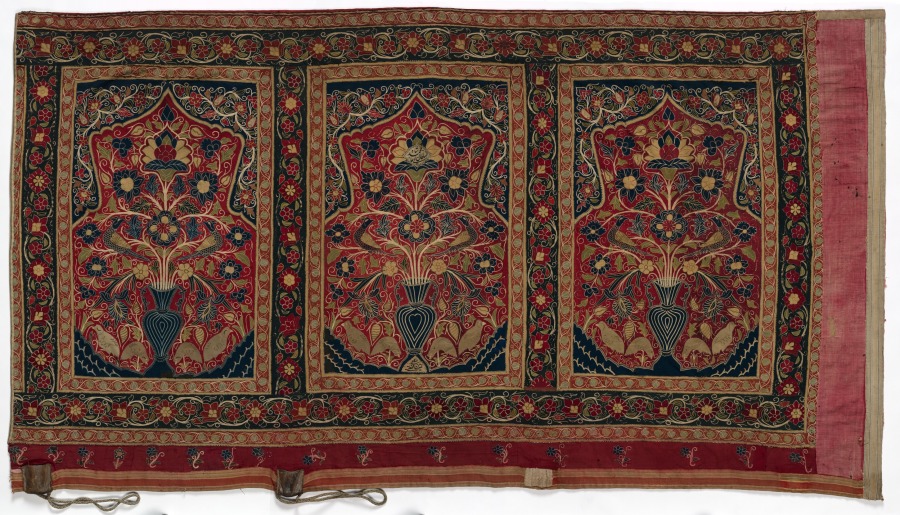
Royal Round Tent made for Muhammad Shah (wall panel with three design units) · 1834–48 · Interior: wool: plain weave, inlaid work; silk: embroidery, chain stitch; tape, leather; Exterior: cotton, wool: plain weave; rope, iron ring · Iran, Rasht, Qajar period (1779-1925)
Cleveland Museum of Art, 2014.388.2 · CC0 · Museum record
One catalogued Iranian example whose museum title or technique line names this process; not a defining specimen.
Process, step by step
- Bring the thread up
- Loop and catch it
- Repeat along the line
Variations
A hook (tambour) can speed up the work.
Conservation
Support the textile when hanging.
Looped stitch
Chain stitch forms linked loops, worked with a needle or a hook (qollab). Rasht work (qollab-duzi) uses chain stitch with felt appliqué on wool cloth.
Machine chain stitch
Chain-stitch machines exist; uniform loops and long continuous runs indicate them.
Care
Pulled loops can unravel a whole line; never pull loose ends.
Guild traditions and coastal trade
Rasht embroidery developed within a well-structured urban guild system along the Caspian transit corridor, where imported broadcloth met locally dyed domestic wool and mulberry-fed silk thread. While hooked chain stitch is traditionally celebrated in Gilan, related looping techniques also circulated through Khorasan, Isfahan, and regional workshops catering to aristocratic furnishings, horse regalia, and ceremonial wall hangings. Ottoman and Central Asian trade brought imported European fulled cloth ('mahut') through northern ports, establishing dense felted grounds that could structurally support tight, rhythmic hookwork without puckering. Historical accounts suggest that male professional artisans often executed large-scale commissioned hangings using wooden tambour hooks, while needle-based domestic work flourished alongside it. The visual language drew heavily from courtly carpet designs, Qajar floral medallions, paired birds, and cypress silhouettes, showing how northern maritime trade routes accommodated both cosmopolitan decorative repertoires and deeply regional textile structures.
Evaluating loop tension and conservation protocols
When assessing chain-stitch textiles, use raking light and low magnification to inspect loop formation and ground penetration. Hand-hooked stitches typically display subtle variations in loop circumference, direction of twist, and minor angular shifts at tight curves, whereas mechanical chain stitch produces exceptionally uniform loops with consistent tension throughout long paths. Examine thread degradation: natural vegetable-dyed silk often exhibits gentle surface fading while retaining pliable core fibers, whereas synthetic twentieth-century fibers may show localized brittleness or uneven dye leaching. Never attempt to pull loose thread ends, as the interlocked nature of the stitch means one pulled thread can unravel an entire row; instead, secure detached loops with fine archival polyester or silk thread using an unknotted couching stitch. Store flat or rolled on acid-free archival tubes with the embroidered surface outward, interleaved with unbuffered tissue paper, ensuring wool bases remain strictly protected from moth larvae and rapid humidity fluctuations.
Practical questions
- Is Rasht work only chain stitch? It combines appliqué.
- Pull a loose loop? No.
| Observation | Useful description | Not established |
|---|---|---|
| Linked loops | Chain stitch | Hand or machine |
| Felt patches | Appliqué | Rasht |
| Uniform runs | Possible machine | — |
References and further reading
- [1] H. E. Wulff, The Traditional Crafts of Persia, MIT Press, 1966; A. U. Pope & P. Ackerman, A Survey of Persian Art, 1938–39.Historical context; not evidence for an individual object.
- [2] Encyclopaedia Iranica ↗Peer-reviewed entries on crafts, motifs and terms.
These sources provide context, not authentication or provenance for an individual object. Editorial interpretations remain under review.
Used in these crafts
A northern Iranian needlework tradition associated with Rasht in Gilan, combining wool felt or broadcloth appliqué with chain-stitch embroidery for covers, hangings and saddle cloths.
A broad term for Iranian needle embroidery on cotton, silk or wool grounds, including counted, darned and satin-stitch work used on covers, garments and prayer cloths.