
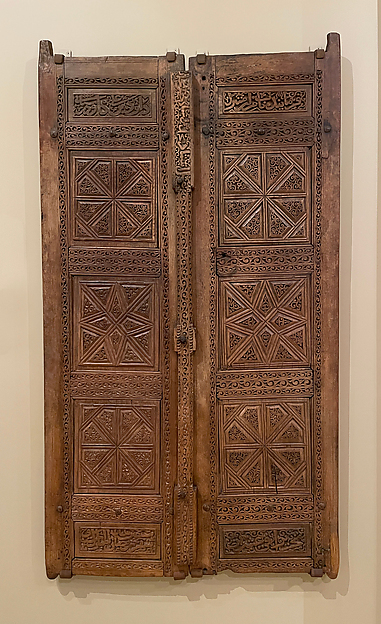
Pair of Carved Doors · dated [8]70 AH/1466 CE · Wood (teak); carved · Iran
The Metropolitan Museum of Art, 35.127a, b · CC0 · Museum record
One catalogued Iranian example whose museum title or technique line names this process; not a defining specimen.
Process, step by step
- Draw design
- Remove surrounding wood
- Refine raised forms
Variations
Relief depth and surface finish vary widely.
Conservation
Do not apply furniture oil to historic carving.
Monabbat
Relief wood carving (monabbat) cuts away the ground to leave raised motifs. Abadeh, Isfahan, Tabriz and Golpayegan are known centres; walnut and pear are common woods.
Depth and finish
Depth varies with style; tool marks and slight variation indicate handwork, while CNC carving produces identical repeats.
Care
Dust with a soft brush; avoid oils that collect in recesses.
Historical Evolution and Regional Styles
Relief wood carving in Iran encompasses a centuries-old tradition that spanned sacred architecture, court furniture, and small decorative wares. While medieval survivals primarily comprise mosque doors, cenotaphs, and minbars embellished with intricate vegetal and epigraphic programs, the craft underwent stylistic shifts during the Safavid and Qajar periods. In the nineteenth century, certain regional centres acquired distinct reputations for specialised production. Abadeh gained renown for finely detailed, low-relief carving on delicate wooden boxes and sherbet spoons, frequently employing dense boxwood or pearwood. Conversely, craftsmen in Isfahan and Golpayegan often developed bolder, deeper relief techniques suited to grand architectural doors, decorative wall panels, and expansive reception room furnishings. The repertoire combined traditional Islamic arabesque motifs (eslimi and khata'i) with figurative elements, European floral naturalism (gol-o-morgh), and dynastic imagery. These regional variations reflected not only local availability of timber—such as mountain walnut, beech, and fruitwoods—but also changing patronage networks ranging from rural domestic markets to elite urban households.
Technical Connoisseurship and Preservation
Evaluating fine relief-carved timber requires a close study of surface texture, tool facets, and depth transitions. Hand carving reveals nuanced variation: tool paths made by gouges (nokhodi and nim-baz) typically show minuscule stepped facets, variable curve angles, and expressive undercutting where the artisan physically cleared the background. In contrast, modern computer-numerically-controlled (CNC) milling produces uniformly rhythmic micro-grooves, strictly identical repeated floral medallions, and lacks genuine undercut shadow. Collectors should inspect internal corners; machine cutters often leave slight rounded radii at the bases of deep cuts where a flat hand chisel would leave clean, crisp terminal angles. Authenticity cannot be judged by surface wear alone, as artificial distressing can mimic aging. Care for monabbat centers on environmental stability; avoid aggressive commercial polishes, chemical solvents, or heavy waxes that settle into carved crevices and trap dirt. Instead, regular gentle dusting with a soft horsehair brush and maintaining stable indoor relative humidity prevent timber splitting and fiber degradation.
Practical questions
- How to spot CNC? Identical repeats.
- Which woods? Often walnut or pear.
| Observation | Useful description | Not established |
|---|---|---|
| Tool marks | Hand carving | Master |
| Identical repeats | Machine carving | — |
| Deep undercut | High relief | Region |
References and further reading
- [1] H. E. Wulff, The Traditional Crafts of Persia, MIT Press, 1966; A. U. Pope & P. Ackerman, A Survey of Persian Art, 1938–39.Historical context; not evidence for an individual object.
- [2] Encyclopaedia Iranica ↗Peer-reviewed entries on crafts, motifs and terms.
These sources provide context, not authentication or provenance for an individual object. Editorial interpretations remain under review.
Used in these crafts
A relief wood-carving technique in which solid panels, furniture and architectural elements are carved directly with chisels to produce raised or recessed floral, arabesque and geometric ornament, distinct from inlay techniques that build a surface from separate pieces.