
 AI illustration
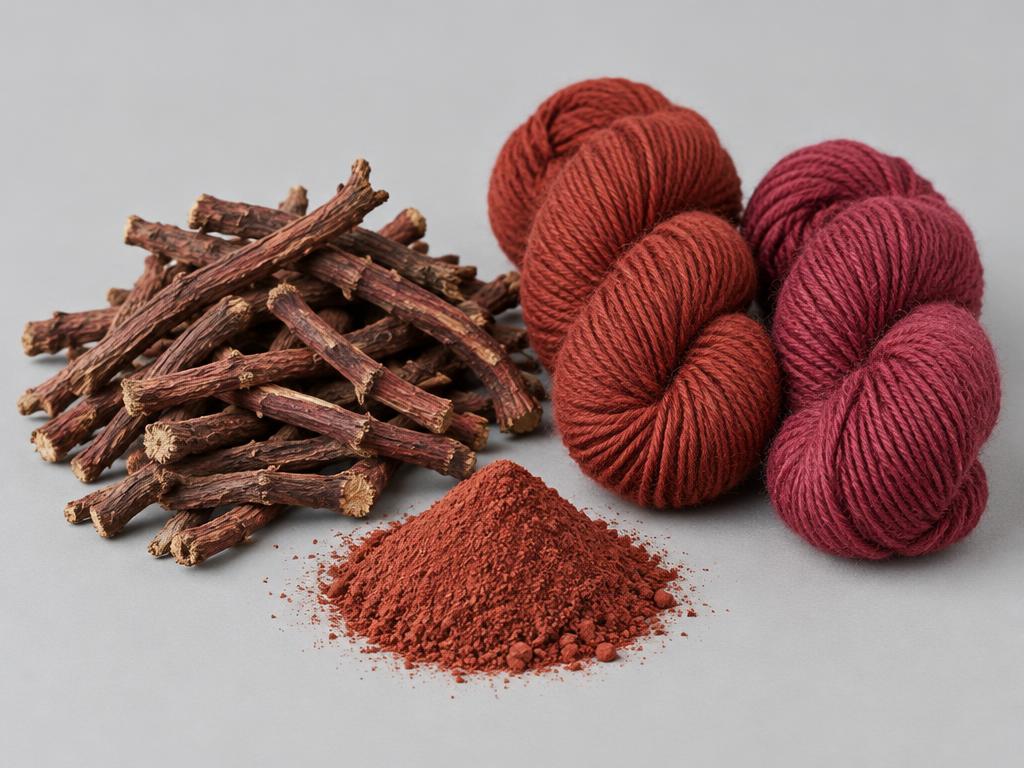
Dried madder roots, ground madder and wool in the brick-red and rose shades it gives.
AI-generated illustration — not a photograph of a real object, place or person, and not evidence of any piece's origin. Shown because no suitable real photograph has been found yet.
Origin
Rubia plants grown in Iran for centuries.
Properties
- Warm reds
- Needs a mordant
- Good lightfastness
Preparation
Dry and grind the root; dye mordanted fibre in a hot bath.
Care & preservation
Reds may bleed if washed carelessly; test first.
General guidance only. For valuable or fragile pieces, consult a qualified conservator before cleaning or treatment.
The plant and its dye
Madder (runās, Rubia tinctorum and related species) is a perennial whose roots contain anthraquinone colourants, chiefly alizarin and purpurin. It was one of the most widely used red dyes in Iranian carpet, kilim and textile production. Roots are usually harvested after several years of growth, dried and ground. Madder is still cultivated in parts of Iran, but the use of the word in a listing does not demonstrate that a textile was dyed with it.
Mordants and the range of colour
Madder needs a mordant, most commonly alum, to bind to wool. Mordant, water, temperature, dye concentration and the addition of other dyes produce shades from orange-red and brick to deep red, pink and, combined with other dyestuffs, purple-brown. Wool from one dye batch can differ from another, contributing to abrash. Synthetic alizarin, produced from 1869, is chemically identical to the main madder component, which is why visual judgement is unreliable.
What testing can show
Laboratory methods such as HPLC can detect the mixture of compounds typical of plant madder versus a single synthetic component, and can identify other natural or synthetic dyes. Simple home tests are unsafe and inconclusive. A seller's statement of 'vegetable dyes' should be read as a claim; ask whether analysis was done, by whom and on which yarns. Faded tips, uneven bands and a pleasing palette are not proof.
Light, washing and care
Madder reds are comparatively lightfast on alum-mordanted wool, but all dyes fade with long exposure to daylight. Rotate rugs, avoid direct sun and never bleach or use strong alkaline cleaners. Colour run during washing points to a dyeing or finishing problem and should be assessed by a specialist cleaner rather than tested at home.
Practical questions
- Is every red Persian rug madder-dyed? No; synthetic dyes have been used since the late nineteenth century.
- Can the eye detect synthetic alizarin? No; laboratory analysis is required.
The red root
Madder (runas) is the dried root of Rubia tinctorum, ground and simmered with alum-mordanted wool to give the reds that dominate many Persian carpets. The shade depends on the age of the root, the water, the mordant, the temperature and how long the wool stays in the bath; overdyeing with indigo gives purples and with walnut gives browns.
Madder was grown in several Iranian provinces, and Yazd and Kerman were known for it historically. Its use declined after synthetic alizarin appeared in the 1870s and returned in natural-dye revivals of the twentieth century.
What a red rug can tell you
A madder red cannot be identified by eye; synthetic alizarin is chemically the same main colourant. Look instead for documentation from the maker or dye house, and treat sellers' 'madder' claims as statements to verify.
- Ask for the dye source and mordant in writing.
- Uneven red across the field shows batch dyeing, not the dye's identity.
- Laboratory testing can distinguish natural madder from synthetic alizarin by its minor components.
Why no photograph
A red rug photo would not show that the red came from madder, and we found no Iran-catalogued record of madder root or a documented madder-dyed object with an analysis in its record. The page therefore stays unillustrated.
| Observation | Useful description | Not established |
|---|---|---|
| Brick-red field | Red dye present | Plant madder |
| Colour bands (abrash) | Batch variation | Natural dye or age |
| 'Vegetable dyed' label | Seller claim | Analysed result |
| What to look at | What it helps with | What it does not prove |
|---|---|---|
| Layout, scale and repeat | Comparing design families | Where or when the piece was made |
| Material and technique | How the design was executed | Iranian handmade origin on its own |
| Dated or signed museum record | A documented reference point | The date or maker of a different object |
References and further reading
- [1] H. E. Wulff, The Traditional Crafts of Persia, MIT Press, 1966.Historical process context; not evidence for an individual object.
- [2] Canadian Conservation Institute — Caring for cultural objects ↗General preventive care; treatment requires assessment of the actual object.
- [3] Encyclopædia Iranica — 'Dyes and dyeing' ↗
- [4] Encyclopædia Iranica — entries on carpets, textiles and decorative arts ↗
These sources provide context, not authentication or provenance for an individual object. Editorial interpretations remain under review.
Used in these crafts
A hand-knotted pile textile woven across Iran in city workshops, village looms and pastoral camps, distinguished by regional structure, palette and design vocabulary.
A thick, coarsely knotted pile rug woven mainly by pastoral and village weavers of the Zagros, with open fields, few motifs and a directly personal design language.
A flat, pileless woven textile made across Iran by interlocking or slit-weaving coloured weft threads over a warp, used as floor covering, storage bag, saddle cover and tent divider depending on region.
A resist-dyed and block-printed cotton textile, historically associated with Isfahan, in which carved wooden blocks stamp repeating floral and figural patterns onto cloth in successive colour stages.