
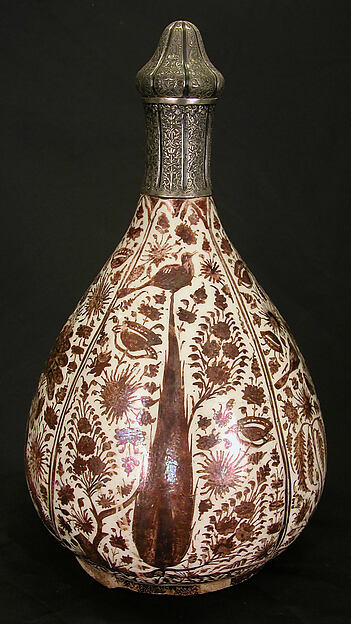
Luster-Painted Bottle · second half 17th century · Stonepaste; luster-painted on opaque white glaze, with silver fittings · Iran
The Metropolitan Museum of Art, 41.199.4a, b · CC0 · Museum record
One catalogued Iranian example whose museum title or technique line names this process; not a defining specimen.
Process, step by step
- Glaze and fire the ware
- Paint lustre
- Refire in a reducing atmosphere
Variations
Kashan was a leading lustre centre in the 12th–13th centuries.
Conservation
Do not polish lustre; it wears off.
Metallic sheen
Lustre paint containing silver and copper compounds is applied over a fired glaze and refired in a reducing kiln, leaving a thin metallic film. Kashan produced celebrated lustre tiles and vessels from the late twelfth century; Safavid lustre revived the technique.
Recognition
Lustre changes colour with viewing angle. Modern lustre and gold-coloured overglaze paints exist; tilting under light helps, analysis confirms.
Care
Lustre film is thin and abrades; never scrub.
Kiln alchemy and regional ceramic centers
Lustreware represents one of the most technologically sophisticated accomplishments of medieval Persian ceramicists. Centered predominantly in Kashan during the late twelfth and thirteenth centuries, familial workshops developed specialized stonepaste bodies coated in alkaline or tin opacified glazes. The vessel or architectural tile received an initial high-temperature firing, after which calligraphers and painters applied a suspension of silver and copper oxides mixed with ocher onto the cooled glossy surface. A second firing occurred in a specialized reducing kiln, where starved oxygen levels forced carbon monoxide to strip oxygen from the metal oxides, depositing a nanometer-thin iridescent metallic film bonded permanently to the glassy matrix. Kashan's master potters inscribed star tiles, prayer niches ('mihrabs'), and elite vessels with elaborate verses and courtly iconography. The technique declined following socioeconomic shifts but was selectively revived under the Safavids, continuing to mesmerize observers with its light-shifting polychrome iridescence.
Surface reflectivity analysis and conservation limits
Authenticating historical lustre requires careful observation of surface iridescence under shifting light angles. True reduction lustre produces delicate chromatic shifts—ranging from amber gold to copper red and peacock green—caused by light diffraction through metallic nanoparticles embedded within the glaze skin. In contrast, modern overglaze gold paints or resin-bound lustres appear monochromatic, opaque, and plasticky under high magnification. Examine the surface for microscopic glaze pitting, pinholes, and natural burial irisation, keeping in mind that clever forgeries often simulate age through acid etching. The metallic lustre layer is microscopically thin and chemically delicate; exposure to abrasive cleaners, acidic solutions, or vigorous mechanical scrubbing will permanently abrade the metallic film. Clean solely with dry, ultra-soft artist brushes or gentle swabs dampened with distilled water if structurally sound. Never immerse vessels with crackled glazes, as water penetration into porous stonepaste bodies can promote salt efflorescence and shatter fragile surfaces.
Practical questions
- Why does it shimmer? Metallic nanoparticles.
- Is all lustre Kashan? No.
| Observation | Useful description | Not established |
|---|---|---|
| Angle-dependent sheen | Lustre | Kashan |
| Flat gold paint | Overglaze gilding | Lustre |
| Worn sheen | Abrasion | Age |
References and further reading
- [1] H. E. Wulff, The Traditional Crafts of Persia, MIT Press, 1966; A. U. Pope & P. Ackerman, A Survey of Persian Art, 1938–39.Historical context; not evidence for an individual object.
- [2] Encyclopaedia Iranica ↗Peer-reviewed entries on crafts, motifs and terms.
These sources provide context, not authentication or provenance for an individual object. Editorial interpretations remain under review.
Used in these crafts
A ceramic decoration in which metallic oxides are painted onto a glazed surface and fired in a reducing kiln to produce a metallic sheen, associated especially with Kashan.