
Process, step by step
- Set the pattern harness
- Lift pattern warps for each pick
- Weave the ground and pattern wefts
Variations
Termeh, zari-bafi and velvet all rely on pattern-lifting looms.
Conservation
Fold textiles loosely and never iron metal-thread areas.
Pattern by draw cords
A drawloom has a pattern harness operated by a draw-boy (gushvar-kesh) who lifts groups of warps for each pass, allowing complex repeats. Termeh, zari and Safavid figured silks were woven this way.
Today
Few traditional drawlooms survive in Yazd and Kashan; most termeh-like fabric is now jacquard machine-woven. Ask whether a piece is handloom.
Care
Silk weakens in light; store rolled, never folded sharply.
Historical Centers and the Drawloom Tradition
The complex figured textiles of Iran, historically created on intricate drawlooms, represent one of the pinnacles of Islamic weaving technology. While complex multi-harness looms operated in Sasanian and early Islamic periods, drawloom weaving attained legendary technical sophistication during the Safavid era, when imperial workshops in Isfahan, Kashan, and Yazd produced intricate figured silks, compound twills, and metallic brocades (zari). Later, during the eighteenth and nineteenth centuries, urban drawloom traditions concentrated predominantly in Yazd and Kerman for the manufacture of wool and silk termeh, characterized by dense boteh motifs. The drawloom relied on an ingenious division of labor: a master weaver working at floor level, while a young assistant, the draw-boy (gushvar-kesh), sat atop the wooden frame manually manipulating a network of cords to raise predetermined warp groups for each weft shoot. By the mid-twentieth century, the rapid arrival of automated mechanical Jacquard heads largely supplanted this labor-intensive, human-driven pattern mechanism.
Distinguishing Handweaves and Textile Preservation
Evaluating historic drawloom textiles demands careful magnification of weft pathways, selvage construction, and pattern transitions. Authentic hand-loomed figured fabrics, whether historic termeh or fine zari, reveal slight, organic variations in warp tension and weft compaction across the panel, reflecting the rhythmic breathing and physical exertion of human weavers. Conversely, modern machine Jacquard yardage presents unrelenting mechanical perfection, uniform synthetic thread densities, and rigid, machine-stitched selvages. In antique hand-woven brocades, precious metal threads (golabetun) consist of genuine silver-gilt strips wound around a fine silk core, which display gentle patina or localized tarnish rather than the reflective plastic luster of modern Lurex. Conserving fragile drawloom silks requires uncompromising preventive care. Textiles should never be hung unpadded or sharply folded, as permanent creases fracture delicate silk fibers and metal strips. Instead, store objects rolled horizontally around acid-free cardboard cylinders, separated by unbuffered tissue paper, in dark, climate-controlled environments free from humidity fluctuations and moth infestation.
Practical questions
- Is all termeh handwoven? No; most is machine.
- Who is the draw-boy? The helper lifting pattern cords.
| Observation | Useful description | Not established |
|---|---|---|
| Complex repeat | Figured weave | Handloom |
| Perfectly regular edge | Possible machine | — |
| Yazd label | Origin claim | Handloom |
References and further reading
- [1] H. E. Wulff, The Traditional Crafts of Persia, MIT Press, 1966; A. U. Pope & P. Ackerman, A Survey of Persian Art, 1938–39.Historical context; not evidence for an individual object.
- [2] Encyclopaedia Iranica ↗Peer-reviewed entries on crafts, motifs and terms.
These sources provide context, not authentication or provenance for an individual object. Editorial interpretations remain under review.
Documented material and craft examples
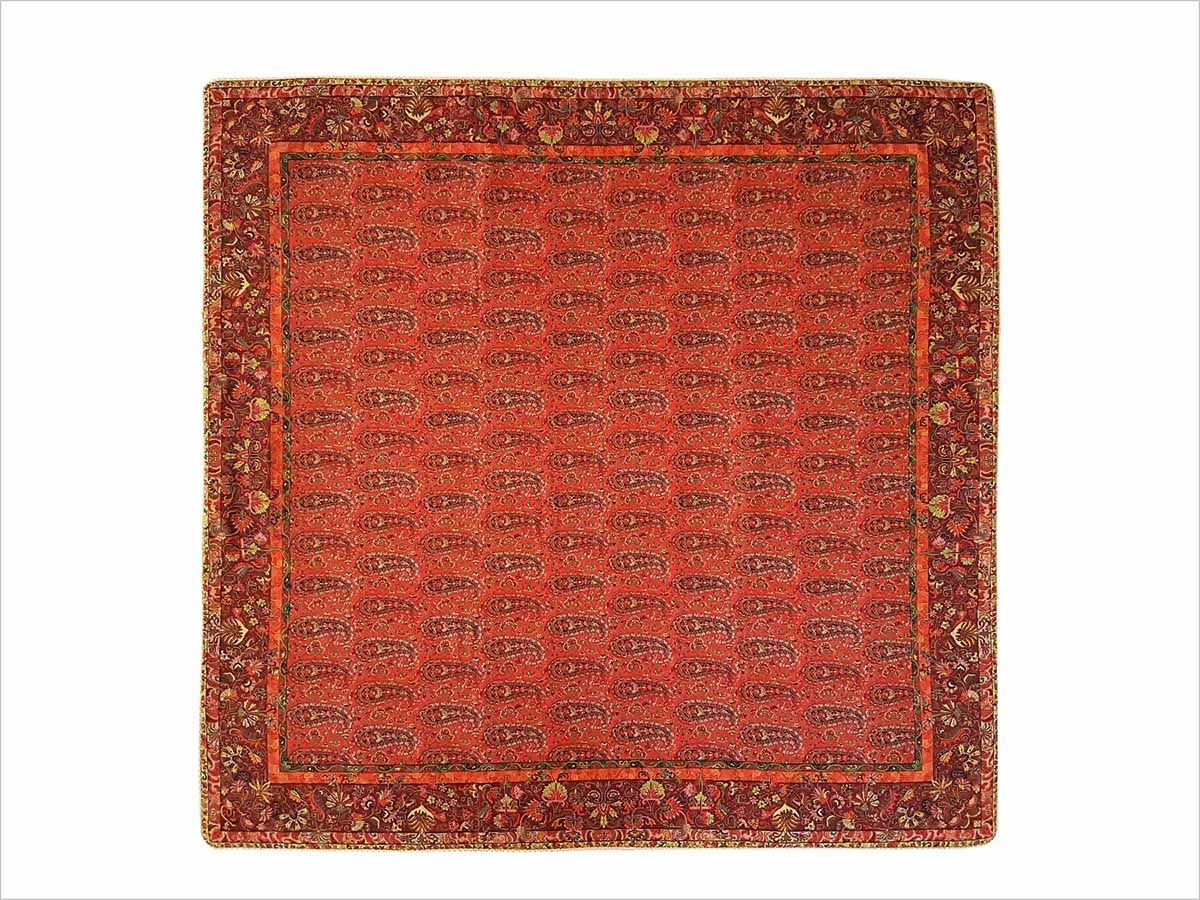
Representative photographs only. Marketplace examples rely on seller descriptions; CraftPersia has not independently authenticated their maker, origin, or rights status. Follow each source link for the listing context.
Used in these crafts
A patterned Iranian brocade woven with supplementary wefts, historically in silk and wool, associated above all with Yazd and Kerman.
A figured silk weaving technique in which supplementary wefts, often including gold- or silver-wrapped thread, create pictorial or floral designs on a silk ground.
A silk weaving technique producing a cut or voided pile on a foundation weave, used in Iran for garments, cushion covers and furnishing panels, with figured Safavid velvets among the most studied survivals.