
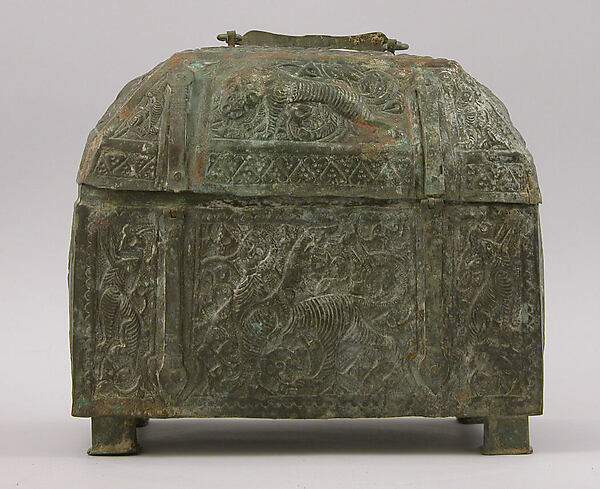
Casket · late 12th–early 13th century · Brass; hammered in repoussé and chased · Iran
The Metropolitan Museum of Art, 2001.762 · CC0 · Museum record
One catalogued Iranian example whose museum title or technique line names this process; not a defining specimen.
Process, step by step
- Fix sheet on pitch
- Push out forms from the back
- Chase details from the front
Variations
Often combined with engraving on brass and copper.
Conservation
Avoid aggressive polishing that wears high points.
Hammering from behind
Repoussé pushes sheet metal outward from the back with punches and hammers, often over pitch, then chasing refines it from the front. It is central to Isfahan silverwork and copper.
Cast imitations
Cast or stamped pieces have even thickness and a crisp, mechanical relief; repoussé shows hammer marks inside.
Care
Thin raised areas dent easily; never press on high relief.
Metropolitan styles and metallurgical heritage
Repoussé metalworking in Iran embodies an unbroken legacy linking pre-Islamic metallurgy with urban craft traditions of the Islamic era. Isfahan emerged as the undisputed center of high-relief chasing and embossing, although Tabriz, Shiraz, and Zanjan developed notable regional variants. In the traditional Isfahan workshop, sheet silver or copper was fixed face-down upon warm pitch mixed with plaster and oil, allowing the metalsmith to drive the relief outward using rounded iron punches without piercing the flexible plate. The object was then reversed, cleaned of pitch, and re-bedded face-up so that chasing tools could delineate surface textures, arabesques, and calligraphic bands. During the Qajar period, narrative scenes illustrating historical epics and courtly leisure gained immense popularity alongside classical floral foliage. This craft relied upon an intimate empirical knowledge of metal elasticity, requiring frequent annealing cycles over charcoal braziers to prevent the work-hardened sheet from cracking during violent upward deformation.
Detecting mechanical fabrications and structural care
Distinguishing genuine repoussé from modern hydraulic pressings or electrotypes requires a thorough examination of the object's interior walls. Authentic hand-raised metalwork reveals uneven hammer facets, tool marks, and gradual thickness variations where the metal was stretched outward by hand punches. Mechanical presswork, by contrast, displays consistent wall thickness, unnaturally crisp back contours, and an absence of manual working marks. Furthermore, cast reproductions are significantly heavier and reveal characteristic micro-porosity under magnification. Because thin repoussé forms are hollow and structurally vulnerable, collectors should avoid grasping objects by their highest relief elements or applying thumb pressure, which can cause irreparable inward crushing. Never polish embossed surfaces with commercial abrasive creams; these abrade the delicate surface chased detail and strip historical patinas from deep recesses. Dust solely with soft goat-hair brushes, and store in stable relative humidity to prevent progressive corrosion of underlying copper alloys.
Practical questions
- How to confirm handwork? Hammer marks inside.
- Is chasing the same? Its front-side partner.
| Observation | Useful description | Not established |
|---|---|---|
| Hammer marks inside | Repoussé | Isfahan |
| Even thickness | Possible stamping | Handwork |
| Dents | Handling damage | Age |
References and further reading
- [1] H. E. Wulff, The Traditional Crafts of Persia, MIT Press, 1966; A. U. Pope & P. Ackerman, A Survey of Persian Art, 1938–39.Historical context; not evidence for an individual object.
- [2] Encyclopaedia Iranica ↗Peer-reviewed entries on crafts, motifs and terms.
These sources provide context, not authentication or provenance for an individual object. Editorial interpretations remain under review.
Used in these crafts
The Iranian tradition of decorating copper, brass and silver vessels with small chisels struck by hammer, working the metal into line, ground and relief.
Decoration of brass, bronze or steel vessels by setting silver, copper or gold into cut recesses, producing figurative scenes, inscriptions and ornament in contrasting colour.