
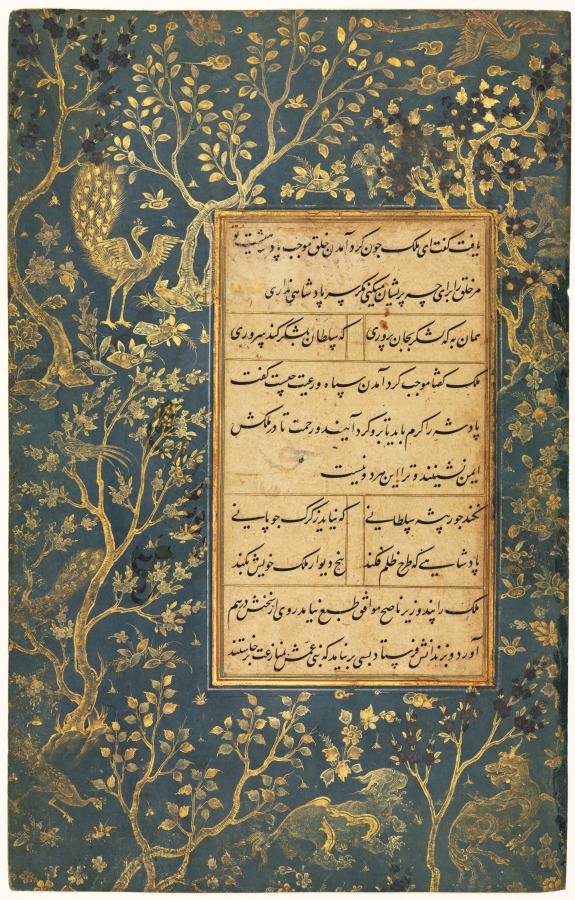
Illuminated Folio from a Gulistan (Rose Garden) of Sa'di (c. 1213–1291) · c. 1475–1500; border: c. 1550 · Gum tempera, ink, gold, and silver on paper · Iran, Tabriz, Safavid period (1501-1722)
Cleveland Museum of Art, 2006.148 · CC0 · Museum record
One catalogued Iranian example whose museum title or technique line names this process; not a defining specimen.
Process, step by step
- Size and burnish the paper.
- Rule the frame and lay out the ornamental scheme.
- Apply gold, then burnish it.
- Paint pigment grounds around the gold.
- Draw the fine outlining last.
Variations
Timurid Herat schemes are denser and more regular than later Qajar work.
Conservation
Paper and gold both suffer from light and humidity swings; display in low, filtered light only.
Gold and colour on the page
Tazhib is the illumination of manuscripts and calligraphy with gold and pigments: headpieces (sarlowh), margins, rosettes and panels. The illuminator draws the design, often with a pounced stencil for symmetry, lays gold and colour grounds, then outlines (tahrir) every form with fine lines.
References: [1]
Materials
Traditional materials include shell gold and gold leaf, lapis ultramarine, malachite, vermilion and other pigments bound with gum arabic, on sized and burnished paper. Many contemporary illuminators use modern pigments and gouache; the archive records what the artist states rather than assuming.
References: [1]
Styles and attribution
Timurid Herat, Safavid Tabriz and Qazvin and Qajar workshops developed distinct palettes and motif density, but contemporary masters work in all historical styles. Attribution of an old leaf to a school needs codicological study, not style alone.
References: [1]
Care
Illumination is light- and abrasion-sensitive. Frame behind UV-filtering glazing with a spacer so the surface never touches the glass, keep humidity steady and never retouch or clean the surface.
References: [1]
Practical questions
- Is all gold in tazhib real? Not always; ask the artist.
- Can style date a leaf? Not alone; contemporary masters use historic styles.
| Observation | Useful description | Not established |
|---|---|---|
| Dense Timurid-style palette | Historic style | Timurid date |
| Fine dark outlines | Tahrir stage | Hand of a master |
| Bright blue ground | Blue pigment | Natural lapis |
References and further reading
- [1] A. U. Pope & P. Ackerman (eds.), A Survey of Persian Art, Oxford University Press, 1938–39.Broad historical context; individual claims need current scholarship.
- [2] Encyclopaedia Iranica ↗Peer-reviewed entries on motifs, crafts and terms.
These sources provide context, not authentication or provenance for an individual object. Editorial interpretations remain under review.
Used in these crafts
The Iranian tradition of small-scale painting made for manuscripts and albums, built from fine line, flat luminous colour and layered spatial convention rather than single-point perspective.
A hanging cursive script developed in Iran for Persian poetry, distinguished by its sloping baseline, sharply contrasted thick and thin strokes, and sweeping final letters.