
Process, step by step
- Wrap yarn over both warps
- Pull ends up between them
- Cut and beat
Variations
Tabriz weavers often use a hook knife for speed.
Conservation
Strong structure; avoid wet cleaning without drying fully.
Structure
The symmetric (Turkish or ghiordes) knot passes over two adjacent warps and brings both ends up between them, giving a firm, slightly bulkier knot.
In Iran
Widely used in Iranian Azerbaijan (Tabriz, Heriz), Hamadan, Kurdistan (including Bijar and Senneh), Qashqai and Afshar weaving. Calling it 'Turkish' refers to the knot, not the rug's country.
Durability
Dense symmetric knotting with heavy wefting, as in Bijar, produces famously stiff, hard-wearing rugs; such rugs should not be folded.
Tribal Hearth and Northwestern Looms
The symmetric knot is deeply rooted in the weaving traditions of north-western Iran, the Zagros mountains, and various nomadic confederacies. Historically prevalent throughout Iranian Azerbaijan, Hamadan, and Kurdistan, this structure was equally championed by tribal weavers such as the Qashqai and Afshar. Its balanced attachment across two warps lends itself to both bold, geometric compositions and the rugged resilience demanded of nomadic furnishings. During the carpet export boom of the late nineteenth and early twentieth centuries, urban centres like Tabriz adapted the symmetric knot to intricate workshop cartoons, while rural workshops in Heriz and Bijar retained robust, rectilinear expressions. In scholarship, this knot is frequently linked to ancient pastoralist migrations across western and central Asia. Rather than denoting an exclusive ethnic boundary, its wide presence reflects centuries of inter-regional exchange, shared loom technologies, and local wool characteristics that favoured an unyielding, balanced anchor capable of withstanding severe mountain climates and sustained utilitarian wear.
Assessing Structure and Conservation
When inspecting a textile featuring symmetric knotting, part the pile along a horizontal weft line to view the collar encircling two warps symmetrically. Note the tension and thickness of the wefts: heavy, damp-beaten wefting, characteristic of historical Bijar carpets, creates an immovable structure where warps sit closely aligned on two levels. A heavy handle or rigid body often suggests this structure, but it must not be assumed that stiffness alone establishes provenance, as modern workshop copies exist. Carefully check for structural fatigue or dry rot; heavily wefted symmetric rugs can snap along warp ridges if flexed incorrectly. When acquiring or displaying such pieces, never fold them across the warps or place heavy furniture directly upon antique foundations. Clean solely through gentle vacuuming without rotating brush rollers, which can pull at coarse pile fibres. Store flat or loosely rolled with acid-free tissue between layers in stable environmental conditions.
Practical questions
- Is a Turkish knot rug from Turkey? Not necessarily.
- Can Bijar rugs be folded? Avoid it; roll them.
| Observation | Useful description | Not established |
|---|---|---|
| Two-warp wrap | Symmetric knot | Turkish origin |
| Very stiff handle | Dense wefting | Bijar origin |
| Mixed knot types | Unusual structure | Repair |
References and further reading
- [1] H. E. Wulff, The Traditional Crafts of Persia, MIT Press, 1966; A. U. Pope & P. Ackerman, A Survey of Persian Art, 1938–39.Historical context; not evidence for an individual object.
- [2] Encyclopaedia Iranica ↗Peer-reviewed entries on crafts, motifs and terms.
These sources provide context, not authentication or provenance for an individual object. Editorial interpretations remain under review.
Documented material and craft examples
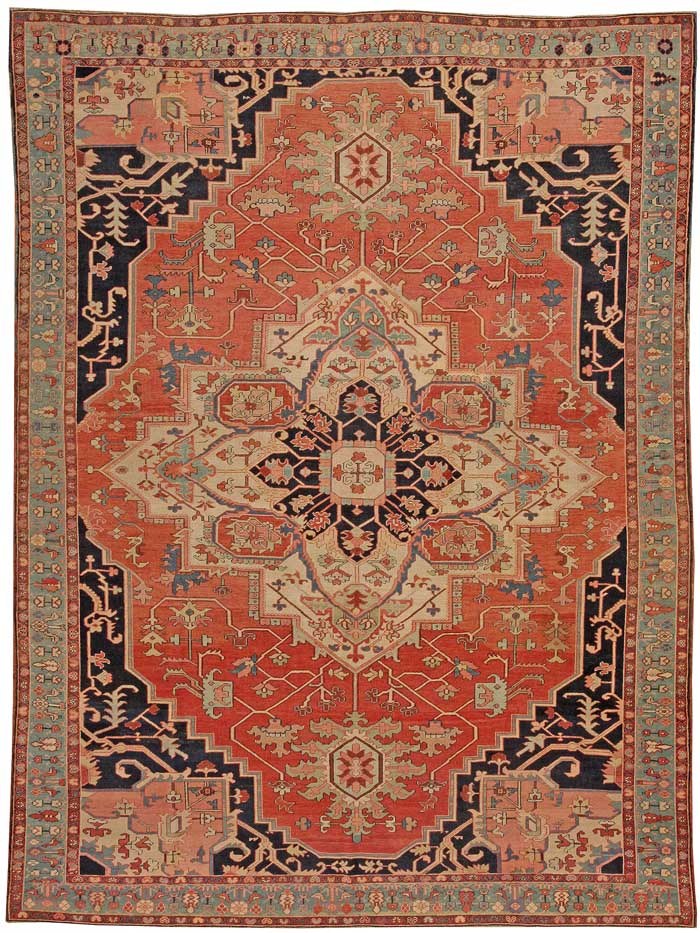
Representative photographs only. Marketplace examples rely on seller descriptions; CraftPersia has not independently authenticated their maker, origin, or rights status. Follow each source link for the listing context.
Used in these crafts
The workshop carpet tradition of Tabriz in East Azerbaijan, characterised by drawn cartoons, a distinctive hook-knife weaving method and a wide range of fineness grades.
Durable, geometric village carpets from the Heris area of East Azerbaijan, with large angular medallions.
A hand-knotted pile textile woven across Iran in city workshops, village looms and pastoral camps, distinguished by regional structure, palette and design vocabulary.