
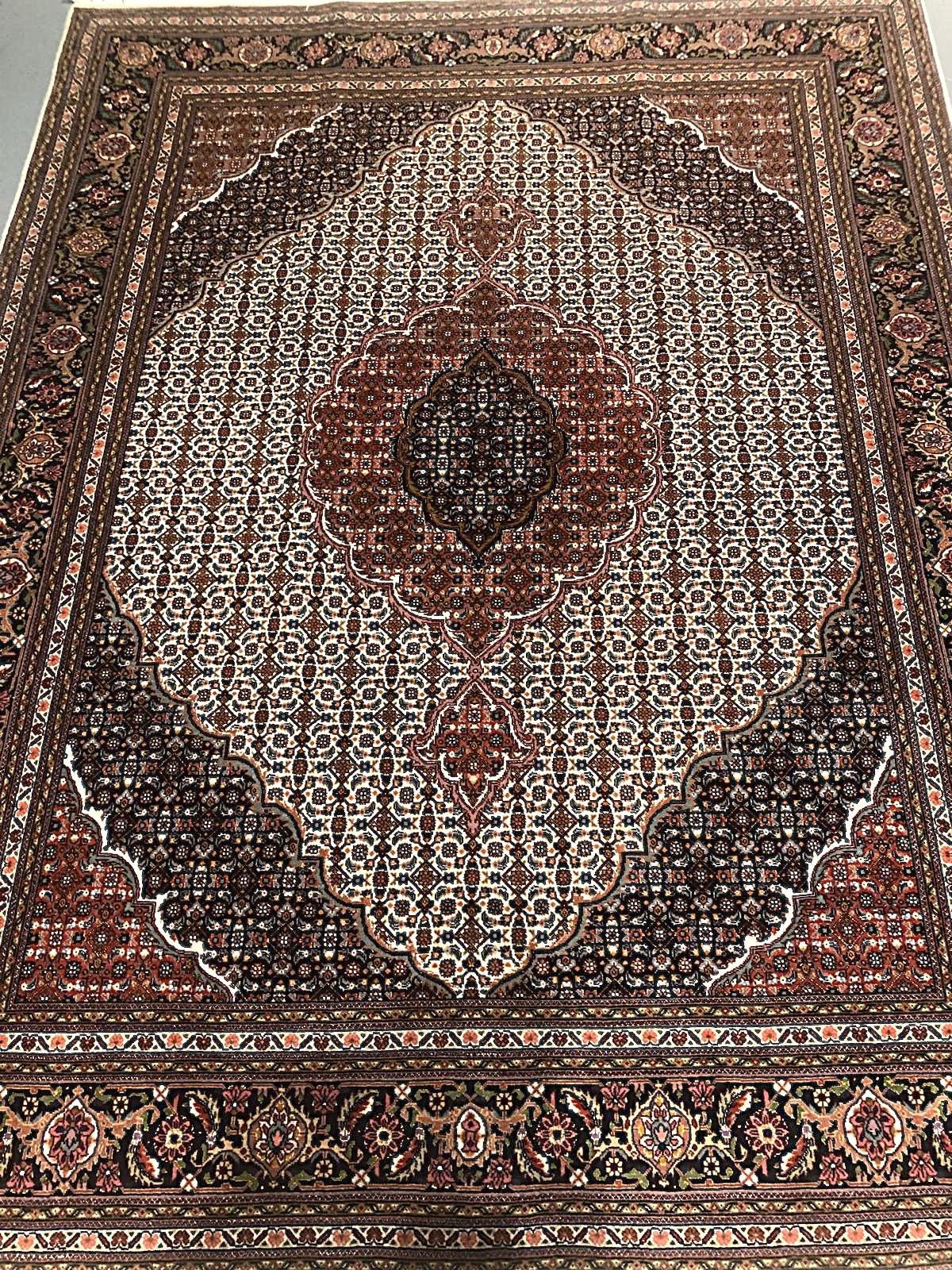
Representative image from an independent shop or archive, not a photograph of the listed object. The seller, price, date, materials, provenance and documentation described on this page have not been verified against the pictured item. Colour varies between screens.
Tabriz Medallion Carpet
Hand-knotted wool on a cotton foundation with a classical Shah Abbasi medallion, corner spandrels and an all-over vine field. Woven from a cartoon drawn in the workshop, at approximately 50 raj.
- Craft
- Tabriz carpet
- Region
- Tabriz
- Technique
- Knotted pile weaving
- Materials
- Wool pile, cotton foundation, silk highlights
- Dimensions
- 200 × 300 cm
- Weight
- 24 kg
- Date
- 2023
Condition
New, unused
Provenance
Woven in the seller's workshop; loom records available on request.
Documentation
Workshop certificate naming weaver, cartoon and raj count.
This is illustrative sample documentation, not evidence for the pictured object. No seller or object claim has been independently verified. The archive does not certify authenticity.
Care
Follow the preservation guidance in the Tabriz carpet entry: light, humidity and physical support matter more than cleaning.
About Tabriz carpet
Definition
Tabriz carpets are woven from a squared cartoon prepared by a designer, which allows complex curvilinear and pictorial compositions to be executed consistently by several weavers on one loom.
Weavers in Tabriz typically use a hooked knife that cuts the pile as each knot is tied, a working method not general elsewhere in Iran.
History
Tabriz was an Ilkhanid capital and a repeated centre of design innovation. Its nineteenth-century workshops organised the export trade on a commercial footing, and the city has since remained the main source of designed, workshop-woven Iranian carpets.
Structure
Foundations are usually cotton, with silk used for highlights or for the whole pile in the finest work. Grades are often quoted in raj, a count of knots across a fixed width; higher raj indicates finer weave but again does not by itself indicate quality.
- Cotton warp and weft in most grades
- Asymmetric knotting, double-wefted
- Raj counts commonly from 30 to 70 in current production
- Silk highlights in medallion and corner work
General background on the craft, not a statement about any individual object; dates and attributions summarise common positions in the literature and remain under review. Read the full Tabriz carpet entry.
Checklist before buying Tabriz carpet
Inspect
- Turn the piece over: hand-knotted or hand-stitched work shows slight irregularities on the back.
- Look at fringes and edges — on knotted carpets the fringe is usually the warp itself, not a sewn-on strip.
- Check colour consistency; natural dyes often show gentle banding (abrash), which is not a defect.
- Ask whether the colours have been tested for bleeding; never wet-test an old or valuable piece yourself.
Red flags
- Perfectly uniform backs, glued backing cloth or a latex layer (typical of machine or tufted rugs).
- Listings that say 'Persian style', 'Persian design' or 'inspired by' without naming a place of making.
- Printed patterns sold as hand-embroidered or hand-block-printed.
Ask the seller
- Where and by whom was this made, and roughly when?
- What are the fibre and dye (wool, silk, cotton; natural or synthetic)?
- Can you show a close-up photo of the back and the edges?