
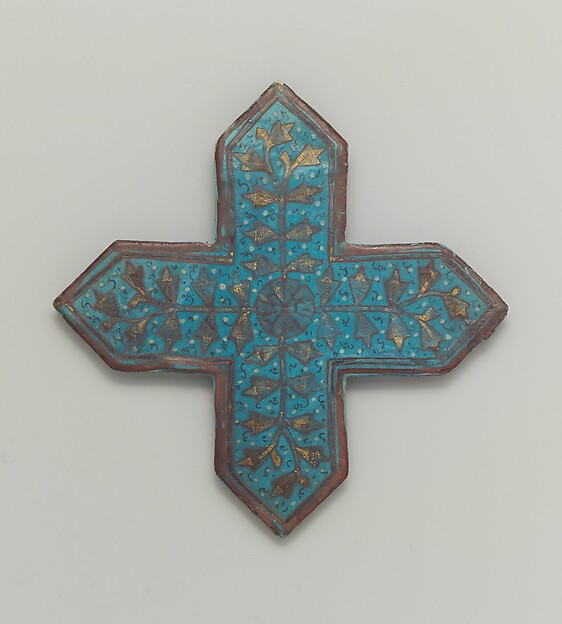
Cross-Shaped Tile · second half 13th–early 14th century · Stonepaste; overglaze painted and leaf gilded (lajvardina) · Iran
The Metropolitan Museum of Art, 1975.30 · CC0 · Museum record
One catalogued Iranian example whose museum medium line names this material; not a defining specimen.
Origin
Beaten from gold by specialist suppliers; purity varies.
Properties
- Very thin and fragile
- Does not tarnish when pure
- Needs an adhesive ground
Preparation
Lay leaf over a size or ground, then burnish or tool.
Care & preservation
Do not rub gilded surfaces; loose flakes need a conservator.
General guidance only. For valuable or fragile pieces, consult a qualified conservator before cleaning or treatment.
Beaten metal, very thin
Gold leaf is gold beaten into sheets thin enough to be translucent. In Iranian manuscript illumination (tazhib), lacquer painting and architectural decoration it was applied over an adhesive size or burnished. Shell gold (talā-ye hall) is different: powdered gold mixed with binder and applied with a brush, often for fine lines and highlights. Distinguish leaf from painted gold before describing technique.
Gold, brass powder and imitation leaf
Brass ('Dutch metal') leaf and bronze powders imitate gold and tarnish to brown or green over time; genuine gold does not tarnish but can wear through to the underlying ground. In older objects, restorers may have added later imitation gilding. Non-destructive X-ray fluorescence analysis is the reliable way to identify the metal; colour alone is not.
Gold in tazhib
In illumination, gold grounds, outlines and fine hatching interact with lapis, other pigments and paper sizing. Burnished gold reflects strongly at certain angles; matte areas may be unburnished or worn. Contemporary illuminators in Iran continue to use genuine gold, but some commercial work uses gold-coloured paints. Ask the artist or seller what was used and keep that statement as a claim.
Care of gilded surfaces
Gilding on paper and lacquer is extremely fragile and can lift with flexing, humidity and touch. Never rub, dust with cloth or use any cleaner. Display under low light, store flat, and use a conservator for flaking. On frames and woodwork, avoid moisture; water-gilding in particular dissolves on wetting.
Practical questions
- Is shell gold the same as gold leaf? No; it is powdered gold in binder.
- Does tarnish mean fake gold? Tarnish suggests a base metal; analysis confirms.
| Observation | Useful description | Not established |
|---|---|---|
| Bright golden ground | Gilding present | Genuine gold |
| Brown or green spots | Possible base-metal leaf | Later restoration date |
| Fine gold lines | Possible shell gold | The illuminator |
References and further reading
- [1] H. E. Wulff, The Traditional Crafts of Persia, MIT Press, 1966.Historical process context; not evidence for an individual object.
- [2] Canadian Conservation Institute — Caring for cultural objects ↗General preventive care; treatment requires assessment of the actual object.
These sources provide context, not authentication or provenance for an individual object. Editorial interpretations remain under review.
Used in these crafts
The decoration of manuscript pages and album leaves with gold and coloured pigments in geometric and floral designs framing text or painting.
A decorative technique in which papier-mâché or wooden objects, such as boxes, mirror cases and pen boxes, are painted with fine miniature-style scenes or floral ornament and then sealed under multiple coats of clear lacquer varnish.
The hand binding of manuscripts and books with leather or lacquer covers, often with a flap (lisan) and stamped, cut or gilded decoration.