
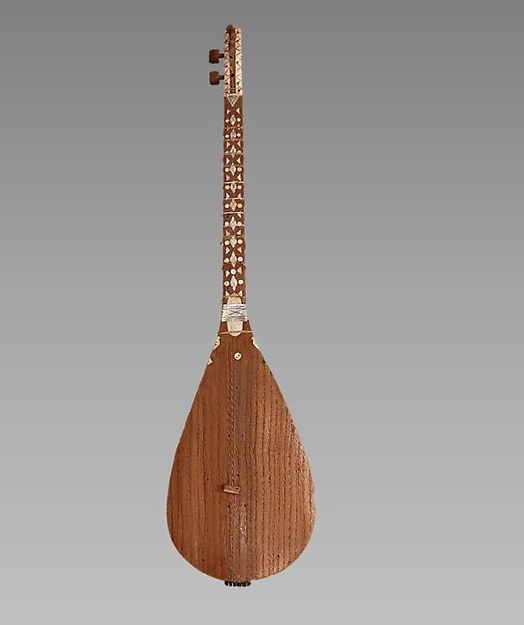
Tanbūr · late 19th century · Mulberry, walnut, mother-of-pearl, camel bone, wire · Iran (Persia)
The Metropolitan Museum of Art, 89.4.326 · CC0 · Museum record
One catalogued Iranian example whose museum medium line names this material; not a defining specimen.
Origin
Workshop timber may be locally supplied or traded; grain alone cannot identify a growing region.
Properties
- Grain varies with cut
- Colour affected by finish
- Can hold fine carved detail
- Moves with moisture changes
Preparation
Air-dried for long periods, then sawn and thicknessed before veneering or inlay.
Care & preservation
Maintain steady humidity; sudden change lifts inlay and opens joints.
General guidance only. For valuable or fragile pieces, consult a qualified conservator before cleaning or treatment.
Timber is not a workshop signature
Walnut can form a carved surface, an inlay element or the structural body beneath decoration. These uses must be recorded separately: a box with walnut veneer need not have a walnut carcase. Colour varies with growth, cut, finish and ageing. A brown surface cannot identify walnut reliably, much less establish a tree's region or an Iranian maker. Ask whether the material description comes from a maker, a collection catalogue or an analytical examination.
Grain direction, seasoning and joints
Seasoning reduces moisture before work but does not stop later movement. Wood responds differently along and across its grain. A thin decorative layer bonded across a thicker support can develop stress when their movement differs. Inspect lid fit, mitred corners, warping and opened seams without forcing the object closed. Tight geometry is a useful workmanship observation; it is not proof of a historical date or hand manufacture.
Carving, micro-mosaic and surface finish
Relief carving removes surrounding wood to leave forms standing proud. Khatam combines small elements into patterned sheets attached to a support; the visible geometry does not reveal every underlying timber. Paint, varnish and later refinishing can hide grain or soften tool marks. Request photographs of an undecorated edge and the underside as well as the front. Do not scratch a finish, lift an inlay strip or remove hardware to identify a wood species.
Storage and collecting evidence
Keep wooden objects away from radiators, direct sunlight and persistently damp walls. Support the whole base rather than a projecting handle or loose lid. Loose fragments, new insect debris and lifting decoration warrant isolation or professional advice, not household oil or insecticide. For a purchase, record dimensions, maker attribution, repairs and replacements. A claimed Shiraz or Isfahan origin requires evidence independent of a familiar decorative pattern.
Practical questions
- Can a dark finish prove walnut? No; stains and other timbers can resemble it.
- Should a tight lid be forced? No; swelling or distortion needs assessment.
| Observation | Useful description | Not established |
|---|---|---|
| Exposed grain | Construction and cut | Species or geographical origin |
| Opened joint | Movement or damage | Exact age |
| Inlaid face | Decorative assembly | Every hidden timber |
References and further reading
- [1] H. E. Wulff, The Traditional Crafts of Persia, MIT Press, 1966.Historical process context; not evidence for the origin of an individual object.
- [2] Canadian Conservation Institute — Caring for cultural objects ↗General preventive care; treatment requires assessment of the actual object.
These sources provide context, not authentication or provenance for an individual object. Editorial interpretations remain under review.
Used in these crafts
A Persian inlay art in which fine rods of wood, bone and metal are bundled into star units, sliced into thin sheets and applied to a wooden surface to form dense geometric tessellation.
A joinery technique for building geometric lattice screens and panels from small, precisely cut wooden pieces assembled without glue or nails, using interlocking notched joints to form windows, doors and room dividers with openwork star and polygon patterns.
A relief wood-carving technique in which solid panels, furniture and architectural elements are carved directly with chisels to produce raised or recessed floral, arabesque and geometric ornament, distinct from inlay techniques that build a surface from separate pieces.
The workshop making of Iranian instruments such as the tar, setar, kamancheh, santur and oud, combining woodwork, skin membranes and inlaid decoration.