
Origin
By-product of pastoral herding.
Properties
- Dense and pale
- Takes a high polish
- Brittle in thin sections
- Yellows slowly with age
Preparation
Degreased, bleached, then sawn and filed into triangular rods.
Care & preservation
Avoid solvents and heat, both of which crack thin bone elements.
General guidance only. For valuable or fragile pieces, consult a qualified conservator before cleaning or treatment.
White elements in khatam
Khatam (marquetry micro-mosaic) traditionally combines woods, brass or other metal wire and a light-coloured element historically made from bone, often described as camel bone, and in some historic work ivory. Bundles of thin rods are glued into triangular or polygonal bars, sliced and laid onto a box, frame or panel. In contemporary production the white element may also be plastic or resin; reputable makers and sellers should state which is used.
Bone, ivory and plastic
Bone shows tiny dark pores and canals under magnification; elephant ivory shows characteristic cross-hatched Schreger lines on cut sections; plastic is usually uniform. In khatam the pieces are so small that identification without magnification is unreliable. Trade in ivory is restricted in many countries, so a claim of ivory can create legal problems for export and sale. Ask for clear documentation instead of hot-needle tests, which damage the object.
Preparation in the workshop
Workshop accounts describe boiling and degreasing bone, sawing it into strips and planing it to thin rods matched to wooden and metal elements. Uneven preparation shows as gaps or variable triangle sizes in the finished pattern. Fine, regular geometry indicates skill, but tolerances alone cannot date an object or distinguish a master from a well-run modern workshop.
Care and humidity
Bone, wood and metal expand and contract differently with humidity and temperature, so khatam is vulnerable to lifting, cracking and lost elements. Keep objects away from radiators and direct sun, avoid wet cleaning and polish, and dust gently with a soft brush. Collect any fallen fragments and give them to a conservator rather than regluing with household adhesives.
Practical questions
- Is the white in modern khatam always bone? No; plastic or resin may be used.
- Can I test it with a hot needle? Avoid it; it damages the object.
| Observation | Useful description | Not established |
|---|---|---|
| White triangles | Light-coloured element | Bone rather than plastic |
| Very regular geometry | Skilled assembly | Age or a named master |
| Lifted pieces | Humidity stress | Poor original work |
References and further reading
- [1] H. E. Wulff, The Traditional Crafts of Persia, MIT Press, 1966.Historical process context; not evidence for an individual object.
- [2] Canadian Conservation Institute — Caring for cultural objects ↗General preventive care; treatment requires assessment of the actual object.
These sources provide context, not authentication or provenance for an individual object. Editorial interpretations remain under review.
Documented material and craft examples
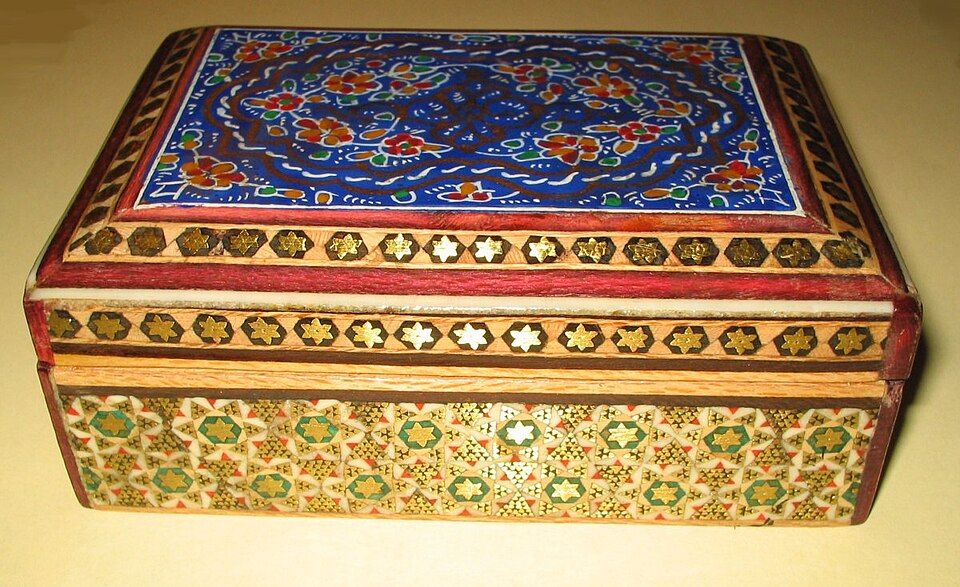
Representative photographs only. Marketplace examples rely on seller descriptions; CraftPersia has not independently authenticated their maker, origin, or rights status. Follow each source link for the listing context.
Used in these crafts
A Persian inlay art in which fine rods of wood, bone and metal are bundled into star units, sliced into thin sheets and applied to a wooden surface to form dense geometric tessellation.