
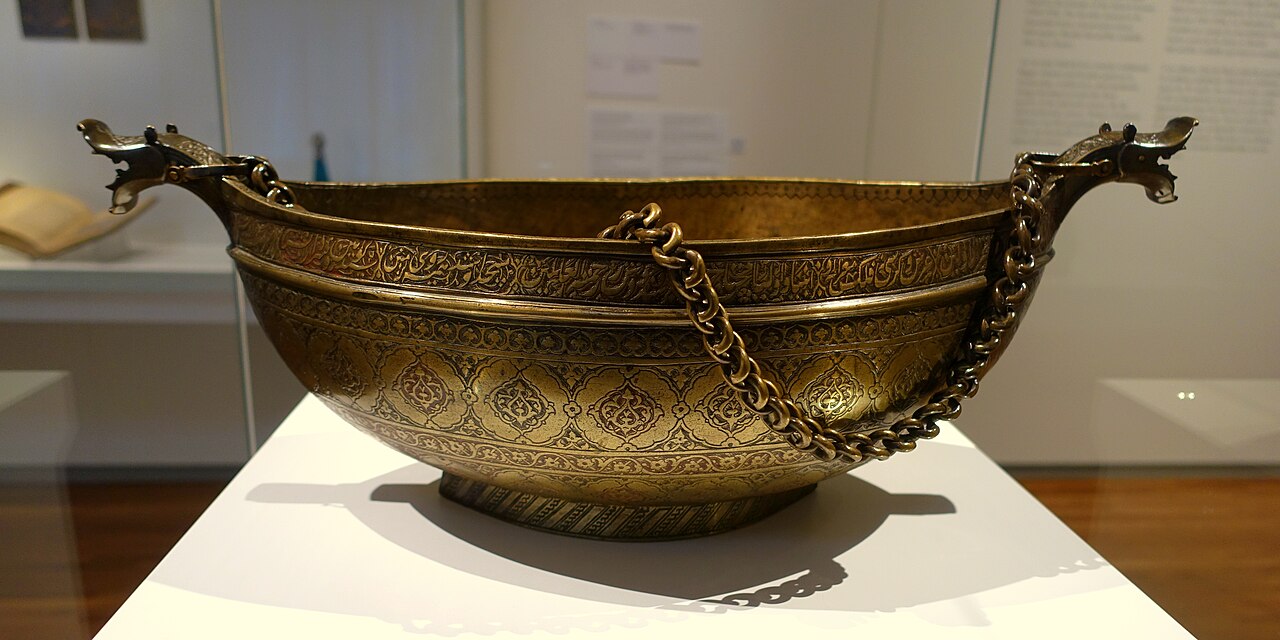
Kashkul (alms vessel) with dragon-headed terminals · 1575-1600 · Engraved brass; Aga Khan Museum · Iran
Daderot · Public domain · Wikimedia Commons record
One catalogued Iranian example whose museum medium line names this material; not a defining specimen.
Origin
Worked from sheet stock in Isfahan, Tabriz and Zanjan workshops.
Properties
- Takes fine engraving
- Bright warm tone
- Work-hardens under hammering
- Polishes to high shine
Preparation
Bodies may be raised, spun, cast or assembled; engraving support and annealing depend on the alloy and method.
Care & preservation
Handle with clean gloves; avoid abrasive polishes that soften engraved detail.
General guidance only. For valuable or fragile pieces, consult a qualified conservator before cleaning or treatment.
Alloy, colour and coatings
Brass is a family of copper-zinc alloys, not one fixed recipe. Composition affects working behaviour and appearance; gilding, lacquer, patina and polishing also change the visible colour. An engraved yellow vessel might be brass, coated copper or another material. A photograph can describe its surface but cannot determine bulk composition. Keep seller material claims separate from analytical results and do not use colour as proof of Iranian origin.
Forming before engraving
Vessels can be raised from sheet, spun, cast or assembled from separate components. Hammering can work-harden suitable alloys; annealing restores working capacity in appropriate workshop processes. Pitch support may be used for engraving, but it is not a universal method for every form. Look at seams, rim construction, handles and the underside to describe how the object was assembled. A hand-engraved surface may coexist with a mechanically formed body.
Reading detail without claiming authenticity
Compare relief, line endings, repeated motifs and surface texture in close photographs. These observations help discuss execution but cannot conclusively separate hand cutting, stamping and casting. Repairs may include soldered patches or replacement handles, and a polished surface can obscure them. Collect front, reverse and detail images of the actual object. An inscription should be transcribed and interpreted independently; a famous city name is not a certificate of manufacture.
Tarnish, corrosion and safe handling
Tarnish is not automatically damage requiring removal. Abrasive polishing wears fine engraving and may remove coatings or evidence of use. Powdery deposits, flaking or recurring corrosion need material-specific assessment. Do not soak a mixed-material object or test acid-based household cleaners. Decorative metalware should not be assumed food-safe: lining, solder, coatings and past use all matter, and appearance alone cannot establish suitability for cooking or serving.
Practical questions
- Does yellow colour prove brass? No; coatings can produce a similar appearance.
- Does engraving prove a fully handmade vessel? No; surface work and body forming are separate.
| Observation | Useful description | Not established |
|---|---|---|
| Yellow surface | Visible appearance | Bulk alloy composition |
| Seam or solder | Assembly or repair | A single production method |
| Darkened recesses | Surface condition | Historical age |
References and further reading
- [1] H. E. Wulff, The Traditional Crafts of Persia, MIT Press, 1966.Historical process context; not evidence for the origin of an individual object.
- [2] Canadian Conservation Institute — Caring for cultural objects ↗General preventive care; treatment requires assessment of the actual object.
These sources provide context, not authentication or provenance for an individual object. Editorial interpretations remain under review.
Documented material and craft examples
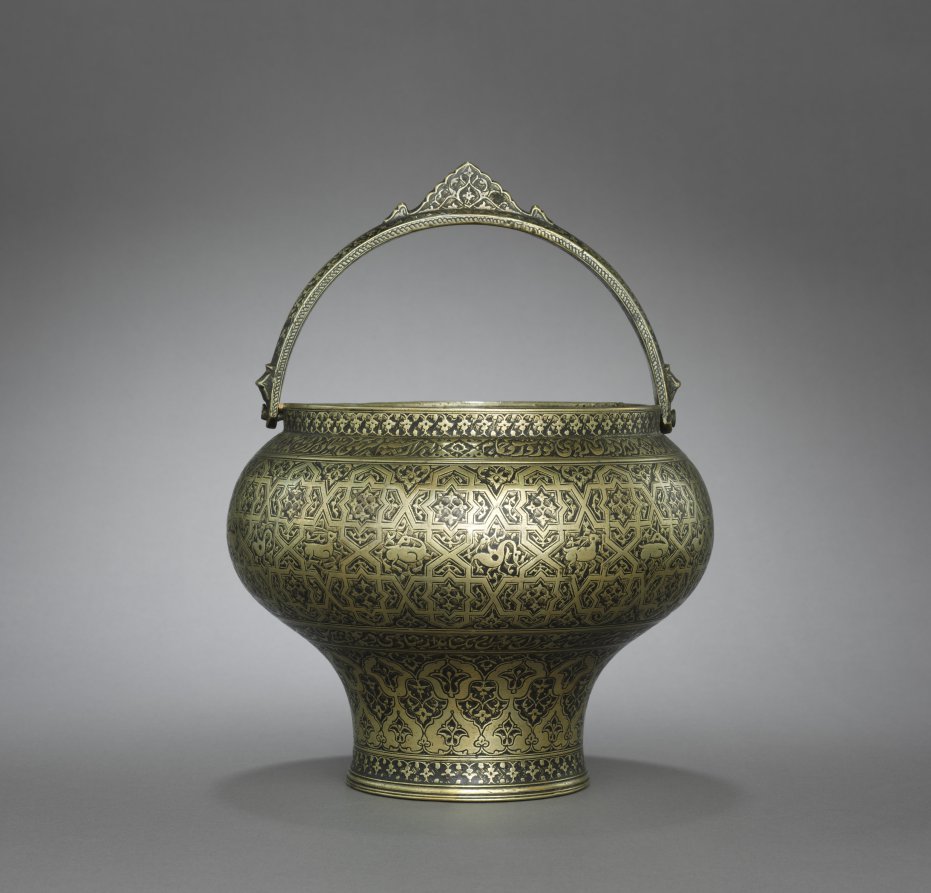
Representative photographs only. Marketplace examples rely on seller descriptions; CraftPersia has not independently authenticated their maker, origin, or rights status. Follow each source link for the listing context.
Used in these crafts
The Iranian tradition of decorating copper, brass and silver vessels with small chisels struck by hammer, working the metal into line, ground and relief.
A Persian inlay art in which fine rods of wood, bone and metal are bundled into star units, sliced into thin sheets and applied to a wooden surface to form dense geometric tessellation.
Decoration of brass, bronze or steel vessels by setting silver, copper or gold into cut recesses, producing figurative scenes, inscriptions and ornament in contrasting colour.