
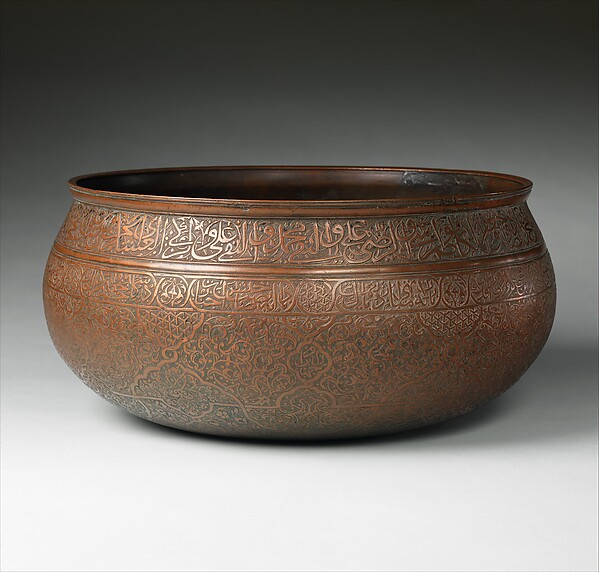
Inscribed Bowl · dated 942 AH/1535–36 CE · Copper; tinned, engraved, and inlaid with black compound · Iran
The Metropolitan Museum of Art, 91.1.615 · CC0 · Museum record
One catalogued Iranian example whose museum medium line names this material; not a defining specimen.
Origin
Supplied through mining, trade and recycling; metal source is not the same as a vessel's place of manufacture.
Properties
- Very malleable
- Excellent heat conduction
- Develops surface corrosion
- Some cooking vessels have tin linings
Preparation
Sheet may be raised and planished with repeated annealing; lining and finishing vary by intended use.
Care & preservation
Stabilise patina rather than stripping it; avoid damp storage.
General guidance only. For valuable or fragile pieces, consult a qualified conservator before cleaning or treatment.
Metal supply versus place of making
Copper is highly workable and conducts heat well, making it useful for vessels and some enamel supports. Workshop metal may come from traded or recycled stock. A mining region, the place a vessel was made and the place it was sold are different claims. A reddish exposed area does not prove pure copper: copper-rich alloys and coatings can resemble it. Retain the source's terminology and disclose where composition has not been established.
Raising, seams and applied decoration
Repeated forming and annealing can turn sheet into a vessel. Planishing refines the surface; separately made handles, feet and spouts introduce joints. Casting and spinning also occur in metal production, so hammer marks are not a complete account of manufacture. Engraving or enamel belongs to another stage of work. Compare the underside and interior with the decorated exterior, keeping later repairs and replacement parts visible in the record.
Tin lining and food-use questions
Some cooking vessels have tin linings; others are decorative or have different interiors. Worn lining, unknown solder and unidentified coatings require specialist assessment before food use. Do not recommend a historic vessel for acidic food on the basis of a catalogue photograph. Re-tinning is a treatment decision that changes a surface, not a routine preservation step for every collected object. For contemporary cookware, request the maker's material and food-use guidance.
Patina and collecting documentation
A stable surface and active corrosion are not interchangeable. Green colour alone does not date an object or tell you which corrosion compounds are present. Avoid salt-and-acid cleaning recipes, rough polishing and damp packing. Record dents, pinholes, solder repairs, enamel losses and coatings before purchase. Hold a vessel under its base rather than by an uncertain handle. Fragile enamel or attached organic materials make immersion especially inappropriate.
Practical questions
- Does a green surface prove antiquity? No; corrosion can develop under many conditions.
- Is every copper vessel safe for cooking? No; lining and construction need assessment.
| Observation | Useful description | Not established |
|---|---|---|
| Tin-coloured interior | Possible lining | Food safety or metal identity |
| Hammered surface | A forming or finishing stage | Entirely handmade production |
| Green deposits | Need for condition assessment | Date or provenance |
References and further reading
- [1] H. E. Wulff, The Traditional Crafts of Persia, MIT Press, 1966.Historical process context; not evidence for the origin of an individual object.
- [2] Canadian Conservation Institute — Caring for cultural objects ↗General preventive care; treatment requires assessment of the actual object.
These sources provide context, not authentication or provenance for an individual object. Editorial interpretations remain under review.
Used in these crafts
The Iranian tradition of decorating copper, brass and silver vessels with small chisels struck by hammer, working the metal into line, ground and relief.
A decorative technique in which powdered coloured glass is fused by heat onto the surface of gold, silver or copper objects, producing a smooth, glossy coloured surface, historically practised in Isfahan on vessels, jewellery and decorative panels.
A metalworking technique in which fine drawn wires of silver or gold, often twisted or beaded, are soldered into openwork lattices and coiled floral forms to build jewellery, vessels and decorative panels.
A decorative technique, associated particularly with Mashhad, in which small chips of turquoise are set edge to edge with adhesive onto a metal object's surface to create a dense mosaic-like covering, most often seen on vessels, jewellery and decorative plates.
Decoration of brass, bronze or steel vessels by setting silver, copper or gold into cut recesses, producing figurative scenes, inscriptions and ornament in contrasting colour.