
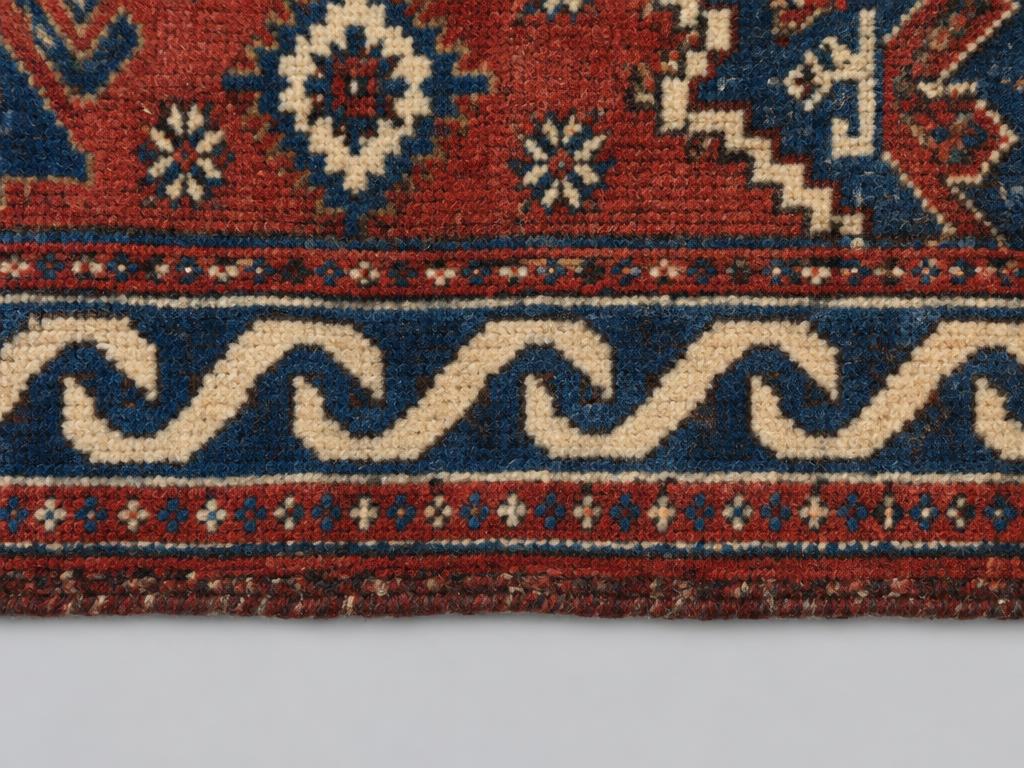
 AI illustration
A running-dog border: a continuous wave of hooked scrolls between narrow guard stripes.
AI-generated illustration — not a photograph of a real object, place or person, and not evidence of any piece's origin. Shown because no suitable real photograph has been found yet.
Readings of this motif
- Water and waves.
- A simple repeat that frames a field.
How to recognise it
Look for the Running dog border as a repeated unit rather than a single image: its scale, density and the way it sits in a border or field often tell you more about workshop and region than the form alone. The same motif crosses weaving, metal, tile and painting, so a match is a starting point for comparison, never proof of origin.
- Trade names
- Running dog, Greek key variant, 'wave' border
- Position
- Usually a narrow guard border
- Common in
- Village and tribal rugs, kilims
Recognising a hooked meander
The trade term running dog describes a repeated hooked or wave-like unit travelling along a border; it does not describe a pictured animal. Identify the stem, return hook and intervening ground before deciding that two borders share the same pattern. A stepped angular version and a rounded version can have a similar rhythm without identical construction. Record the motif's direction and the number of alternating colours, since these are more useful observations than a speculative story attached to the English name.
Repeat, corners and neighbouring bands
Examine a complete side and its corner rather than an isolated hook. In a reciprocal arrangement, the ground between one colour's hooks may form a second interlocking sequence. Count both sequences and note how the maker resolves a corner: by turning a unit, shortening it or interrupting the rhythm. Distinguish this narrow guard stripe from a wider principal border. Neither a tidy corner nor a disrupted repeat proves machine manufacture; handweavers can plan precise repeats and commercial designs can deliberately imitate irregularity.
Names are not provenance
Similar meanders circulate across north-west Iranian and neighbouring weaving regions. Dealer names may vary, and a Greek-key-like angular border need not be identical to a running-dog repeat. Describe what is visible before choosing a catalogue term. The decorative band does not physically reinforce a selvedge simply because it sits near the edge: reinforcement depends on yarns and construction. For origin, require the object's maker information or a qualified attribution supported by structure and ownership history, not the border name.
Historical and Regional Context
The hooked, wave-like meander termed the 'running dog' by Western carpet dealers constitutes one of the most widely distributed guard borders across north-western Iran and the southern Caucasus. Appearing frequently in the textile productions of Azerbaijan, Ardabil, Kurdistan, and the nomadic Shahsavan confederacies, the motif consists of interlocking, reciprocal wave forms that alternate between two contrasting colors. Historically, this geometric meander emerged from ancient shared design vocabularies across Eurasia, adapted by pastoral weavers who translated fluid curvilinear waves into the angular grid demanded by knotted pile and flatweave structures. Because nomadic pastoralists migrated across historical frontiers and traded actively in regional market towns, the motif never belonged to a single ethnic group or localized valley. Instead, it served as a ubiquitous, framing perimeter throughout the eighteenth, nineteenth, and early twentieth centuries, visually stabilizing the vibrant, highly varied geometric programs displayed within central carpet fields.
Examination, Connoisseurship, and Care
Evaluating textiles with running-dog borders demands careful attention to reciprocal balance, dye quality, and side-finish integrity. In well-executed historic examples, the positive and negative spaces of the interlocking wave should remain visually equivalent, creating an optical illusion where neither color dominates the other. Inspect the narrow guard stripes for synthetic bleeding; inferior late-nineteenth-century reds or purples often bleed into adjacent white or ivory wave segments when exposed to moisture. Because the running dog commonly runs along outer edges near the selvages, examine this area for structural weakness, fraying selvage cords, or clipped fringes that indicate past trimming. When acquiring such pieces, do not accept the presence of this border as proof of Caucasian or Iranian origin without corroborating warp spin, knot density, and foundation materials. Custodians should protect edges by securing loosened selvages with conservation stitching, keeping the textile flat, and avoiding prolonged direct sunlight.
Practical questions
- Are dogs shown? No.
- Caucasian only? No.
A hooked wave in the border
'Running dog' is a Western trade name for a continuous border of hooked, wave-like units that seem to chase one another around the rug. It is related to meander and 'Greek key' borders but drawn with diagonal hooks rather than right angles.
It appears in Caucasian, Anatolian and northwest Persian village rugs, which is why a running-dog border on its own says little about where a rug was woven.
What to note
Look at the corners: a weaver who planned the border carefully turns the hooks neatly; an improvised corner often shows a break or compressed units. Record the colours of the two alternating halves of each wave and whether the direction changes midway along a side.
- Corner resolution: shows how the border was planned.
- Direction changes: common in village work.
- Combine with knot type and foundation before suggesting a region.
Why there is no photo
Museum records rarely mention minor borders in their titles. We have not used a rug photo with a running-dog border unless its record names both the border and an Iranian origin, so the page stays unillustrated for now.
| Observation | Useful description | Not established |
|---|---|---|
| Hooked waves | Running-dog border | Region |
| Narrow border | Guard stripe | Weaver |
| Two colours | Reciprocal design | Date |
| What to look at | What it helps with | What it does not prove |
|---|---|---|
| Layout, scale and repeat | Comparing design families | Where or when the piece was made |
| Material and technique | How the design was executed | Iranian handmade origin on its own |
| Dated or signed museum record | A documented reference point | The date or maker of a different object |
References and further reading
- [1] H. E. Wulff, The Traditional Crafts of Persia, MIT Press, 1966; A. U. Pope & P. Ackerman, A Survey of Persian Art, 1938–39.Historical context; not evidence for an individual object.
- [2] Encyclopaedia Iranica ↗Peer-reviewed entries on crafts, motifs and terms.
- [3] The Metropolitan Museum of Art, Islamic Art collection search (filter: Iran) ↗
- [4] Encyclopædia Iranica — entries on carpets, textiles and decorative arts ↗
These sources provide context, not authentication or provenance for an individual object. Editorial interpretations remain under review.
Used in these crafts
A flat, pileless woven textile made across Iran by interlocking or slit-weaving coloured weft threads over a warp, used as floor covering, storage bag, saddle cover and tent divider depending on region.
A hand-knotted pile textile woven across Iran in city workshops, village looms and pastoral camps, distinguished by regional structure, palette and design vocabulary.
A thick, coarsely knotted pile rug woven mainly by pastoral and village weavers of the Zagros, with open fields, few motifs and a directly personal design language.