
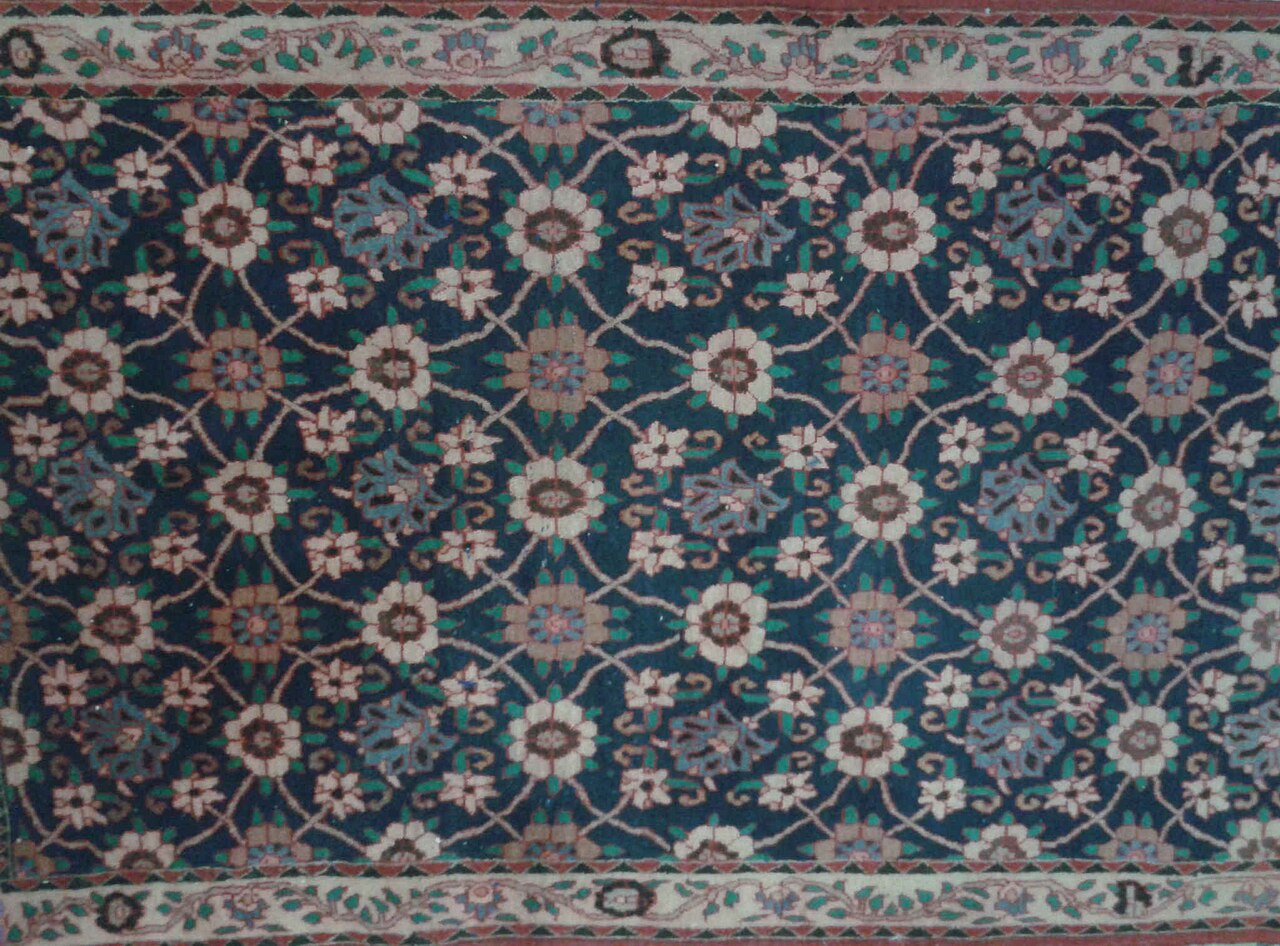
Varamin carpet with mina-khani floral lattice · early 20th century · Knotted-pile wool carpet · Iran
Pouyakhani · CC BY-SA 3.0 · Wikimedia Commons record
One catalogued Iranian example whose museum title names this motif; not a defining specimen.
Readings of this motif
- A garden lattice read as abundance.
- A trade name for a repeat, with no fixed meaning.
How to recognise it
Look for the Mina khani as a repeated unit rather than a single image: its scale, density and the way it sits in a border or field often tell you more about workshop and region than the form alone. The same motif crosses weaving, metal, tile and painting, so a match is a starting point for comparison, never proof of origin.
A lattice of flowers
Mina-khani is an all-over repeat in which large rosettes sit at the points of a diamond lattice, linked by smaller flowers and stems, so the eye reads both a grid and continuous bloom. It is strongly associated with Varamin weaving and with Kurdish and Bakhtiari rugs, but also appears in town workshops. Presence of the pattern is a design observation; it cannot by itself name a weaving group.
References: [1]
Drawing and scale
Village versions often render the rosettes angular and large, with fewer lattice units across the field; workshop versions curve the stems and multiply the repeat. Colour placement can emphasise either the lattice or the flowers, changing the rug's effect. Compare scale and drawing, not just the presence of rosettes.
References: [1]
Name and meaning
The name is often explained through a legendary person or place, but such stories are not documented history. Present them as tradition and avoid assigning fixed symbolic meanings to each flower.
References: [1]
Practical questions
- Is every mina-khani rug from Varamin? No; the pattern is widely woven.
- Does the legend explain the name? It is tradition, not documented history.
| Observation | Useful description | Not established |
|---|---|---|
| Rosettes on a lattice | Mina-khani repeat | Varamin origin |
| Angular large flowers | Village-style drawing | A specific tribe |
| Legend of the name | Oral tradition | Historical fact |
References and further reading
- [1] A. U. Pope & P. Ackerman (eds.), A Survey of Persian Art, Oxford University Press, 1938–39.Broad historical context; individual claims need current scholarship.
- [2] Encyclopaedia Iranica ↗Peer-reviewed entries on motifs, crafts and terms.
These sources provide context, not authentication or provenance for an individual object. Editorial interpretations remain under review.
Used in these crafts
A hand-knotted pile textile woven across Iran in city workshops, village looms and pastoral camps, distinguished by regional structure, palette and design vocabulary.
Durable, geometric village carpets from the Heris area of East Azerbaijan, with large angular medallions.
Village and tribal carpets from the Chaharmahal and Bakhtiari region, best known for the garden (khesti) design of repeated panels.