
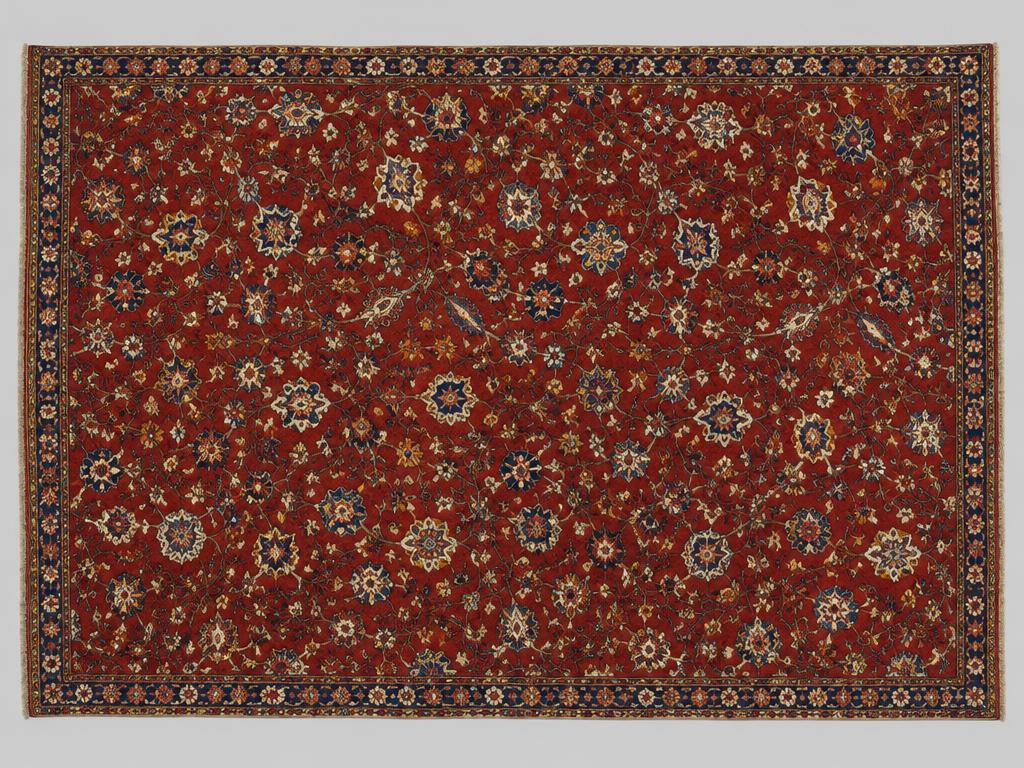
 AI illustration
An all-over afshan field: scattered blossoms and palmettes on fine spiralling vines, with no central medallion.
AI-generated illustration — not a photograph of a real object, place or person, and not evidence of any piece's origin. Shown because no suitable real photograph has been found yet.
Readings of this motif
- A scattering of blossoms suggesting an endless garden.
- A layout term rather than a symbol.
How to recognise it
Look for the Afshan as a repeated unit rather than a single image: its scale, density and the way it sits in a border or field often tell you more about workshop and region than the form alone. The same motif crosses weaving, metal, tile and painting, so a match is a starting point for comparison, never proof of origin.
- Persian
- افشان — 'scattered'
- Layout type
- All-over field, no medallion
- Common in
- Carpets, bookbinding, lacquer, illumination
Scattered flowers
Afshan ('scattered') fills the field with an all-over arrangement of flowers, leaves and scrolls without a medallion. It is frequent in Isfahan, Tabriz and Kashan rugs and in illumination margins.
Structure
Underlying spiral or lattice scrolls usually organise the 'scatter'; tracing them reveals the design's logic.
Gold-sprinkled paper
In book arts, zar-afshan means paper sprinkled with gold flecks, a related use of the word.
Genesis and Continuity of the Scattered Composition
The afshan motif, translating literally to 'scattered' or 'dispersed', evolved as one of the quintessential continuous field designs in classical Persian visual arts. Emerging prominently during the Safavid golden age, when court designers in Isfahan, Tabriz, and Kashan sought alternatives to dominant central-medallion formats, afshan offered an impression of unbounded rhythmic expanse. While visually evoking wind-blown blossoms or celestial gardens, the design was rigorously codified through mathematical lattices and spiralling floral rinceaux (eslimi and khata'i) running beneath the surface. This compositional strategy spread across media, finding expression in woven silk brocades, hand-knotted urban carpets, and the illuminated margins of precious manuscripts. Provincial carpet workshops in regions such as Kerman and Khorasan later embraced the pattern, adapting the density of palmettes and leaves to local knotting traditions and colour palettes. Far from remaining static, afshan endured into the modern era as an iconic embodiment of harmonious complexity in Persian decorative arts.
Visual Analysis, Drafting Logic, and Preservation
In appraising textiles or illuminated leaves bearing the afshan pattern, one must trace the underlying draftsmanship beneath the scattered blossoms. High-quality workshop execution reveals an unbroken, rhythmic spiral or interlacing vine system that governs the placement of Shah Abbasi flowers, buds, and serrated foliage, avoiding unbalanced voids or awkward compositional crowding. Conversely, less sophisticated village copies or rushed commercial interpretations often truncate connecting stems, producing disconnected floral clusters that betray mechanical reproduction or naive drafting. Furthermore, decorative consistency does not guarantee antique manufacture, as faithful cartoon reproductions are common in contemporary workshops. For knotted carpets with afshan fields, maintenance relies on even wear distribution; rotating the rug periodically prevents concentrated foot traffic from fraying delicate vine motifs. Cleaning should always be entrusted to textile conservators using neutral-pH soaps without optical brighteners. For works on paper, such as zar-afshan manuscripts, storage in acid-free archival enclosures protected from ultraviolet light prevents fading and medium detachment.
Practical questions
- Does afshan have a medallion? No.
- Is it random? Hidden scrolls organise it.
What 'afshan' describes
Afshan names a way of filling a field rather than a single motif: flowers, palmettes, leaves and sometimes small animals are spread over the ground as if scattered, without a central medallion to organise them. In carpets the effect is usually held together by a hidden grid of thin spiralling vines; in illumination and lacquer the 'scatter' is often gold flecks or small sprays across a coloured ground.
Because the word describes a layout, two afshan pieces can share almost no individual motifs. Read the page or field for its organising principle first: is there a repeating lattice under the flowers, a set of vine scrolls, or a genuinely irregular spread?
How to read an afshan field
Trace a single vine with your finger. If it returns to the same point at a regular interval, the design is drawn on a repeat; most woven afshan fields are. Then compare the direction of the flowers: in many carpets they all point one way, which tells you the design has a top and bottom even without a medallion.
- Count how often the same palmette recurs across the width.
- Check whether the border motifs continue the field's scale or contrast with it.
- In gold-flecked paper or lacquer, look for the edge of the speckled area — it shows how the sheet was prepared.
Why no photograph yet
Museum titles rarely use the word afshan; they describe a piece as a 'floral carpet' or 'vine-scroll carpet'. We only lead a page with a photograph whose own record names the subject, so this page stays unillustrated rather than borrowing a floral carpet and calling it afshan. A trade listing that says 'afshan' is a seller's description, not a catalogue identification.
| Observation | Useful description | Not established |
|---|---|---|
| All-over flowers | Afshan | City |
| Spiral scrolls | Hidden structure | Workshop |
| Gold flecks on paper | Zar-afshan | Date |
| What to look at | What it helps with | What it does not prove |
|---|---|---|
| Layout, scale and repeat | Comparing design families | Where or when the piece was made |
| Material and technique | How the design was executed | Iranian handmade origin on its own |
| Dated or signed museum record | A documented reference point | The date or maker of a different object |
References and further reading
- [1] H. E. Wulff, The Traditional Crafts of Persia, MIT Press, 1966; A. U. Pope & P. Ackerman, A Survey of Persian Art, 1938–39.Historical context; not evidence for an individual object.
- [2] Encyclopaedia Iranica ↗Peer-reviewed entries on crafts, motifs and terms.
- [3] The Metropolitan Museum of Art, Islamic Art collection search (filter: Iran) ↗
- [4] Encyclopædia Iranica — entries on carpets, textiles and decorative arts ↗
These sources provide context, not authentication or provenance for an individual object. Editorial interpretations remain under review.
Used in these crafts
A hand-knotted pile textile woven across Iran in city workshops, village looms and pastoral camps, distinguished by regional structure, palette and design vocabulary.
Hand-knotted city carpets from Kashan, often in wool or silk, known for medallion designs and deep reds and blues.
Very finely knotted city carpets from Nain, recognisable by ivory and blue palettes with silk highlights.