
 AI illustration
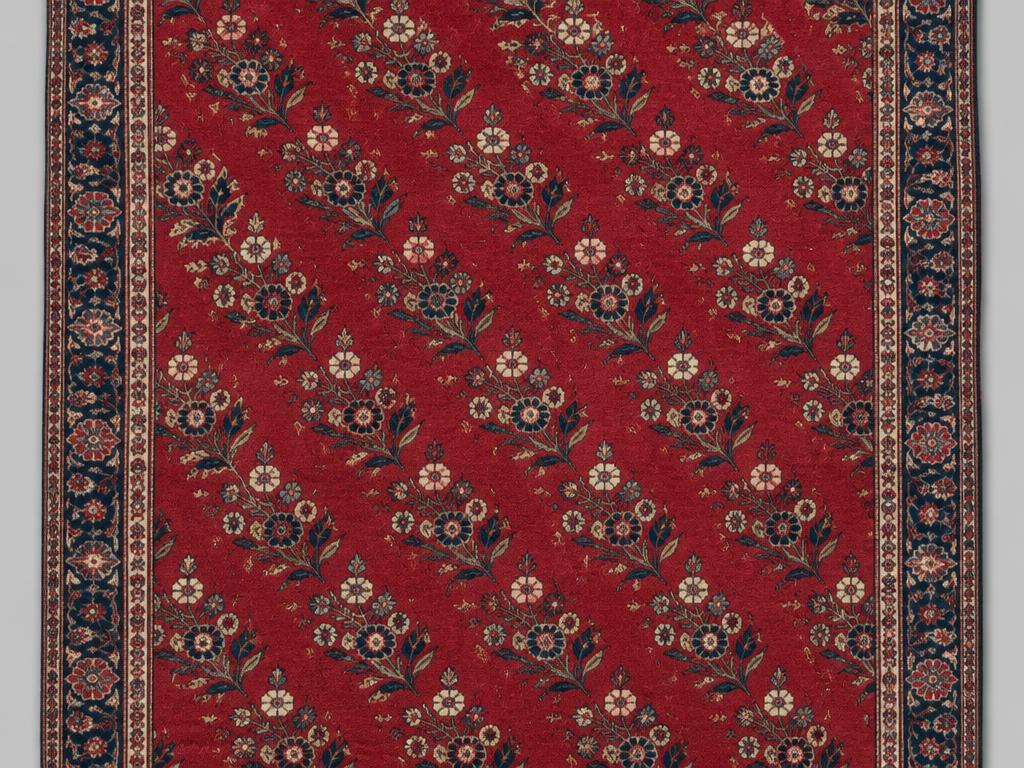
Small sarband bouquets repeated in diagonal rows across a rose-red field, as in many Sarouk-type rugs.
AI-generated illustration — not a photograph of a real object, place or person, and not evidence of any piece's origin. Shown because no suitable real photograph has been found yet.
Readings of this motif
- A regional repeat used in trade descriptions.
How to recognise it
Look for the Sarband bouquet as a repeated unit rather than a single image: its scale, density and the way it sits in a border or field often tell you more about workshop and region than the form alone. The same motif crosses weaving, metal, tile and painting, so a match is a starting point for comparison, never proof of origin.
- Persian
- سربند — Saraband, Sarouk-Farahan area
- Usual form
- Small bent boteh in staggered rows
- Common in
- Village rugs of Arak province
Mir and sarband
Sarband (or saraband) designs repeat rows of small boteh, often alternating direction, on a red or blue field. Associated with the Saraband area near Arak.
Mir
The related 'mir' boteh is a finely drawn variant; trade names overlap.
Attribution
The pattern is woven elsewhere too; structure and provenance decide origin.
Regional Ecology and the Anglo-Persian Market
The Sarband design represents a quintessential expression of rhythmic field composition in western Iranian carpet weaving, rooted historically in the mountainous district south of Arak. Emerging as an influential village weaving tradition during the eighteenth and nineteenth centuries, the pattern became a cornerstone of the regional cottage industry that later fed the global Sultanabad export boom. The defining element is the continuous repetition of small boteh motifs arranged in horizontal rows across an indigo or madder ground, with each tier typically reversing its bent apex. Within the region, weavers from the town of Mir gained special renown for producing an exceptionally fine, tightly spaced variation known in the international trade as the 'Mir-e Saraband'. Framed by characteristic multi-banded border systems filled with meandering angular vines and rosette guards, the Sarband layout achieved an understated, rhythmic sophistication that influenced commercial workshop production throughout central Iran.
Appraising Field Rhythm, Edge Bands, and Preservation
When authenticating and caring for Sarband rugs, careful analysis of the field cadence and border construction is essential. High-grade traditional examples exhibit a lively, vibrating visual texture because the boteh figures, though uniform at first glance, contain subtle organic variations in angle, scale, and detailing produced by memory weaving. In contrast, modern commercial reproductions made on rigid urban cartoons appear stiff and mechanically uniform. Examine the primary border: classic pieces feature the traditional 'broken branch' (shakheh shekasteh) vine bordered by multiple narrow guard stripes, often showing charming abrash where dye vats changed mid-weave. Test the dyes gently with a damp white cloth in an unobtrusive spot, as late nineteenth-century specimens sometimes feature fugitive aniline dyes that bleed when exposed to water or spot cleaning. To care for these pieces, avoid direct sunlight which rapidly fades fugitive red tones, vacuum strictly with suction attachments rather than motorized beater bars, and maintain stable indoor humidity.
Practical questions
- Is every boteh-row rug Saraband? No.
- Mir vs sarband? Overlapping trade names.
The Sarband or Mir-Sarband field
In the rug trade 'Sarband' (often written Serabend or Mir-Serabend) names both a district near Arak and the dense field of small boteh that its village rugs are known for. The boteh are arranged in offset rows, frequently alternating direction from row to row, on a red or dark-blue ground with a narrow multi-stripe border.
The same layout is woven far outside the district, so the name works as a design label first and a place label only when a record documents the source.
Reading row direction and scale
Look at whether every boteh tip bends the same way or whether rows reverse. Note the number of boteh across the width and whether a small medallion has been laid over the field — a later commercial variation. Fine, small boteh with a narrow border are typical of older pieces in published collections; very large boteh usually indicate a different family.
- Rows reversing direction: a common Sarband arrangement.
- Small central medallion over the boteh: a variation, not a different tradition.
- Back of the rug: check knot type and warp material before reading the design further.
What a 'Sarband' label can and cannot tell you
Auction and shop listings use 'Sarband' freely. Treat it as a description of the field until a museum record, inscription or documented purchase ties the piece to Arak province. No Iran-catalogued open-access record we checked names Sarband in its title, so this page has no lead photograph.
| Observation | Useful description | Not established |
|---|---|---|
| Rows of boteh | Sarband pattern | Arak area |
| Alternating direction | Design rhythm | Weaver |
| Many borders | Border style | Age |
| What to look at | What it helps with | What it does not prove |
|---|---|---|
| Layout, scale and repeat | Comparing design families | Where or when the piece was made |
| Material and technique | How the design was executed | Iranian handmade origin on its own |
| Dated or signed museum record | A documented reference point | The date or maker of a different object |
References and further reading
- [1] H. E. Wulff, The Traditional Crafts of Persia, MIT Press, 1966; A. U. Pope & P. Ackerman, A Survey of Persian Art, 1938–39.Historical context; not evidence for an individual object.
- [2] Encyclopaedia Iranica ↗Peer-reviewed entries on crafts, motifs and terms.
- [3] Encyclopædia Iranica — entries on carpets, textiles and decorative arts ↗
- [4] The Metropolitan Museum of Art, Islamic Art collection search (filter: Iran) ↗
These sources provide context, not authentication or provenance for an individual object. Editorial interpretations remain under review.
Used in these crafts
A hand-knotted pile textile woven across Iran in city workshops, village looms and pastoral camps, distinguished by regional structure, palette and design vocabulary.