
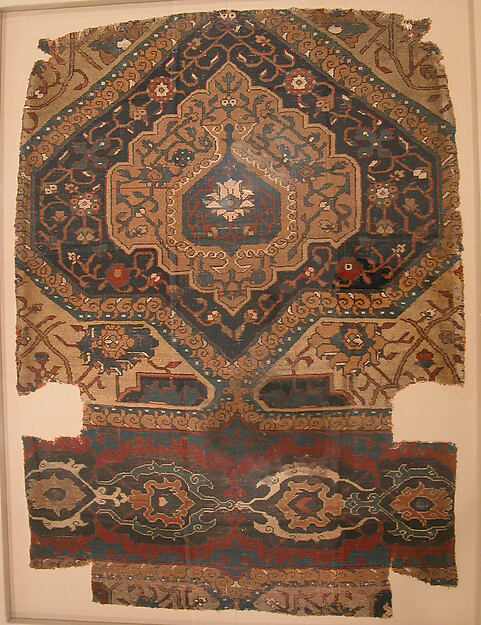
Fragment of a Northwest Persian Medallion Carpet · early 16th century · Cotton (warp), wool (weft and pile); asymmetrically knotted pile · Northwestern Iran
The Metropolitan Museum of Art, 22.100.67 · CC0 · Museum record
One catalogued Iranian example whose museum title names this motif; not a defining specimen.
Readings of this motif
- A citrus-shaped ornament.
- A compositional centre.
How to recognise it
Read the Medallion (toranj) as a whole composition rather than a repeating unit: how it is centred and framed, how its proportions relate to the field or page, and which details — corners, figures, inscriptions — are drawn with the most care. Related compositions appear across weaving, metal, tile and painting, so a match is a starting point for comparison, never proof of origin.
The medallion
Toranj (citron) names the central medallion—round, oval, lobed or polygonal—at the heart of Persian layouts in carpets, book covers and ceilings.
Shapes
Lozenge medallions typify village and tribal rugs; curvilinear lobed medallions typify town workshops. Exceptions abound.
Meaning
Readings range from sun to pool to dome; none is settled.
Historical and Regional Context
The toranj or central medallion layout has anchored Persian decorative compositions for centuries, appearing prominently on bookbindings, palace ceilings, architectural tiles, and carpets. Historically, scholars associate its monumental emergence in textile arts with early sixteenth-century Safavid court design, where illuminators transferred complex, multi-lobed cartouche layouts directly into royal carpet cartoons. Regional adaptation developed rapidly across the plateau. Metropolitan ateliers in Kashan, Tabriz, and Isfahan refined curvilinear medallions featuring matching pendants, termed shamseh or sar-toranj, framing them with complementary corner brackets known as lachak. Concurrently, village and tribal groups across Fars, Azerbaijan, and Khorasan simplified the sinuous courtly medallion into geometric, diamond, or stepped hexagonal shapes that aligned naturally with horizontal and vertical knotting grids. The medallion layout thus operated across social spectra, accommodating both meticulous royal geometry and spontaneous communal weaving while remaining the quintessential symbol of balanced Iranian spatial design.
Examination, Comparison, and Care
When evaluating a medallion carpet, check the proportion of the toranj relative to the surrounding field. In balanced classic compositions, the medallion occupies approximately one-third of the central axis without overwhelming the negative space or crowding the main borders. Examine the alignment of the central point and pendant attachments: tribal pieces embrace natural asymmetries resulting from freehand knotting, whereas city workshop rugs should exhibit disciplined axial symmetry. Turn the carpet over to verify knot uniformity across the medallion boundary, ensuring the medallion was not spliced or inserted from a different fragment during modern restoration. To maintain structural integrity, rotate the rug end-for-end every six months to distribute pedestrian wear evenly across the medallion center. When cleaning, avoid harsh spot cleaners that leave dry halos; consult professional conservators trained in hand-washing textiles using pH-neutral cleansers.
Practical questions
- Why 'citron'? Its shape recalls the fruit.
- Lozenge = tribal? Often, not always.
| Observation | Useful description | Not established |
|---|---|---|
| Central medallion | Toranj | City |
| Lozenge shape | Geometric drawing | Tribe |
| Lobed outline | Curvilinear design | Workshop |
References and further reading
- [1] H. E. Wulff, The Traditional Crafts of Persia, MIT Press, 1966; A. U. Pope & P. Ackerman, A Survey of Persian Art, 1938–39.Historical context; not evidence for an individual object.
- [2] Encyclopaedia Iranica ↗Peer-reviewed entries on crafts, motifs and terms.
These sources provide context, not authentication or provenance for an individual object. Editorial interpretations remain under review.
Used in these crafts
A hand-knotted pile textile woven across Iran in city workshops, village looms and pastoral camps, distinguished by regional structure, palette and design vocabulary.
The decoration of manuscript pages and album leaves with gold and coloured pigments in geometric and floral designs framing text or painting.
The hand binding of manuscripts and books with leather or lacquer covers, often with a flap (lisan) and stamped, cut or gilded decoration.
Hand-knotted city carpets from Kashan, often in wool or silk, known for medallion designs and deep reds and blues.
Durable, geometric village carpets from the Heris area of East Azerbaijan, with large angular medallions.