
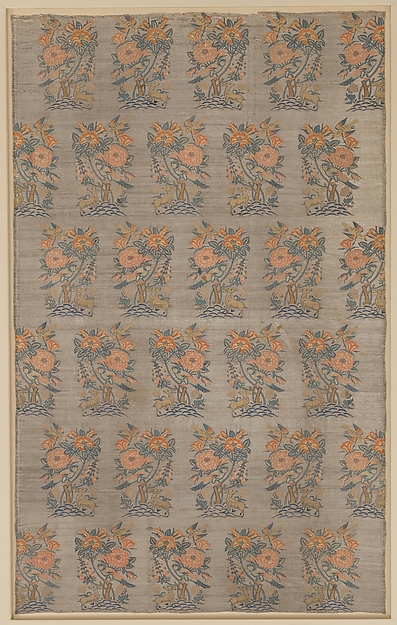
Panel with Rosebush, Birds, and Deer Pattern · late 17th–early 18th century · Silk, silver and gilded metal wrapped thread; compound twill weave, brocaded · Iran
The Metropolitan Museum of Art, 49.32.99 · CC0 · Museum record
One catalogued Iranian example whose museum title names this motif; not a defining specimen.
Readings of this motif
- The nightingale and rose of Persian poetry.
How to recognise it
Read the Bird on a branch as a whole composition rather than a repeating unit: how it is centred and framed, how its proportions relate to the field or page, and which details — corners, figures, inscriptions — are drawn with the most care. Related compositions appear across weaving, metal, tile and painting, so a match is a starting point for comparison, never proof of origin.
Rose and nightingale
The nightingale (bolbol) on a rose branch is a classic of Persian poetry and painting, central to gol-o-morgh and to decoration in Shiraz, the city of Sa'di's Golestan.
Poetic meaning
The nightingale's love for the rose expresses longing for the beloved or the divine—a well-documented literary convention.
Media
It appears in lacquer, tiles, textiles and miniatures across periods.
Literary Lyricism and Shiraz Artisanal Lineages
The gol-o-morgh (flower and bird) tradition, particularly the nightingale perched beside a rose, forms an iconic synthesis of Persian aesthetic and literary sensibilities. While depictions of avian life date back centuries, the specific romantic configuration of the singing bird yearning before the unfolding petals gained supreme expression during the late Safavid, Zand, and Qajar periods. Shiraz, celebrated as the poetic sanctuary of Sa'di and Hafez, emerged as a premier centre for this genre, reflecting the lush gardens and gentle pastoral topography of Fars province. In Sa'di's Golestan and across classical Persian lyrical poetry, the nightingale functions as the archetypal devoted lover, steadfast despite the thorn's wounding embrace. Artisans translated this poetic metaphor across an array of decorative arts, including architectural plaster reliefs, lacquer pen boxes, inlaid woodwork, and architectural tile panels, transforming literary yearning into enduring decorative motifs that symbolized eternal devotion and spiritual longing.
Technical Evaluation, Craquelure Analysis, and Preservation
Assessing gol-o-morgh artwork involves close analysis of technical execution, anatomical delicacy, and natural aging characteristics. In fine lacquerware or book covers, examine the meticulous feather-rendering of the bird and the translucent shading (sayeh-pardaz) of rose petals. Master craftsmen achieved remarkable depth through hundreds of fine brush strokes; by contrast, commercial reproductions display mechanical brush marks or flat colour fields. Inspect surfaces under angled illumination to verify whether the craquelure is genuine age-induced fracturing or shallow chemically etched distressing. When caring for antique lacquer objects adorned with gol-o-morgh, environmental stability is paramount. Relative humidity extremes cause the organic papier-mâché substrate to expand or contract, shearing the brittle gesso layer and causing paint flaking. Dust these precious surfaces solely with dry, ultra-soft natural bristle brushes, never with damp microfibre cloths or solvent cleaners, and keep them protected from sunlight to preserve subtle madder and carmine glazes.
Practical questions
- Is the meaning documented? Yes, in poetry.
- Only Shiraz? No.
| Observation | Useful description | Not established |
|---|---|---|
| Bird on rose | Gol-o-bolbol | Shiraz |
| Glossy box | Lacquer | Qajar |
| Poem nearby | Literary link | Poet |
References and further reading
- [1] H. E. Wulff, The Traditional Crafts of Persia, MIT Press, 1966; A. U. Pope & P. Ackerman, A Survey of Persian Art, 1938–39.Historical context; not evidence for an individual object.
- [2] Encyclopaedia Iranica ↗Peer-reviewed entries on crafts, motifs and terms.
These sources provide context, not authentication or provenance for an individual object. Editorial interpretations remain under review.
Used in these crafts
A decorative technique in which papier-mâché or wooden objects, such as boxes, mirror cases and pen boxes, are painted with fine miniature-style scenes or floral ornament and then sealed under multiple coats of clear lacquer varnish.
A decorative technique in which powdered coloured glass is fused by heat onto the surface of gold, silver or copper objects, producing a smooth, glossy coloured surface, historically practised in Isfahan on vessels, jewellery and decorative panels.
The decoration of manuscript pages and album leaves with gold and coloured pigments in geometric and floral designs framing text or painting.