
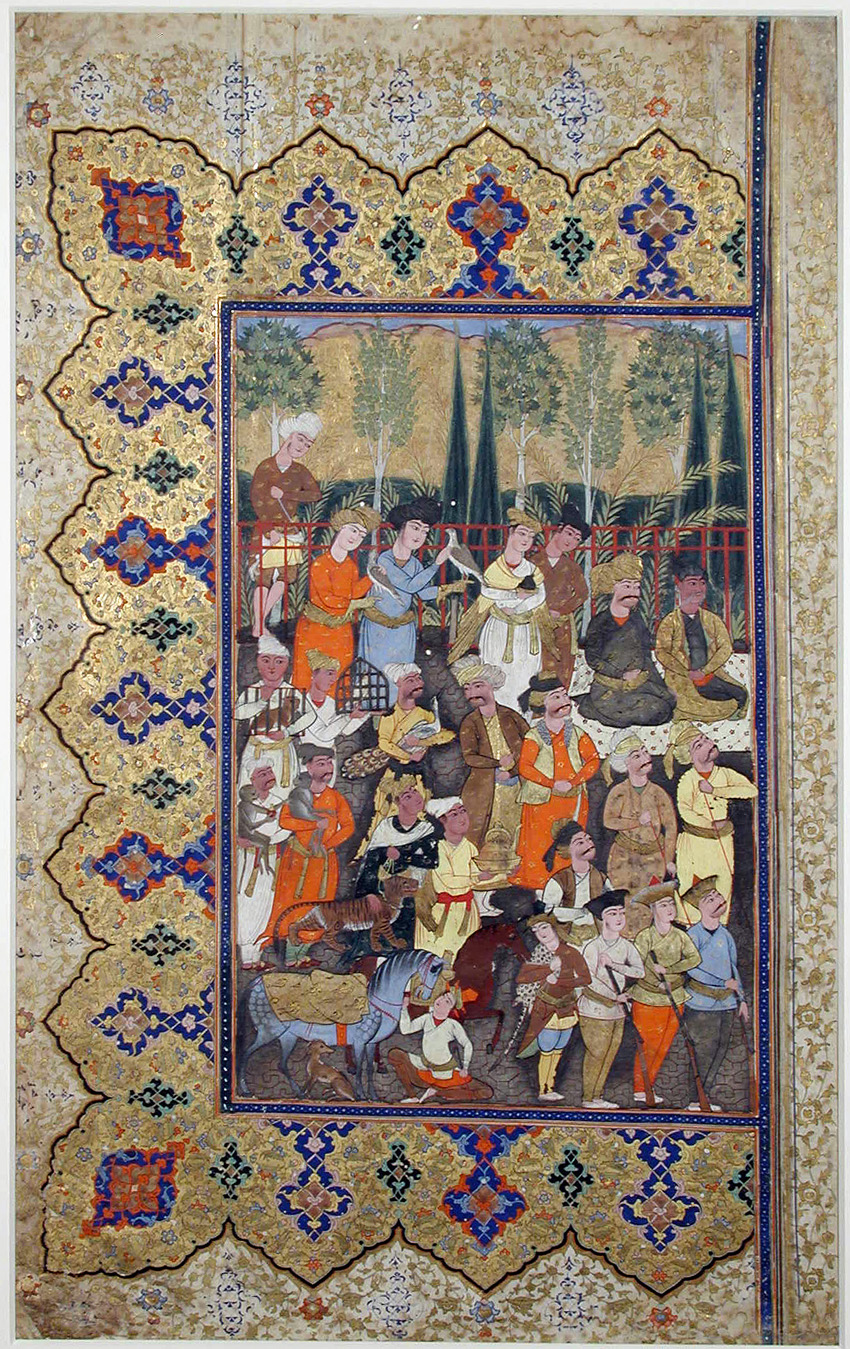
Enthronement of Luhrasp, Shahnameh painting with dark cypresses behind the garden screen · 17th century · Opaque watercolour and gold on paper; San Diego Museum of Art · Iran
San Diego Museum of Art · Public domain · Wikimedia Commons record
The cypresses stand among flowering trees behind the figures; the museum title names the scene, not the motif. One example, not a defining specimen.
Readings of this motif
- Endurance and dignity in Persian poetry.
- A garden tree used decoratively.
How to recognise it
Look for the Cypress (sarv) as a repeated unit rather than a single image: its scale, density and the way it sits in a border or field often tell you more about workshop and region than the form alone. The same motif crosses weaving, metal, tile and painting, so a match is a starting point for comparison, never proof of origin.
The upright evergreen
The cypress (sarv) is one of the most persistent images in Persian art and poetry, praised for its straight form and evergreen leaves. It appears in carpets, tiles, miniature painting and textiles, frequently paired with flowering trees. The ancient Cypress of Abarkuh is a famous living example often linked to the motif.
References: [1]
Cypress and boteh
Some writers derive the boteh from a bent cypress. This is one of several competing theories, alongside a flame, a leaf or a seed; none is proven. Keep the cypress page and the boteh page connected but do not state descent as fact.
References: [1]
Poetry and garden
Poets compare the beloved's stature to a cypress, and Persian gardens use cypress avenues. In painting, a cypress beside a blossoming tree can suggest spring and pairing. Such readings help viewers but should be cited to specific texts where possible.
References: [1]
Practical questions
- Is the boteh a bent cypress? It is one unproven theory.
- Why is the cypress so common? Poetry, gardens and evergreen symbolism.
| Observation | Useful description | Not established |
|---|---|---|
| Tall narrow tree | Cypress form | Mourning meaning |
| Bent tip | Possible boteh relation | Proven derivation |
| Cypress beside blossom | Paired composition | Painter's intention |
References and further reading
- [1] A. U. Pope & P. Ackerman (eds.), A Survey of Persian Art, Oxford University Press, 1938–39.Broad historical context; individual claims need current scholarship.
- [2] Encyclopaedia Iranica ↗Peer-reviewed entries on motifs, crafts and terms.
These sources provide context, not authentication or provenance for an individual object. Editorial interpretations remain under review.
Used in these crafts
A hand-knotted pile textile woven across Iran in city workshops, village looms and pastoral camps, distinguished by regional structure, palette and design vocabulary.
A patterned Iranian brocade woven with supplementary wefts, historically in silk and wool, associated above all with Yazd and Kerman.
The carving and moulding of gypsum plaster into architectural ornament, including mihrabs, inscriptions, muqarnas and wall panels.
A resist-dyed and block-printed cotton textile, historically associated with Isfahan, in which carved wooden blocks stamp repeating floral and figural patterns onto cloth in successive colour stages.