
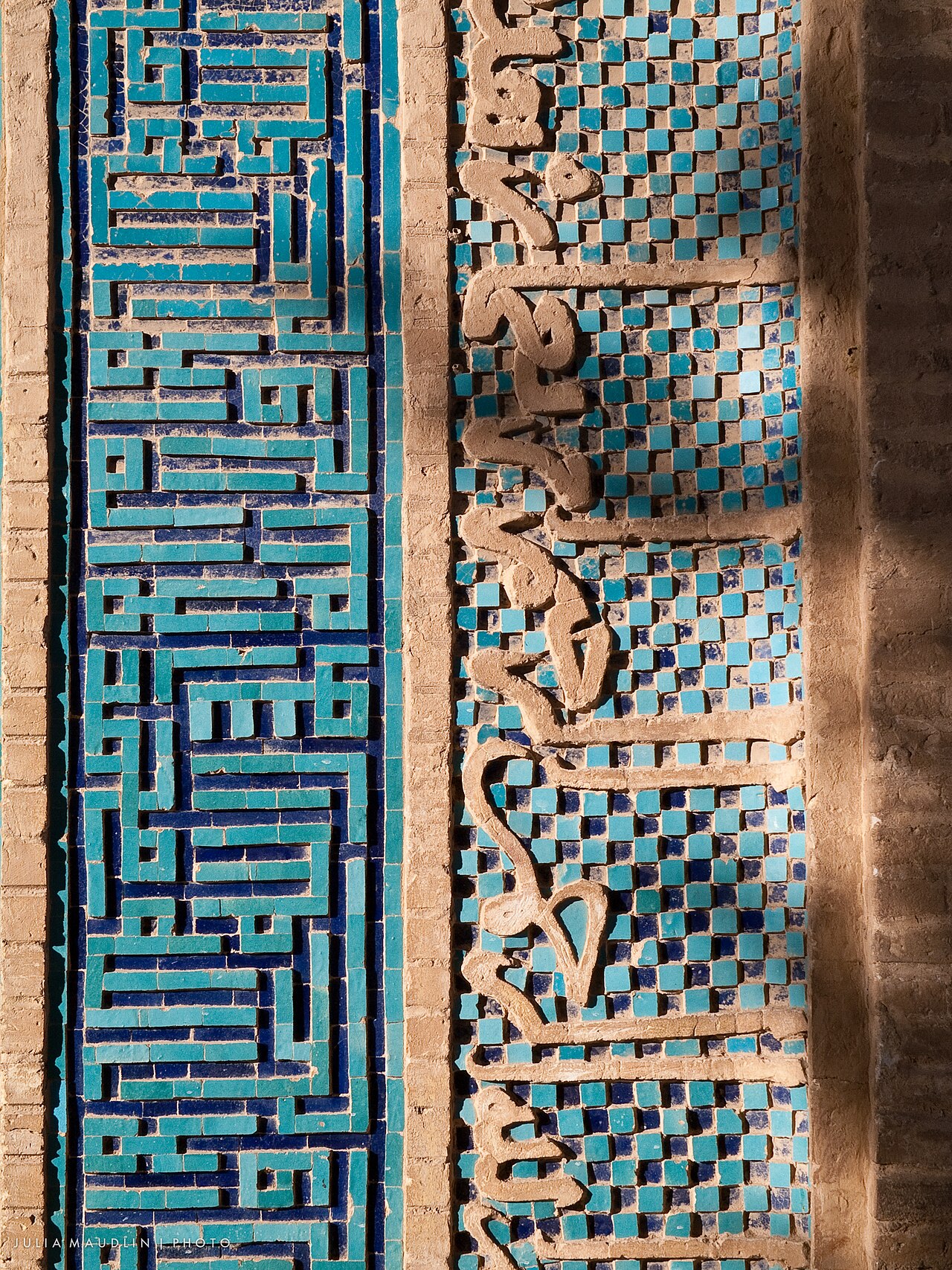
Banna'i brick-and-tile inscription, Friday Mosque, Natanz · photo 2014 · Glazed tile set in brickwork · Iran
Julia Maudlin from Lake Oswego, Oregon, USA · CC BY 2.0 · Wikimedia Commons record
One catalogued Iranian example whose museum title names this motif; not a defining specimen.
Readings of this motif
- Sacred names repeated across a wall.
- Lettering used as architecture.
How to recognise it
Read the Brick script (banna'i) as a whole composition rather than a repeating unit: how it is centred and framed, how its proportions relate to the field or page, and which details — corners, figures, inscriptions — are drawn with the most care. Related compositions appear across weaving, metal, tile and painting, so a match is a starting point for comparison, never proof of origin.
Brick script
Banna'i ('builder's') writes square Kufic with glazed and unglazed bricks so that words emerge from the wall pattern. Repeated names such as Allah, Muhammad and Ali are common, as in Isfahan and Yazd monuments.
Reading
Square Kufic can be read by tracing the continuous light or dark band; inscriptions often rotate around a square.
In crafts
The motif is adapted on tiles, kilims and wood; sacred names merit respectful use.
Historical and Regional Context
Banna'i script, historically termed ma'qeli, represents an architectural synthesis of monumental calligraphy and geometric brick construction. Originating in the medieval period and reaching exceptional refinement under Ilkhanid, Timurid, and Safavid patronage, this technique utilized rectangular glazed and unglazed bricks to embed sacred phrases directly into structural surfaces. Significant ensembles survive across Iran, notably in Yazd, Isfahan, Natanz, and throughout Khorasan, where sanctuary domes, minarets, and portal iwans are enveloped in vast textual grids. Repeating sacred invocations—most frequently the names of the Divine, the Prophet Muhammad, and the Imams—banna'i was carefully tailored to the modular dimensions of standard fired bricks. The style effectively dissolved the boundary between linguistic inscription and decorative surface ornament. Over subsequent centuries, the structural grid of banna'i transcended monumental masonry, influencing local folk crafts such as flatwoven textiles, vernacular tiles, and decorative woodwork throughout urban and regional crafting centers.
Examination, Connoisseurship, and Care
Assessing artifacts adorned with banna'i lettering requires rigorous attention to structural proportion and medium-specific execution. When evaluating architectural tile panels or salvaged brick elements, inspect the mortar and brick paste; historic examples generally exhibit lime-based bedding mortars and hand-cut clay bodies rather than uniform industrial Portland cements. Scrutinize the glaze for authentic atmospheric kiln variations, subtle color pooling, and surface patina resulting from centuries of environmental exposure. In textiles or woodcraft adapting banna'i motifs, observe how faithfully the grid is integrated with the weave or carving; irregular line counts often indicate folk adaptations rather than rigid architectural cartoons. Collectors should exercise ethical caution regarding looted architectural fragments, verifying legitimate provenance before acquisition. For physical conservation, protect porous brick and tilework from water infiltration and soluble salts, which cause efflorescence and catastrophic glaze spalling. In domestic or display settings, avoid chemical cleaners and maintain dry, well-ventilated conditions.
Practical questions
- Is it decoration or text? Both.
- How to read? Trace the band.
| Observation | Useful description | Not established |
|---|---|---|
| Brick square letters | Banna'i | Date |
| Repeated names | Religious text | Patron |
| On a kilim | Adapted motif | Literacy |
References and further reading
- [1] H. E. Wulff, The Traditional Crafts of Persia, MIT Press, 1966; A. U. Pope & P. Ackerman, A Survey of Persian Art, 1938–39.Historical context; not evidence for an individual object.
- [2] Encyclopaedia Iranica ↗Peer-reviewed entries on crafts, motifs and terms.
These sources provide context, not authentication or provenance for an individual object. Editorial interpretations remain under review.
Used in these crafts
A technique of architectural revetment in which monochrome glazed tiles are cut into small individual pieces to a template and set together, glaze face down, into a mortar bed to form complex polychrome patterns and inscriptions.
Square polychrome tiles painted with several overglaze colours and fired together, allowing large architectural schemes to be produced faster than cut tile mosaic.