
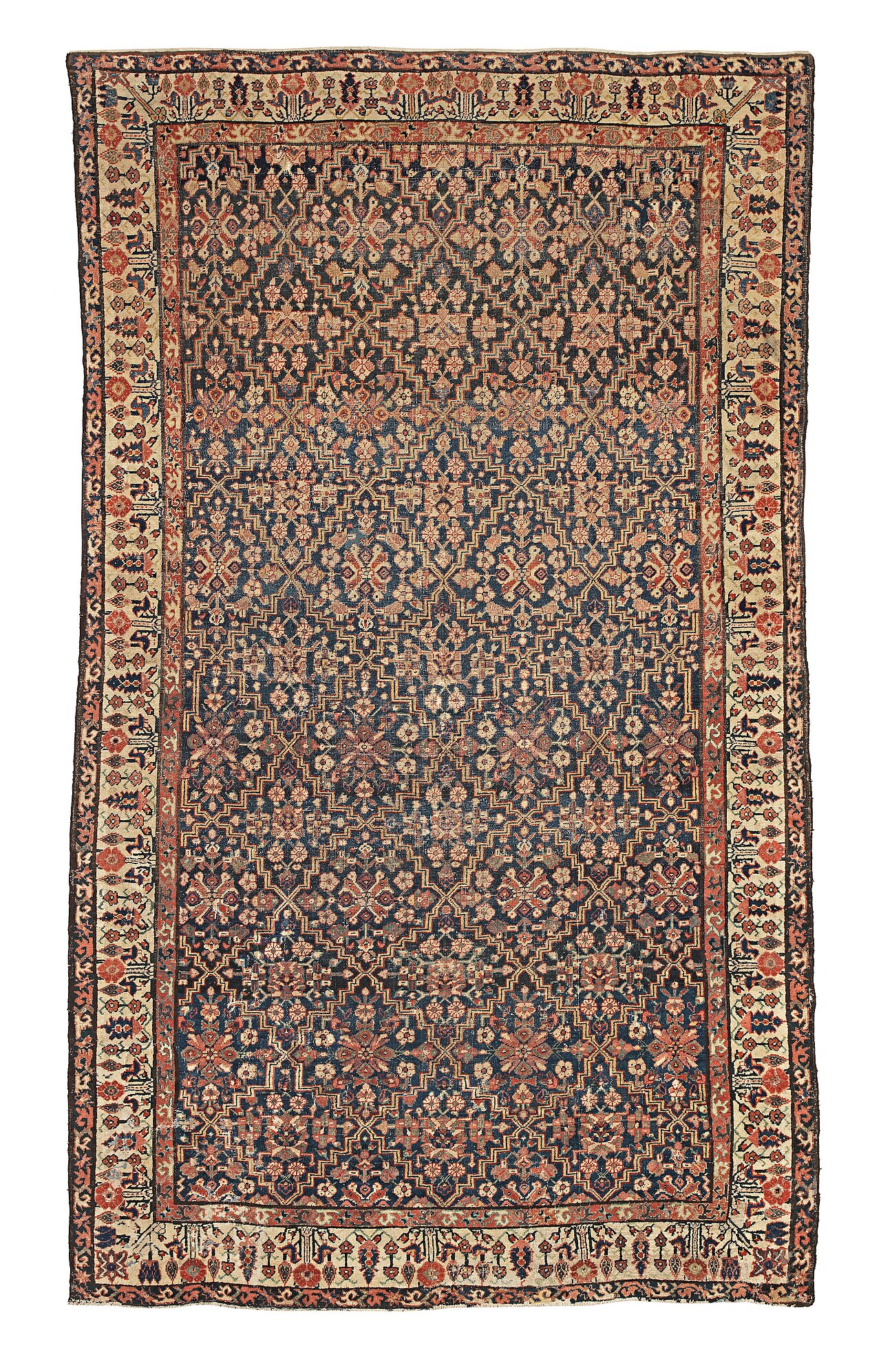
Joshaghan carpet · ca. 1900 · Knotted-pile wool carpet · Iran
Photographer not credited on source page · Public domain · Wikimedia Commons record
One catalogued Iranian example whose museum title names this motif; not a defining specimen.
Readings of this motif
- A regional lattice used as a trade label.
How to recognise it
Look for the Joshaghan lattice as a repeated unit rather than a single image: its scale, density and the way it sits in a border or field often tell you more about workshop and region than the form alone. The same motif crosses weaving, metal, tile and painting, so a match is a starting point for comparison, never proof of origin.
Flowers organised in a diamond lattice
Joshaghan or Joshaqan is used as a pattern name for arrangements of stylised floral sprays in a diamond framework, associated with the town near Kashan. Identify the lattice first and then trace the stems and blossoms inside successive cells. The framework may be visually implied rather than drawn as a continuous line. A central lozenge can interrupt or dominate the repeat without removing the underlying all-over organisation. Record the arrangement, not simply the presence of angular flowers.
Comparison with neighbouring layouts
Compare several adjacent compartments: do they contain alternating bouquets, repeated single forms or another floral system? Herati layouts can also imply a diamond network, but their surrounding leaves and central floral organisation should be described separately. A khesti arrangement divides the field into panels and is not automatically a Joshaghan lattice. Trade labels overlap, so retain the seller's term as a claim and supply an independent visual description. A detail photograph should be accompanied by a full-field view.
Pattern name versus place of weaving
A design associated with Joshaqan can be woven elsewhere, just as a weaver in the town can work from a different pattern. Do not derive workshop, date or material from the name. Compare foundation yarns, knot structure, end finishes and documented maker information with catalogued examples whose attribution is qualified clearly. Repaired cells or later added borders can change the visual balance, so inspect front and reverse before assuming a design irregularity belongs to the original weaving.
Historical and Regional Context
The settlement of Joshaqan-e Qali, situated north of Isfahan and south of Kashan, has maintained an enduring reputation in Iranian weaving history, with historical accounts often linking its looms to royal workshop production as early as the Safavid era. Over the centuries, however, the distinctive lozenge-lattice framework moved far beyond the local district. Village and urban workshops across central and western Iran adopted the compartmental layout, adapting its floral filling motifs according to regional palettes and technical preferences. In some weaving traditions, such as Bakhtiari or Kurdish village looms, the rigid lattice softened into more angular, geometric interpretations, while central Iranian city workshops maintained crisp, draftsman-like regularity. Because the design became a widely recognized carpet genre rather than the exclusive output of a single valley, historians generally view the Joshaghan label as a stylistic category. This diffusion reflects a dynamic exchange between courtly draughtsmanship and autonomous village weavers over generations.
Examination, Comparison, and Care
When evaluating a carpet bearing the Joshaghan pattern, examine the structure from the reverse rather than relying solely on the presence of diamond compartments. Authentic older pieces from Joshaqan itself often employ a distinctive foundation, typically with tightly spun cotton warps and blue or grey cotton wefts, producing a firm, dense handle; yet attribution can never rest on weave structure alone. Inspect the execution of the stylized floral bouquets within each lozenge: high-grade examples maintain distinct internal drawing in the weeping willow, pomegranate blossom, and serrated leaf elements without blurring their contours. Check dye quality under diffused daylight, watching for synthetic color bleeding, particularly among saturated reds and bright blues common in later commercial revivals. For preservation, vacuum gently without revolving brush heads to protect the wool pile from mechanical abrasion. Store rolled pile-outward around an acid-free cardboard core, keeping relative humidity stable to prevent foundation warpage.
Practical questions
- Is it from Joshaqan? Not necessarily.
- Key feature? Sprays in diamonds.
| Observation | Useful description | Not established |
|---|---|---|
| Sprays in diamonds | Joshaghan design | Joshaqan origin |
| Lozenge medallion | Central focus | Date |
| Angular sprays | Village drawing | Tribe |
References and further reading
- [1] H. E. Wulff, The Traditional Crafts of Persia, MIT Press, 1966; A. U. Pope & P. Ackerman, A Survey of Persian Art, 1938–39.Historical context; not evidence for an individual object.
- [2] Encyclopaedia Iranica ↗Peer-reviewed entries on crafts, motifs and terms.
These sources provide context, not authentication or provenance for an individual object. Editorial interpretations remain under review.
Used in these crafts
A hand-knotted pile textile woven across Iran in city workshops, village looms and pastoral camps, distinguished by regional structure, palette and design vocabulary.