
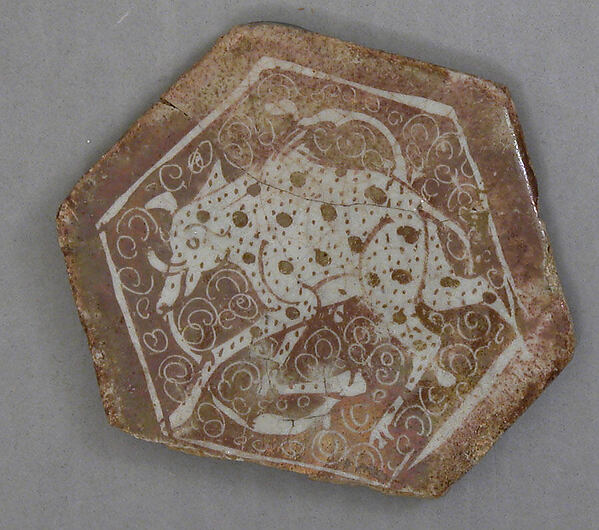
Hexagonal Tile · first half 13th century · Stonepaste; overglaze luster-painted · Iran
The Metropolitan Museum of Art, 28.89.8 · CC0 · Museum record
A single six-sided tile: one unit of the kind that, set edge to edge, forms a honeycomb tiling. One example, not a defining specimen.
Readings of this motif
- A regular, stable grid.
How to recognise it
Look for the Honeycomb (lane-zanbori) as a repeated unit rather than a single image: its scale, density and the way it sits in a border or field often tell you more about workshop and region than the form alone. The same motif crosses weaving, metal, tile and painting, so a match is a starting point for comparison, never proof of origin.
Six-sided repeat and negative space
A regular hexagonal grid is a tiling in which three hexagons meet at each vertex without leaving gaps. In decoration, the visible hexagons may be individual units, outlines formed by interlacing bands or spaces between other shapes. Count sides and trace adjoining cells before describing a pattern as honeycomb: a six-pointed star and a six-sided compartment are not the same form. Record stretched or irregular cells rather than assuming a mathematically regular grid from a distant photograph.
Translating geometry between materials
Brick dimensions, tile modules and the warp-and-weft grid each impose different constraints on the same geometric idea. A ceramic layout may use separate hexagonal tiles, while a textile renders the outline in stepped colour changes. Wooden work can construct cells from joined pieces or cut them from a single panel; those are different processes. Compare joints, boundaries and the pattern's relation to its support. Similar geometry across media does not demonstrate that makers copied one particular building or workshop.
Description without symbolic certainty
Honeycomb is a convenient descriptive name, not evidence that the maker intended a reference to bees or a fixed cosmological meaning. The geometry occurs widely outside Iran. Attribute a particular meaning only where an inscription, maker account or relevant study supports it. For an architectural example, record the building and location; for a portable object, retain its separate ownership and production records. Avoid transferring the date of a photographed wall to a loose tile or a newly produced object with similar geometry.
Architectural and Tribal Dimensions of Hexagonal Tessellation
The regular hexagon and its honeycomb grid hold an enduring place in Iranian material culture, bridging monumental urban architecture and mobile pastoralist craft. In architectural brickwork and glazed tilework, particularly evident from the Seljuk era through the Ilkhanid and Safavid periods, the hexagon functioned as a fundamental geometric module. By subdividing the circle with compass rotations, craftsmen generated stars, rosettes, and intricate girih networks anchored upon sixfold symmetry. Simultaneously, nomadic and village weavers across regions such as Khorasan, Fars, and the Turkmen steppes adopted the hexagon as a natural spatial organizer. In flatweaves and knotted pile carpets, the stepped or straight-sided hexagon frequently frames central medallions or compartments known as güls. Because geometric tessellations resolve practical design constraints in both masonry and interlaced yarns, the recurrence of the honeycomb across disparate media reflects widespread mathematical conventions rather than direct imitation between urban building sites and pastoral looms.
Diagnostic Assessment, Structural Distortion, and Care
Assessing hexagonal patterns requires observing how medium and technique affect geometry. In flatweaves or pile rugs, square grid drafts naturally distort hexagons when horizontal and vertical thread counts diverge; a balanced weave produces equal angles, whereas an unbalanced weft count compresses or elongates the polygon into an oblong shape. This structural variation helps analysts distinguish regional loom setups, though it cannot independently determine tribal origin. In architectural tiles, one must inspect whether the hexagonal plaque was molded individually or shaped after firing, looking for hand-beveled edges and historic lime-mortar residues versus modern gypsum repairs. For preservation, historic hexagonal tiles must never be cleared of original backing using aggressive mechanical chiseling or acid-based washes, which attack glazed surfaces. Woven pieces displaying honeycomb fields should be kept free of grit through gentle suction and rested flat or loosely rolled, preventing localized fold stresses along the diagonal structural axes of the hexagonal network.
Practical questions
- Unique to Iran? No.
- Basis of girih? Often.
| Observation | Useful description | Not established |
|---|---|---|
| Hexagon grid | Honeycomb | Origin |
| In brickwork | Architectural pattern | Date |
| In Turkmen rug | Woven geometry | Tribe |
References and further reading
- [1] H. E. Wulff, The Traditional Crafts of Persia, MIT Press, 1966; A. U. Pope & P. Ackerman, A Survey of Persian Art, 1938–39.Historical context; not evidence for an individual object.
- [2] Encyclopaedia Iranica ↗Peer-reviewed entries on crafts, motifs and terms.
These sources provide context, not authentication or provenance for an individual object. Editorial interpretations remain under review.
Used in these crafts
A Persian inlay art in which fine rods of wood, bone and metal are bundled into star units, sliced into thin sheets and applied to a wooden surface to form dense geometric tessellation.
A joinery technique for building geometric lattice screens and panels from small, precisely cut wooden pieces assembled without glue or nails, using interlocking notched joints to form windows, doors and room dividers with openwork star and polygon patterns.
A technique of architectural revetment in which monochrome glazed tiles are cut into small individual pieces to a template and set together, glaze face down, into a mortar bed to form complex polychrome patterns and inscriptions.