
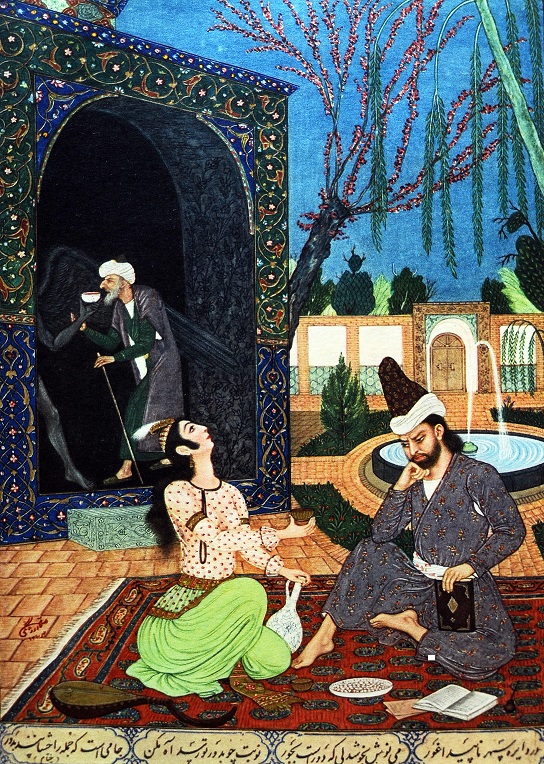
Miniature illustrating a Khayyam scene · date not stated · Miniature painting · Iran
Abbas Rassam Arjangi · Public domain · Wikimedia Commons record
One catalogued Iranian example whose museum title names this motif; not a defining specimen.
Readings of this motif
- Poetry and the passing of time.
- A tourist-market subject since the 20th century.
How to recognise it
Read the Khayyam scene as a whole composition rather than a repeating unit: how it is centred and framed, how its proportions relate to the field or page, and which details — corners, figures, inscriptions — are drawn with the most care. Related compositions appear across weaving, metal, tile and painting, so a match is a starting point for comparison, never proof of origin.
Rubaiyat imagery
Khayyam scenes show a poet with wine, a cupbearer and a garden, inspired by the Rubaiyat attributed to Omar Khayyam. They became popular after FitzGerald's 1859 translation and in modern Iranian miniature painting.
Modern genre
Most Khayyam images are twentieth-century or later, often for tourists; they are not medieval manuscripts.
Attribution
Many quatrains attributed to Khayyam are uncertain.
Literary Transmission and Modern Visualisation
Scenes dedicated to Omar Khayyam constitute a distinctly modern visual tradition within Iranian arts. While Omar Khayyam was celebrated during his lifetime as an eminent astronomer and mathematician, the philosophical quatrains ascribed to him were historically disseminated through anthologies rather than illustrated manuscripts. The widespread visual rendering of Khayyam seated beneath a blossoming tree with a flagon of wine and a companion emerged prominently in the late nineteenth and twentieth centuries. This artistic development was partly stimulated by Edward FitzGerald’s Victorian translation, which introduced a romanticized perception of Khayyam to European audiences. Iranian painters, particularly within the twentieth-century Tehran and Isfahan miniature academies, subsequently reappropriated this imagery, transforming Khayyam into an allegorical emblem of philosophical reflection, ephemeral beauty, and earthly solace. Consequently, such paintings, bone inlays, and carved silver plaques represent modern romantic reconsiderations of classical Persian poetry rather than ancient iconographic lineages.
Evaluating Techniques, Distinguishing Replicas, and Care
When evaluating objects depicting Khayyam themes—whether miniature paintings on bone, illuminated parchment, or repoussé metal—collectors should ascertain the object's true antiquity without romantic preconceptions. Art merchants occasionally distress recent miniatures by using tea stains, smoking paper over flames, or artificially creating craquelure on modern gouache. Genuine twentieth-century miniature paintings by recognized masters demonstrate disciplined brushwork (pardaz), fluid calligraphy in the rendered quatrain borders, and harmonious gouache palettes rather than muddy synthetic watercolours. In bone or ivory panels, natural age lines differ fundamentally from intentional mechanical scratches. Collectors must avoid framing works directly against glass; direct contact traps condensation, encouraging fungal growth and pigment lifting. Paintings on camel bone or paper should be housed in acid-free mounts within ultraviolet-filtering glazed frames. Environmental conditions should remain free of sudden temperature swings, which warp bone plaques and cause brittle binders to flake off.
Practical questions
- Medieval images? Rarely; mostly modern.
- Did Khayyam write all quatrains? Uncertain.
| Observation | Useful description | Not established |
|---|---|---|
| Poet with cup | Khayyam scene | Old manuscript |
| Quatrain text | Rubaiyat quote | Authorship |
| Bright gouache | Modern painting | Date |
References and further reading
- [1] H. E. Wulff, The Traditional Crafts of Persia, MIT Press, 1966; A. U. Pope & P. Ackerman, A Survey of Persian Art, 1938–39.Historical context; not evidence for an individual object.
- [2] Encyclopaedia Iranica ↗Peer-reviewed entries on crafts, motifs and terms.
These sources provide context, not authentication or provenance for an individual object. Editorial interpretations remain under review.
Used in these crafts
The Iranian tradition of small-scale painting made for manuscripts and albums, built from fine line, flat luminous colour and layered spatial convention rather than single-point perspective.
The Iranian tradition of decorating copper, brass and silver vessels with small chisels struck by hammer, working the metal into line, ground and relief.
A decorative technique in which powdered coloured glass is fused by heat onto the surface of gold, silver or copper objects, producing a smooth, glossy coloured surface, historically practised in Isfahan on vessels, jewellery and decorative panels.