
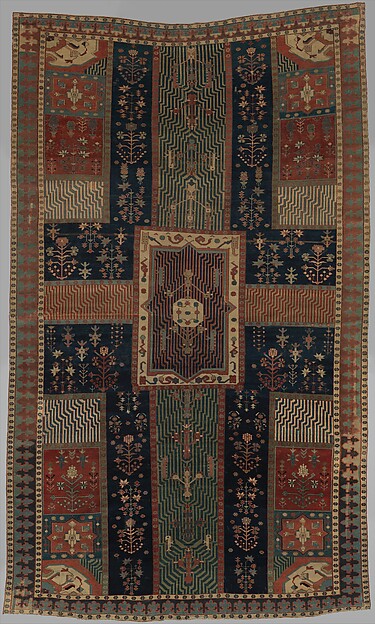
Garden Carpet · second half 18th century · Cotton (warp and weft), wool (pile); symmetrically knotted pile · Iran
The Metropolitan Museum of Art, 22.100.128 · CC0 · Museum record
One catalogued Iranian example whose museum title names this motif; not a defining specimen.
Readings of this motif
Scholars and makers disagree about what this motif means. The readings below are presented side by side; none is endorsed as the settled answer.
- A picture of a four-part paradise garden.
- A decorative grid that borrows garden elements.
How to recognise it
Read the Garden (bagh) as a whole composition rather than a repeating unit: how it is centred and framed, how its proportions relate to the field or page, and which details — corners, figures, inscriptions — are drawn with the most care. Related compositions appear across weaving, metal, tile and painting, so a match is a starting point for comparison, never proof of origin.
The garden carpet
Garden (bagh) designs depict a chahar-bagh: water channels dividing beds of trees and flowers, sometimes with fish and pavilions. A famous early example is the Wagner garden carpet in Glasgow.
Paradise
The word 'paradise' derives from Old Iranian for walled enclosure; the link between gardens and paradise is strongly supported in texts.
Variants
Khesti panel designs are a simplified relative; not every compartment rug is a garden carpet.
Chahar-bagh Cartography and Textual Symbolism
The garden carpet, or bagh, translates the architectural ethos of the classical Persian quadripartite garden (chahar-bagh) into woven textile art. Rooted in ancient Near Eastern concepts of an enclosed, well-watered paradise, this layout crystalised during the Safavid era through imperial masterworks that depicted intersecting canals, central water basins, and gridded parterres filled with weeping willows, cypresses, and flowering shrubs. Historical carpets, such as surviving seventeenth-century examples attributed to central and north-western Iranian workshops, functioned almost as conceptual aerial maps, frequently incorporating woven water ripples, swimming fish, and waterbirds within turquoise or indigo channels. The design held deep spiritual connotations, echoing Qur'anic descriptions of heavenly orchards, while also celebrating terrestrial garden estates built by Persian sovereigns. Over time, stylized regional interpretations emerged, notably in Kurdish, Bakhtiari, and Caucasian weaving areas, where formal waterways evolved into geometric compartmentalised grids known as khesti, illustrating how an imperial landscape archetype was reinterpreted across diverse pastoral and tribal cultures.
Comparative Typology, Structural Reading, and Maintenance
Discerning a genuine classical bagh composition from its modular descendants requires close attention to narrative flow and spatial continuity. In sophisticated garden carpets, watercourses typically connect logically across the central field, feeding into central pavilions or intersecting ponds, with distinct fauna and flora populating adjacent flowerbeds. In contrast, compartmentalised khesti carpets often repeat self-contained floral panels without functional canal networks, serving as decorative brick-like compartments rather than true garden representations. When assessing antique garden carpets, examiners should scrutinise structural details, including foundation warps, knot density, and natural dye stability, remembering that archaic motifs are often revived in later workshop production. For preservation, large garden carpets demand proper physical support to prevent warp distortion caused by self-weight. If displayed on walls, broad hook-and-loop fastening strips should be hand-sewn to the reverse rather than using damaging direct clips. Regular surface maintenance requires gentle vacuuming parallel to the pile using low suction and a mesh protector.
Practical questions
- Are garden carpets maps? Stylised, not literal plans.
- Link to paradise? Well supported.
| Observation | Useful description | Not established |
|---|---|---|
| Water channels | Garden design | Safavid |
| Fish in channels | Water imagery | Region |
| Panels only | Khesti layout | Garden carpet |
References and further reading
- [1] H. E. Wulff, The Traditional Crafts of Persia, MIT Press, 1966; A. U. Pope & P. Ackerman, A Survey of Persian Art, 1938–39.Historical context; not evidence for an individual object.
- [2] Encyclopaedia Iranica ↗Peer-reviewed entries on crafts, motifs and terms.
These sources provide context, not authentication or provenance for an individual object. Editorial interpretations remain under review.
Used in these crafts
A hand-knotted pile textile woven across Iran in city workshops, village looms and pastoral camps, distinguished by regional structure, palette and design vocabulary.
Village and tribal carpets from the Chaharmahal and Bakhtiari region, best known for the garden (khesti) design of repeated panels.