
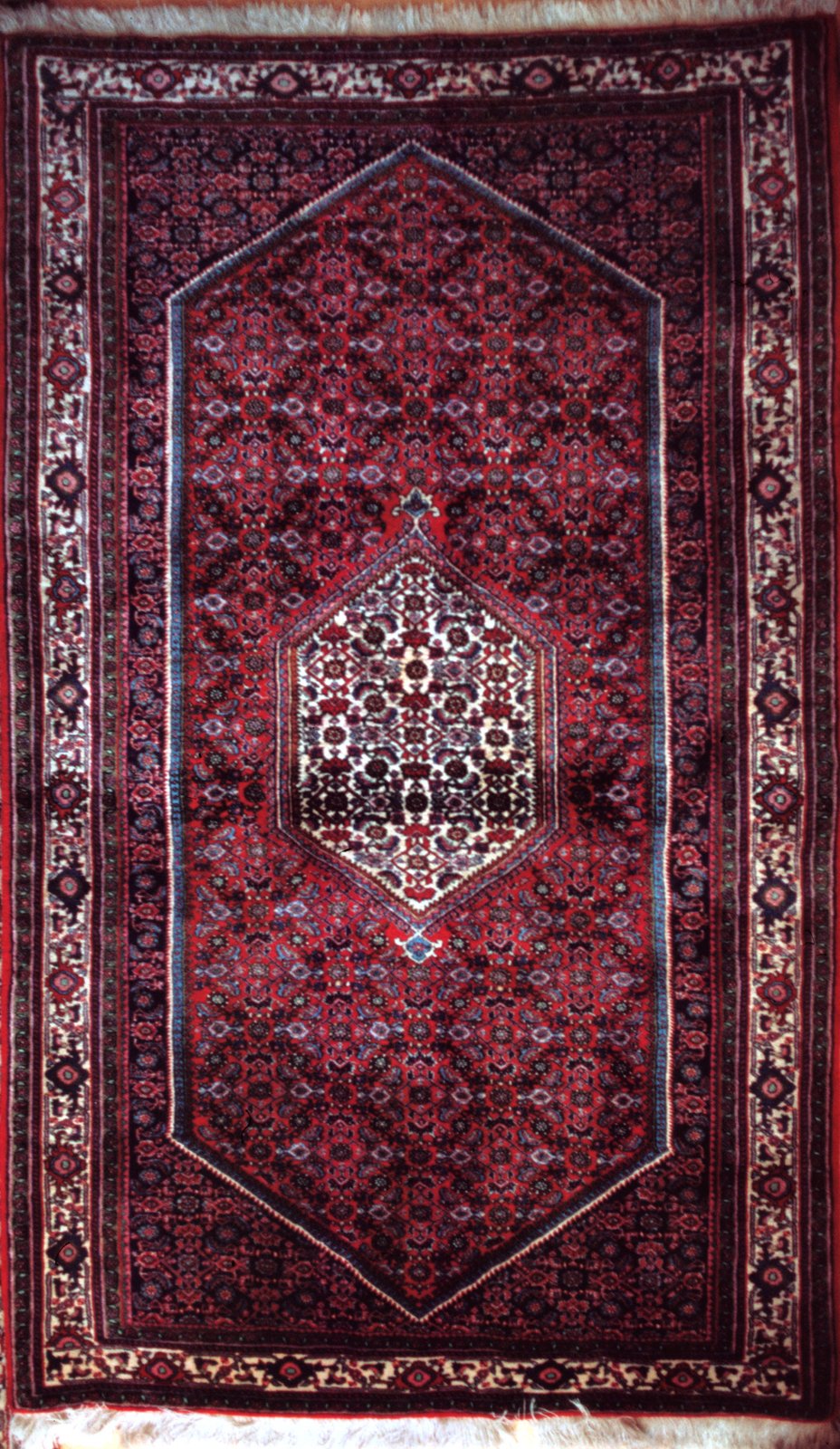
Bijar rug with an all-over herati field around a stepped medallion · Photographed 2008 · Knotted-pile wool rug · Iran
BerndtF · CC BY-SA 3.0 · Wikimedia Commons record
One catalogued Iranian example whose museum title names this motif; not a defining specimen.
Readings of this motif
Scholars and makers disagree about what this motif means. The readings below are presented side by side; none is endorsed as the settled answer.
- A garden lattice reduced to its smallest repeat.
- The 'mahi dar ham' or interlaced-fish reading of the curved leaves.
How to recognise it
Look for the Herati as a repeated unit rather than a single image: its scale, density and the way it sits in a border or field often tell you more about workshop and region than the form alone. The same motif crosses weaving, metal, tile and painting, so a match is a starting point for comparison, never proof of origin.
Visual structure and repeat
Look for a rosette within a diamond and curved leaf-like forms outside it. Units may be compressed, enlarged or simplified by yarn count and weaving scale. Trace one complete repeat and its neighbouring units before classifying a dense field.
History, naming and interpretation
The geographic name is not a certificate of manufacture in Herat. The pattern appears across weaving areas. “Fish” is a conventional reading of curved forms; it should not become a literal account of every maker’s intention.
Build an object-specific comparison
Record the complete design and a detail at a comparable scale. Note medium, dimensions, condition, documented maker and source. Compare a dated museum example without transferring its date to your object. A motif match cannot authenticate Iranian handmade origin or distinguish a replica from an original.
| Observation | Useful comparison | Not proof of |
|---|---|---|
| Repeat and orientation | Pattern organisation | Place of manufacture |
| Material and technique | How a design was executed | Date from motif alone |
| Signed or dated reference | Documented comparator | Authentication of another object |
References and further reading
- [1] Sheila S. Blair and Jonathan M. Bloom, The Art and Architecture of Islam 1250–1800, Yale University Press, 1994.Broad historical context; not an object attribution.
- [2] The Metropolitan Museum of Art — Islamic Art collection ↗Consult individual catalogue records for dates, materials and provenance.
These sources provide context, not authentication or provenance for an individual object. Editorial interpretations remain under review.
Used in these crafts
A hand-knotted pile textile woven across Iran in city workshops, village looms and pastoral camps, distinguished by regional structure, palette and design vocabulary.
The workshop carpet tradition of Tabriz in East Azerbaijan, characterised by drawn cartoons, a distinctive hook-knife weaving method and a wide range of fineness grades.