
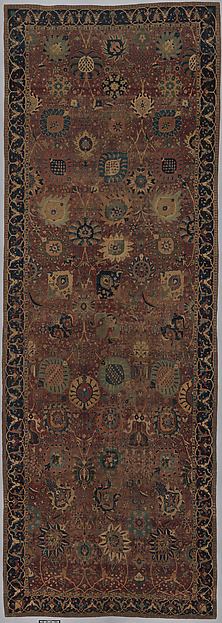
Vase Carpet · late 16th–early 17th century · Cotton (warp and weft), silk (weft), wool (weft and pile); asymmetrically knotted pile · Iran
The Metropolitan Museum of Art, 43.121.2 · CC0 · Museum record
One catalogued Iranian example whose museum title names this motif; not a defining specimen.
Readings of this motif
- Abundance and a garden held in a vessel.
- A layout inherited from Safavid court designs.
How to recognise it
Look for the Vase design (goldani) as a repeated unit rather than a single image: its scale, density and the way it sits in a border or field often tell you more about workshop and region than the form alone. The same motif crosses weaving, metal, tile and painting, so a match is a starting point for comparison, never proof of origin.
Vases and flowering stems
Vase designs repeat vases from which large palmettes and flowering stems grow on a lattice. 'Vase carpets' are a Safavid group usually attributed to Kerman.
Structure
Classic vase carpets have a distinctive triple-weft structure, a technical marker more reliable than the vases themselves.
Today
Vase motifs appear in many modern rugs; the presence of a vase does not place a rug in the Safavid group.
Safavid Origins and Nineteenth-Century Revivals
The classical vase pattern represents one of the most sophisticated achievements of Safavid textile art, historically linked to court production between the late sixteenth and early seventeenth centuries. While older scholarship frequently debated whether these carpets originated in Joshaqan, Isfahan, or Kerman, current consensus generally associates the quintessential group with Kerman workshops based on technical and structural parallels. In these complex designs, elongated Chinese-influenced vases serve as springboards for multi-tiered floral lattices that overlap across multiple visual planes. Large composite palmettes, serrated leaves, and delicate blossoms weave through the field in calculated geometric progressions. By the late nineteenth century, during the Persian carpet revival, designers in Kerman, Kashan, and Tabriz revisited this courtly repertoire. However, late Qajar and Pahlavi interpretations altered the spatial balance, often replacing the intricate multi-layered lattice with pictorial urns overflowing with naturalistic European-influenced bouquets, reflecting changing imperial tastes and evolving Western market demands.
Structural Forensics and Conservation Essentials
Examining a vase carpet requires looking beneath the surface pattern to structural markers that differentiate historic masterworks from later homages. Classical Kerman vase carpets possess an unmistakable foundation: deeply depressed cotton warps and three passes of weft after each row of asymmetric knots — typically two of wool with a finer silk or cotton shoot between them. This technical construction produces a remarkably stiff, corrugated back and exceptional design clarity on the face. When inspecting modern or nineteenth-century revival pieces, examine the back with a magnifying loupe; most revival carpets utilize standard two-weft cotton foundations lacking this pronounced stepped ribbing. Collectors must also check dark-dyed outlines for iron-mordant corrosion, which causes natural pile relief over centuries. For preservation, historic fragments should be mounted on acid-free cloth stretched over archival panels rather than hung freely. Avoid wet washing antique examples without specialized conservators, as brittle degraded wefts can easily disintegrate when saturated.
Practical questions
- Are vase carpets from Kerman? Usually attributed so.
- Does a vase mean Safavid? No.
| Observation | Useful description | Not established |
|---|---|---|
| Repeated vases | Vase design | Kerman |
| Triple wefts | Vase-carpet structure | Date |
| Single vase | Prayer/vase hybrid | Group |
References and further reading
- [1] H. E. Wulff, The Traditional Crafts of Persia, MIT Press, 1966; A. U. Pope & P. Ackerman, A Survey of Persian Art, 1938–39.Historical context; not evidence for an individual object.
- [2] Encyclopaedia Iranica ↗Peer-reviewed entries on crafts, motifs and terms.
These sources provide context, not authentication or provenance for an individual object. Editorial interpretations remain under review.
Used in these crafts
A hand-knotted pile textile woven across Iran in city workshops, village looms and pastoral camps, distinguished by regional structure, palette and design vocabulary.
Hand-knotted city carpets from Kashan, often in wool or silk, known for medallion designs and deep reds and blues.
Square polychrome tiles painted with several overglaze colours and fired together, allowing large architectural schemes to be produced faster than cut tile mosaic.