
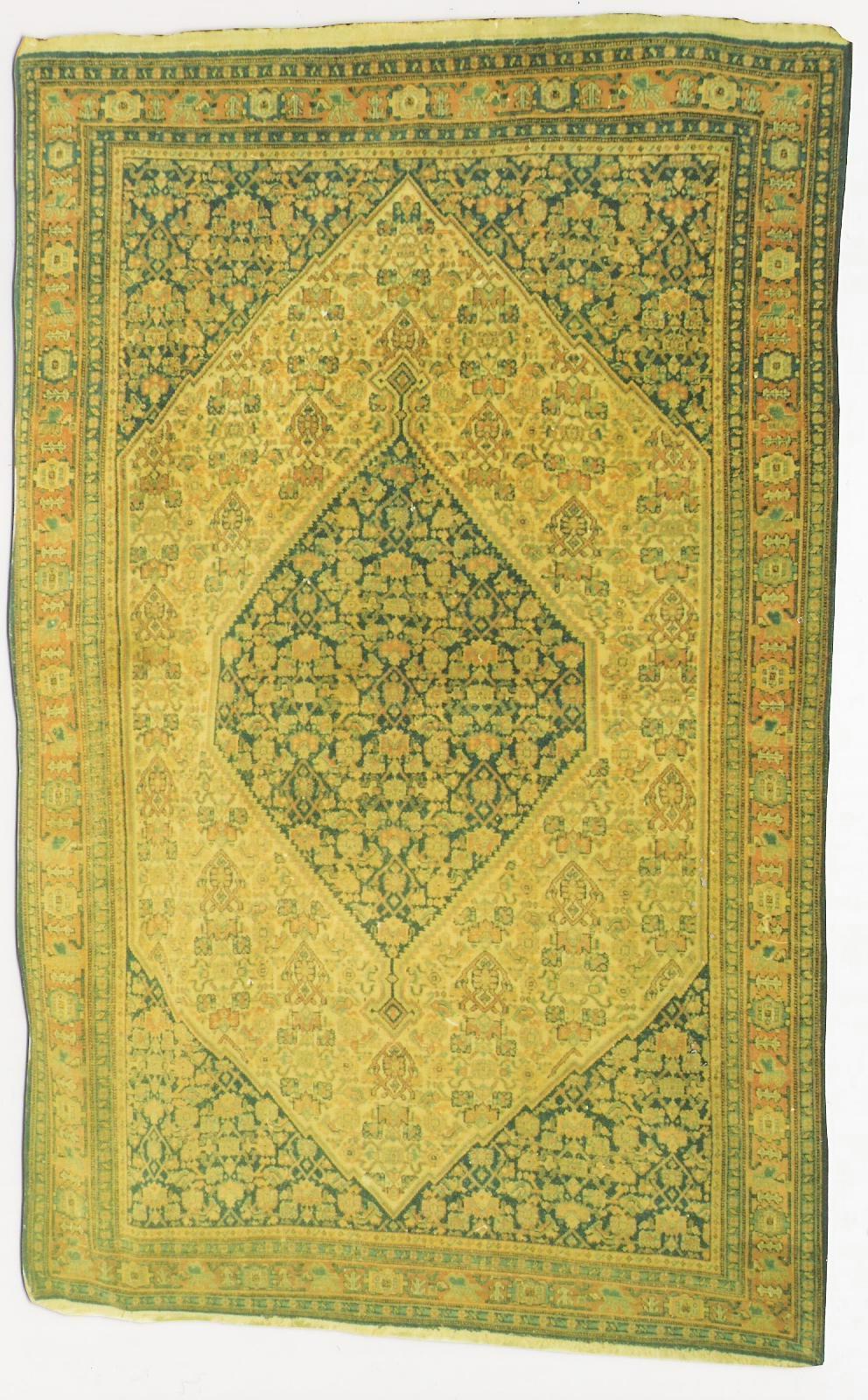
Antique Senneh rug with a dense herati (mahi) field around a diamond medallion · mid to late 19th century · Knotted-pile rug · Iran (Senneh/Sanandaj)
Dr. E. Scherer · Public domain · Wikimedia Commons record
Senneh is one of the towns where the small-scale herati is classic; the source names the rug, not the trade term mahi. One example, not a defining specimen.
Readings of this motif
Scholars and makers disagree about what this motif means. The readings below are presented side by side; none is endorsed as the settled answer.
- Water and fertility.
- A leaf form later called a fish.
How to recognise it
Look for the Fish (mahi) as a repeated unit rather than a single image: its scale, density and the way it sits in a border or field often tell you more about workshop and region than the form alone. The same motif crosses weaving, metal, tile and painting, so a match is a starting point for comparison, never proof of origin.
The mahi pattern
'Fish' herati places lanceolate leaves around a rosette in a diamond; the leaves are called mahi (fish) in the trade. It is classic in Bijar, Senneh, Farahan and Tabriz rugs.
Not literal fish
The leaves are botanical, though stories link them to fish in a pond. Treat that as folk explanation.
Scale
Dense small herati reads as texture; large-scale herati shows the unit clearly.
Stylistic Geography and Lineage of the Motif
The fish-in-the-pond pattern, known across Iran as mahi-e herati, is perhaps the most ubiquitous repeating design in the country's textile history. Although popular folklore interprets the curving lanceolate leaves as fish swimming around water blossoms, scholars generally trace the pattern to classical Timurid and early Safavid court ornament originating in or popularized by Herat ateliers. Over centuries, the design dispersed widely, evolving into distinctive regional dialects across northwestern and western Iran. In the village and workshop looms of Farahan, it achieved a balanced, open elegance surrounded by calm ivory and indigo border fields. In Senneh (Sanandaj), master weavers executed the motif with miniature precision on single-weft structures, creating delicate, jewel-like textures. Conversely, Kurdish weavers in Bijar translated the motif into a robust, geometric composition anchored on a rigid double-weft base. This stylistic elasticity enabled the herati design to span every decorative stratum from royal floors to village households.
Structural Diagnosis and Wear Management
Evaluating a herati-patterned rug involves balancing knot fineness against structural authenticity and regional character. Instead of judging quality solely by knot count, consider how effectively the scale of the mahi repeat harmonizes with the carpet's dimensions. In fine workshop pieces from Tabriz or Farahan, examine whether the diagonal diamond armature remains crisp and perfectly registered throughout the entire field without wandering or crowding at the borders. For Bijar examples, check the characteristic structural stiffness; traditional iron carpets were woven with wet wefts hammered down so tightly that folding them is difficult and may crack the foundation. Inspect high-wear areas across the center field, where dense repeating leaf tips can conceal early foundation exposure. When caring for antique mahi rugs, rotate them every six months to prevent asymmetrical traffic wear, and always utilize a dense rubberized underlay pad to protect the brittle warp threads from abrasion against hard floorboards.
Practical questions
- Are they fish? Leaves called 'fish'.
- Region? Widely woven.
| Observation | Useful description | Not established |
|---|---|---|
| Leaves around rosette | Herati unit | City |
| Fine small repeat | Dense herati | Quality |
| Pond story | Folk explanation | Origin |
References and further reading
- [1] H. E. Wulff, The Traditional Crafts of Persia, MIT Press, 1966; A. U. Pope & P. Ackerman, A Survey of Persian Art, 1938–39.Historical context; not evidence for an individual object.
- [2] Encyclopaedia Iranica ↗Peer-reviewed entries on crafts, motifs and terms.
These sources provide context, not authentication or provenance for an individual object. Editorial interpretations remain under review.
Used in these crafts
A hand-knotted pile textile woven across Iran in city workshops, village looms and pastoral camps, distinguished by regional structure, palette and design vocabulary.
Very finely knotted city carpets from Nain, recognisable by ivory and blue palettes with silk highlights.