
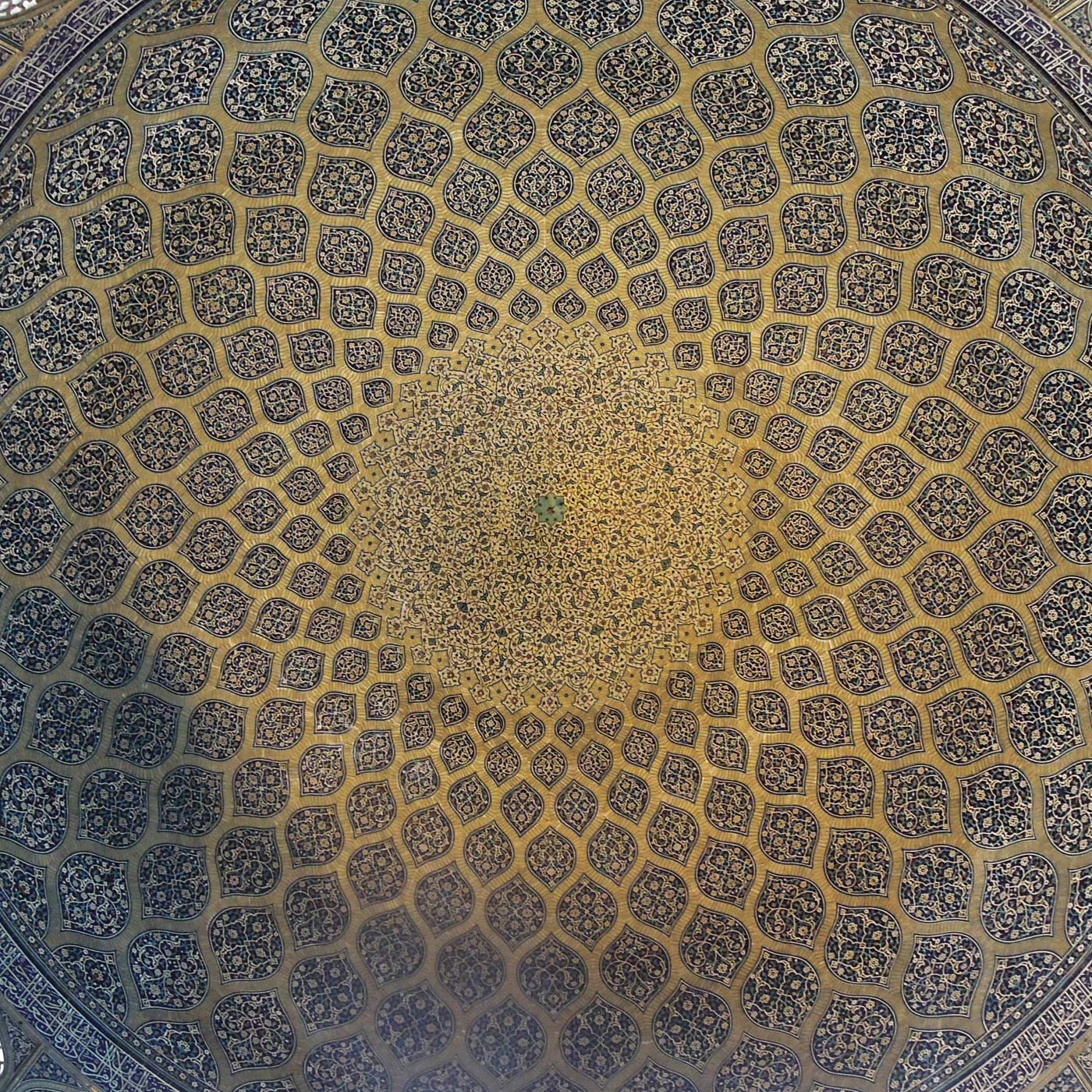
Shamseh sunburst at the crown of the Sheikh Lotfollah Mosque dome, Isfahan · Photographed 2018 (tilework early 17th century) · Glazed tile revetment · Iran
Sr3207 · CC BY-SA 4.0 · Wikimedia Commons record
One catalogued Iranian example whose museum title names this motif; not a defining specimen.
Readings of this motif
- The sun and light.
- A centring device for a page or ceiling.
How to recognise it
Read the Shamseh as a whole composition rather than a repeating unit: how it is centred and framed, how its proportions relate to the field or page, and which details — corners, figures, inscriptions — are drawn with the most care. Related compositions appear across weaving, metal, tile and painting, so a match is a starting point for comparison, never proof of origin.
The sunburst rosette
Shamseh (from shams, sun) is a radiating rosette used at the opening of manuscripts, often with a dedication to the patron in the centre, and on bookbindings, tiles, ceilings and metalwork. Its pointed rays extend into fine blue lines in many illuminated examples.
References: [1]
Inscriptions as evidence
When a shamseh names a patron or library, it can be important historical evidence, but inscriptions can also be later additions or replacements. Specialists examine the hand, pigment and paper before accepting them.
References: [1]
Geometric relatives
In geometric tilework and girih, star-centred rosettes with ten or more points are also called shamseh. Distinguish the illuminated sunburst from these geometric stars when describing an object.
References: [1]
Practical questions
- What is written inside a shamseh? Often a dedication or ownership note.
- Is a shamseh inscription always original? No; it may be added later.
| Observation | Useful description | Not established |
|---|---|---|
| Radiating rosette | Shamseh | Royal manuscript |
| Patron's name inside | Dedication claim | Original inscription |
| Ten-point star | Geometric shamseh | Illumination |
References and further reading
- [1] A. U. Pope & P. Ackerman (eds.), A Survey of Persian Art, Oxford University Press, 1938–39.Broad historical context; individual claims need current scholarship.
- [2] Encyclopaedia Iranica ↗Peer-reviewed entries on motifs, crafts and terms.
These sources provide context, not authentication or provenance for an individual object. Editorial interpretations remain under review.
Used in these crafts
The decoration of manuscript pages and album leaves with gold and coloured pigments in geometric and floral designs framing text or painting.
The hand binding of manuscripts and books with leather or lacquer covers, often with a flap (lisan) and stamped, cut or gilded decoration.
A Persian inlay art in which fine rods of wood, bone and metal are bundled into star units, sliced into thin sheets and applied to a wooden surface to form dense geometric tessellation.
The carving and moulding of gypsum plaster into architectural ornament, including mihrabs, inscriptions, muqarnas and wall panels.